





GBP/USD: Why pound parity (1.00) is a potentially plausible prospect
The eerie similarities to the mid-1980s hint that GBP/USD could fall toward parity (1.00) in the coming quarters...
Share this:

GBP/USD exchange rate history
When was the last time the British pound sterling traded at parity (1.00) with the US dollar?
No need to dig out your history books; it’s a trick question. The pound has NEVER traded at parity with the US dollar.
After spending the entirety of the 1800s at around 5:1, sterling has been trending generally lower against the greenback for the past century. The closest the two currencies got to one another was in 1985, when the GBP/USD exchange rate briefly fell below 1.10:
Source: exchangerates.org.uk
GBP/USD: Historical parallels with 1985
Proving that history doesn’t repeat but it does rhyme, the new UK Prime Minister Liz Truss’s role model, Margaret Thatcher, was in charge back then, and the US had passed large tax cuts under a Republican President (Reagan) a few years earlier that were starting to bear fruit on the underlying economy. Eerily, both the US and UK were grappling with elevated inflation in 1985, though the US was able to get a grasp on price pressures before its colonial overseer, much as traders and policymakers are expecting this time around. In addition, oil prices were normalizing after a sharp spike into the triple digits that led to rationing and calls for price caps.
What factors could drive the pound to parity?
Relative to the US economy, the UK economy is at higher risk of seeing a brutal stagflationary period in the coming quarters. The BOE recently predicted that the UK economy would see a prolonged recession and that inflation would peak above 13%; notably, that inflation forecast was before the UK government announced a plan to cap household energy prices that may put peak inflation closer to 11% in the island nation, but that is nonetheless higher than the US is expected to reach.
While it may defray price pressures, the UK government’s energy cap scheme risks blowing out the UK’s current account deficit further. As a reminder, the current account measures the total value of goods and services a country imports relative to the total value of goods and services it exports. After holding steady in the 1% to 5% of GDP range for decades, the UK current account recently widened to 8% in Q1 2022. If gas prices keep rising due to Russia cutting off deliveries to the European continent, the cost of the energy subsidy scheme could soar, exposing the government’s balance sheet to large losses and driving down the value of the pound sterling sharply.
What to watch on the path to pound parity
Once seen as fanciful, there is some evidence that FX options traders are at least considering the possibility of GBP/USD parity. According to NatWest, current options pricing implies a roughly 25% chance that GBP/USD could hit 1.00 in the next 12 months; similar calculations by Bloomberg put the implied probability closer to 20%.
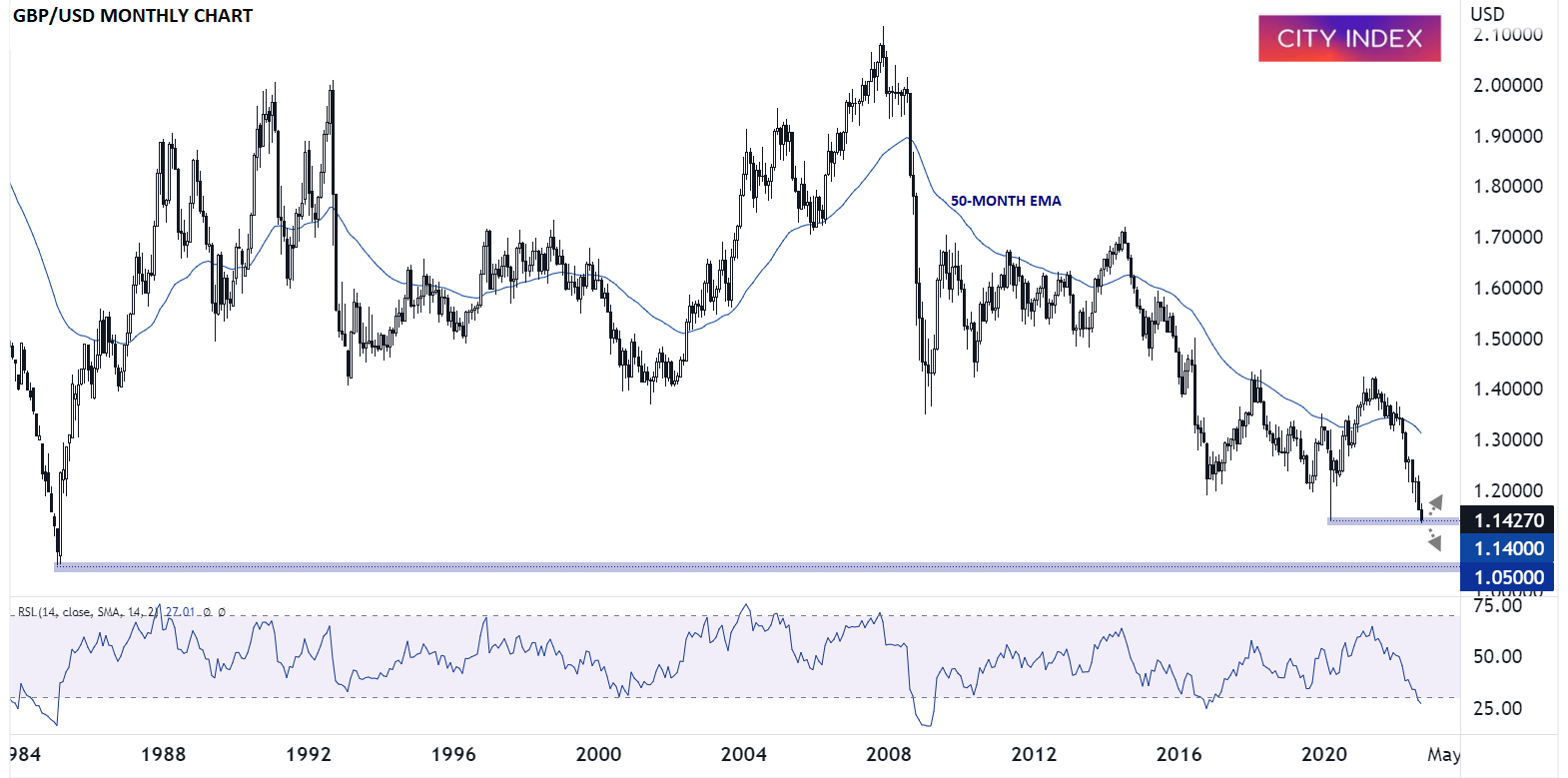
As outlined above, a continued rise in energy prices could speed the prospect along, as would stubbornly high inflation or a deep recession on the European continent. Technically speaking, GBP/USD is currently testing its COVID-lows near 1.1400, the last level of previous support until the 1985 closer to 1.0500. While still not necessarily the most likely path, a break below the 1985 lows would truly bring parity into play for the first time in the 200+ year history of the GBP/USD exchange rate.
Source: TradingView, StoneX
How to trade with City Index
You can trade with City Index by following these four easy steps:
- Open an account, or log in if you’re already a customer
• Open an account in the UK
• Open an account in Australia
• Open an account in Singapore
- Search for the market you want to trade in our award-winning platform
- Choose your position and size, and your stop and limit levels
- Place the trade
Related tags:


Open an account in minutes
Experience award-winning platforms with fast and secure execution.
Economic calendar
Web Trader platform
Our sophisticated web-based platform is packed with features.
Related articles
USD/JPY Weekly Outlook: Bulls Eye Higher Range After Historic Rate Shock
A historic US rate shock has sent USD/JPY above 160, but with intervention risks rising and few major economic catalysts ahead, AI sentiment could hold the key to the next move.

US Dollar Price Action Setups: EUR/USD, USD/JPY
The US Dollar broke out to a fresh yearly high after the CPI report, and that Dollar strength was on full view in pretty much all major pairings with a particular push in EUR/USD.

US dollar forecast: USD/JPY and USD/CHF in focus | Forex Friday
Sticky US inflation and a hawkish Fed have kept the dollar firm across the majors, with USD/JPY pressing on the 160 handle. Here are the levels that matter on USD/JPY and USD/CHF as next week's retail sales, Nvidia results and FOMC minutes approach.

The information on this web site is not targeted at the general public of any particular country. It is not intended for distribution to residents in any country where such distribution or use would contravene any local law or regulatory requirement. The information and opinions in this report are for general information use only and are not intended as an offer or solicitation with respect to the purchase or sale of any currency or CFD contract. All opinions and information contained in this report are subject to change without notice. This report has been prepared without regard to the specific investment objectives, financial situation and needs of any particular recipient. Any references to historical price movements or levels is informational based on our analysis and we do not represent or warranty that any such movements or levels are likely to reoccur in the future. While the information contained herein was obtained from sources believed to be reliable, author does not guarantee its accuracy or completeness, nor does author assume any liability for any direct, indirect or consequential loss that may result from the reliance by any person upon any such information or opinions.
Futures, Options on Futures, Foreign Exchange and other leveraged products involves significant risk of loss and is not suitable for all investors. Losses can exceed your deposits. Increasing leverage increases risk. Spot Gold and Silver contracts are not subject to regulation under the U.S. Commodity Exchange Act. Contracts for Difference (CFDs) are not available for US residents. Before deciding to trade forex, commodity futures, or digital assets, you should carefully consider your financial objectives, level of experience and risk appetite. Any opinions, news, research, analyses, prices or other information contained herein is intended as general information about the subject matter covered and is provided with the understanding that we do not provide any investment, legal, or tax advice. You should consult with appropriate counsel or other advisors on all investment, legal, or tax matters. References to FOREX.com or GAIN Capital refer to StoneX Group Inc. and its subsidiaries. Please read Characteristics and Risks of Standardized Options.