
- The EUR/USD forecast remains tilted to the downside as the US dollar stays firmly in the driving seat
- ADP employment and ISM PMI due shortly
- Softer Eurozone inflation strengthens the case for ECB rate cuts later this year
The EUR/USD forecast continues to look fragile, with the pair slipping back after briefly starting the session on a more positive note. Once again, the US dollar is doing most of the heavy lifting, pushing higher not just against the euro, but also against several other major currencies, especially the Japanese yen, with the latter slumping across the board amid mounting concerns over Japan’s fiscal health ahead of the nation’s snap election on Sunday. Investors were looking ahead to the release of US ADP employment and ISM services PMI for direction, before the focus turns to the ECB tomorrow.
Eurozone core inflation falls faster than expected
From a macro perspective, the latest Eurozone data hasn’t really given euro bulls much to work with. Eurozone core inflation came in softer than expected at 2.2% year-on-year, while headline CPI dropped to 1.7%, now officially below the ECB’s target. That reinforces the idea that the next meaningful move from the ECB is more likely to be a rate cut than a hike. That said, nobody is expecting fireworks from this week’s ECB meeting. The policy decision itself should be fairly uneventful, with most of the focus instead falling on Christine Lagarde’s press conference. Markets will be listening carefully for any hints about the timing of cuts or concerns over the euro’s recent strength. But with the single currency already softening, some of that pressure has eased naturally.
EUR/USD forecast driven by US resilience
In reality, the EUR/USD forecast remains much more about the dollar than the euro. The US dollar index has firmed up on the back of consistently strong US data and a slightly less dovish outlook for the Federal Reserve. Add in higher oil prices – which tend to favour the US over energy-importing regions like the eurozone – and the dollar’s support starts to make more sense.
The bigger issue for euro bulls is that the US economy simply isn’t slowing down as much as markets were expecting. As a result, expectations for aggressive US rate cuts have been dialled back. And unless we see a clear negative shock in US data, it’s still hard to build a convincing bearish case for the dollar.
One near-term wildcard was the US government shutdown, which delayed the release of non-farm payrolls. Ironically, that might actually help the dollar in the short run. Without weak labour data to challenge the narrative, the path of least resistance for the USD remains higher.
Looking ahead, attention shifts to ADP employment and ISM services PMI. ADP is expected at +46k, slightly above last month, while ISM is forecast to ease modestly to 53.4. Earlier this week, ISM manufacturing surprised to the upside at 52.6 – its first expansionary reading in a year – which only adds to the sense that US growth momentum is quietly improving.
EUR/USD technical analysis
From a technical perspective, the EUR/USD forecast has deteriorated in recent sessions. The pair has lost bullish momentum and broken below a couple of levels that should ideally have acted as support, including the former September high around 1.1919.
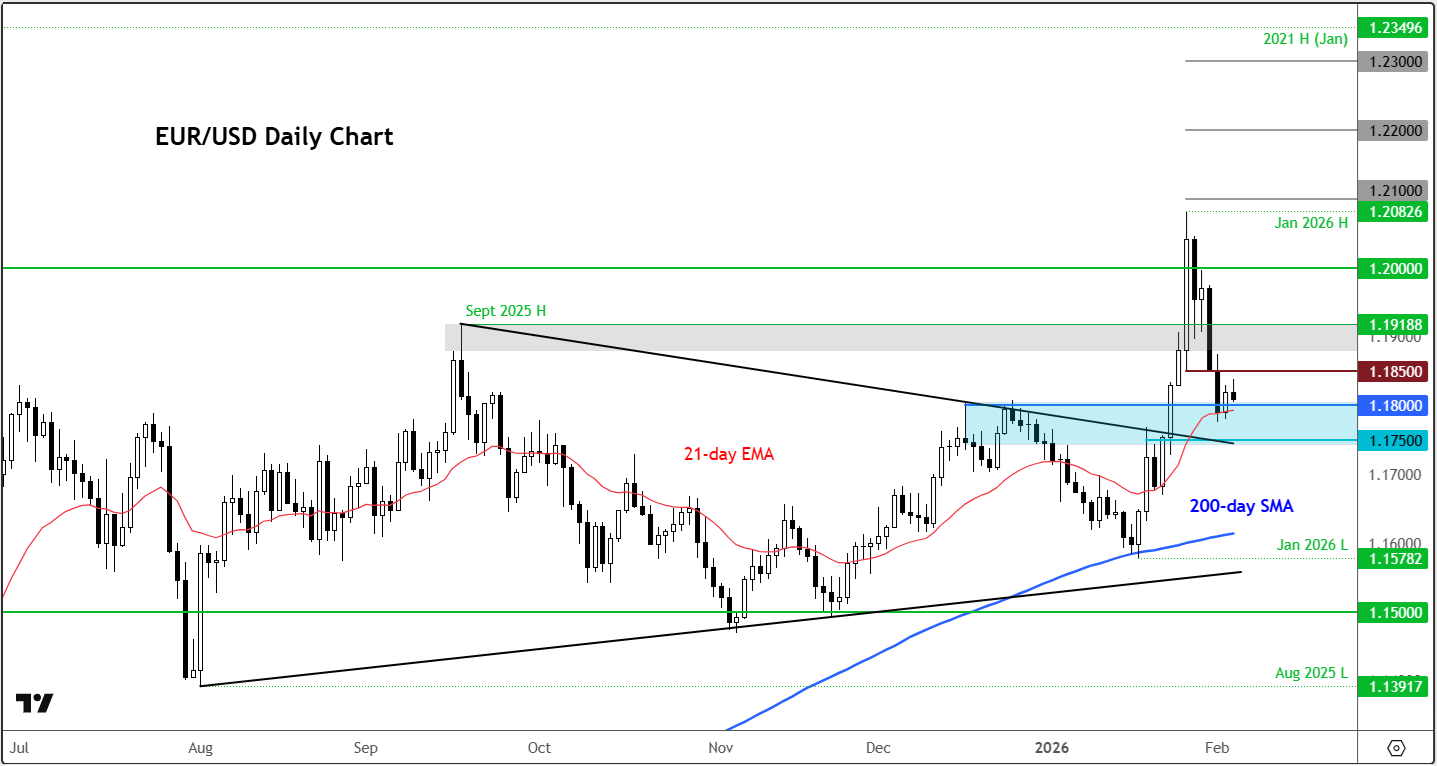
Right now, the EUR/USD is hovering around a key inflection zone between 1.1750 and 1.1800. This area brings together the 21-day EMA, prior resistance, and the top side of a broken trendline. So far, buyers have managed to defend this region, but it’s very much a line in the sand.
As long as the pair holds above this zone, it’s probably too early to flip aggressively bearish. After all, the broader trend has still been positive since last year, and any hint of a bullish reversal could trigger a quick rebound. Initial resistance sits near 1.1850, followed by the 1.1900–1.1920 area. A clean break above there would reopen the door towards the 1.20 handle.
However, if 1.1750 gives way, the technical picture starts to look a lot uglier. Below that, stops under the January low at 1.1578 could be vulnerable, potentially exposing a deeper move towards the 1.1500 region.
Final thoughts on the EUR/USD forecast
Overall, the EUR/USD forecast remains skewed slightly to the downside in the near term. Softer Eurozone inflation and a resilient US economy keep the fundamental balance tilted in favour of the dollar, while the technical structure is starting to crack. Unless US data suddenly disappoints in a meaningful way, rallies in EUR/USD still look more like selling opportunities than the start of a fresh bullish leg. For now, the dollar remains firmly in control.

-- Written by Fawad Razaqzada, Market Analyst
Follow Fawad on Twitter @Trader_F_R