



EUR/USD Forecast: The Euro Fails to Recover Despite U.S. Political Uncertainty
The EUR/USD has posted two consecutive losing sessions, with a short-term decline of nearly 0.6% in favor of the U.S. dollar. For now, the pair shows a neutral bias, mainly due to political uncertainty in the U.S., which has pushed the market into a sideways pattern and prevented the formation of consistent directional moves.
Share this:

The EUR/USD has posted two consecutive losing sessions, with a short-term decline of nearly 0.6% in favor of the U.S. dollar. For now, the pair shows a neutral bias, mainly due to political uncertainty in the U.S., which has pushed the market into a sideways pattern and prevented the formation of consistent directional moves. As long as this situation persists, neutrality could continue to dominate in the coming trading sessions.


What’s Happening in the U.S.?
The government shutdown has entered its second day, and there is still no clarity on how it will be resolved or how long it might last. Non-essential government activities have been suspended, leaving hundreds of thousands of federal employees without pay or work, and so far neither the Executive nor the Senate has given clear signs that the situation will be resolved this week.
This event reflects a deterioration in political confidence and poses an institutional risk regarding government functionality. If prolonged, it could cause billions in losses to U.S. GDP due to the paralysis of key economic agencies. Although the impact has not yet been strongly reflected in the dollar, a longer shutdown—like the last one, which lasted more than a month—could significantly erode confidence in the currency.
Another point to consider is that among the agencies affected by the shutdown are those responsible for releasing employment data, meaning tomorrow’s scheduled Non-Farm Payrolls report could be delayed. Without such key economic indicators, the Federal Reserve would have fewer tools for decision-making, reinforcing expectations that there could still be two more rate cuts before the end of the year. Lower rates reduce the appeal of dollar-denominated assets and could, in the medium term, weaken the currency as an indirect consequence of the shutdown.
In conclusion, while the dollar has not yet shown a sharp decline in the face of political risk, if the shutdown continues for several weeks, it would heighten distrust in the greenback—both due to institutional instability and the lack of economic data. In that case, the euro could benefit from more consistent buying pressure in the short term.
What Does the European Central Bank Think?
There were also important ECB updates this week. President Christine Lagarde stated that inflation risks in the eurozone are under control and highlighted that the eurozone economy has held up well despite U.S. tariffs. However, she also noted that the central bank would likely maintain a neutral stance in upcoming decisions to prevent inflation from rising again.
Recent data shows that annual inflation for September rose to 2.2%, up from 2.0% in August, confirming that prices have started to climb again.
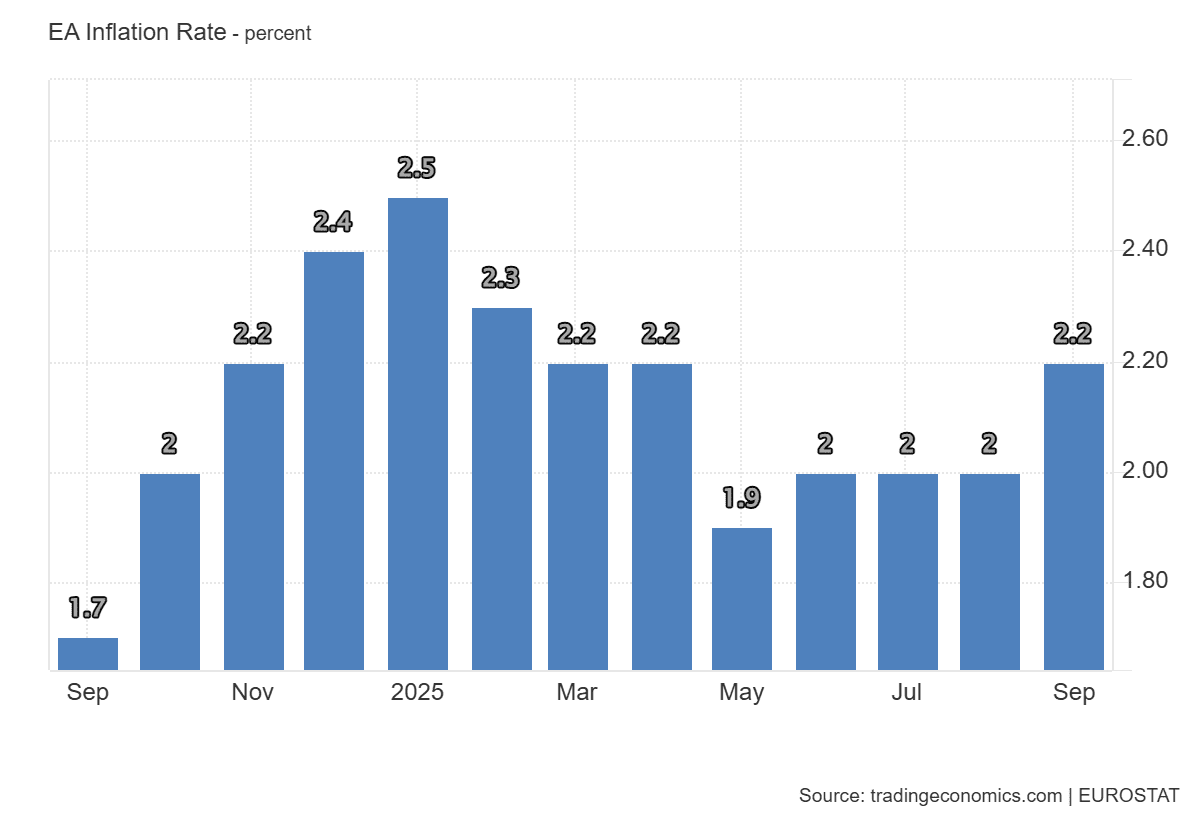
Source: TradingEconomics
Following these remarks, the ECB Watch tool now shows a 98.2% probability that the current 2.00% deposit rate will remain unchanged at the October 28 meeting. This is in line with the ECB’s rhetoric of prioritizing stability without resorting to rate cuts.
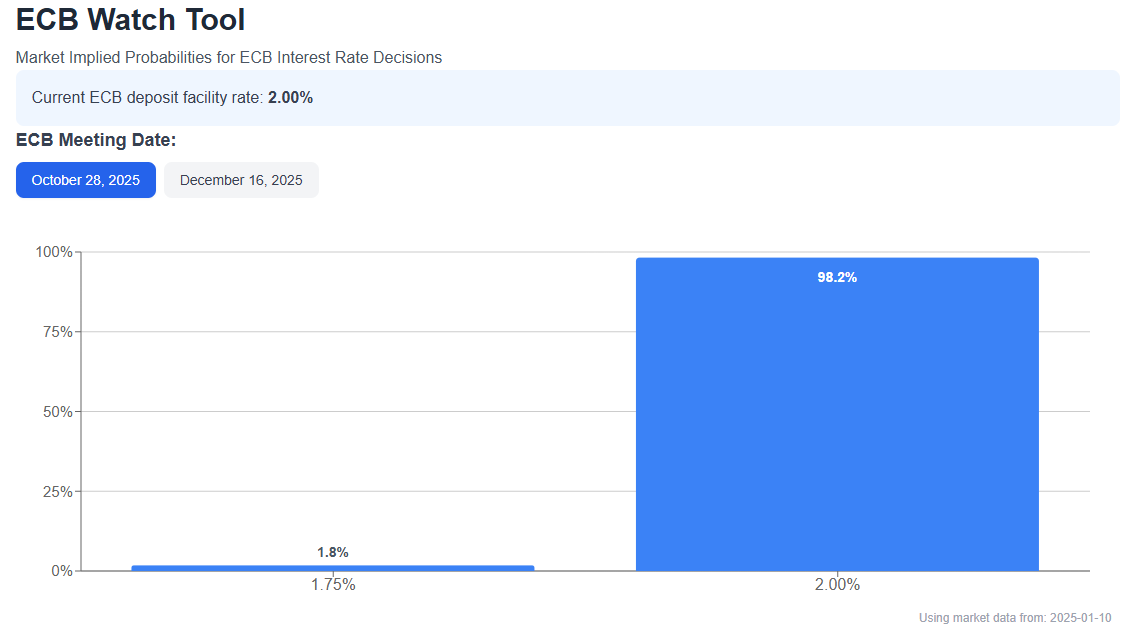
Source: ECBWATCH
In this context, it appears the ECB will remain neutral through the rest of the year. This stance contrasts with the more accommodative policy the Fed may adopt, which would reduce the interest rate differential between the two regions. Over time, this dynamic could make dollar investments less attractive while generating buying pressure on the euro, potentially paving the way for a relevant bullish bias in EUR/USD in the coming weeks.
EUR/USD Technical Outlook
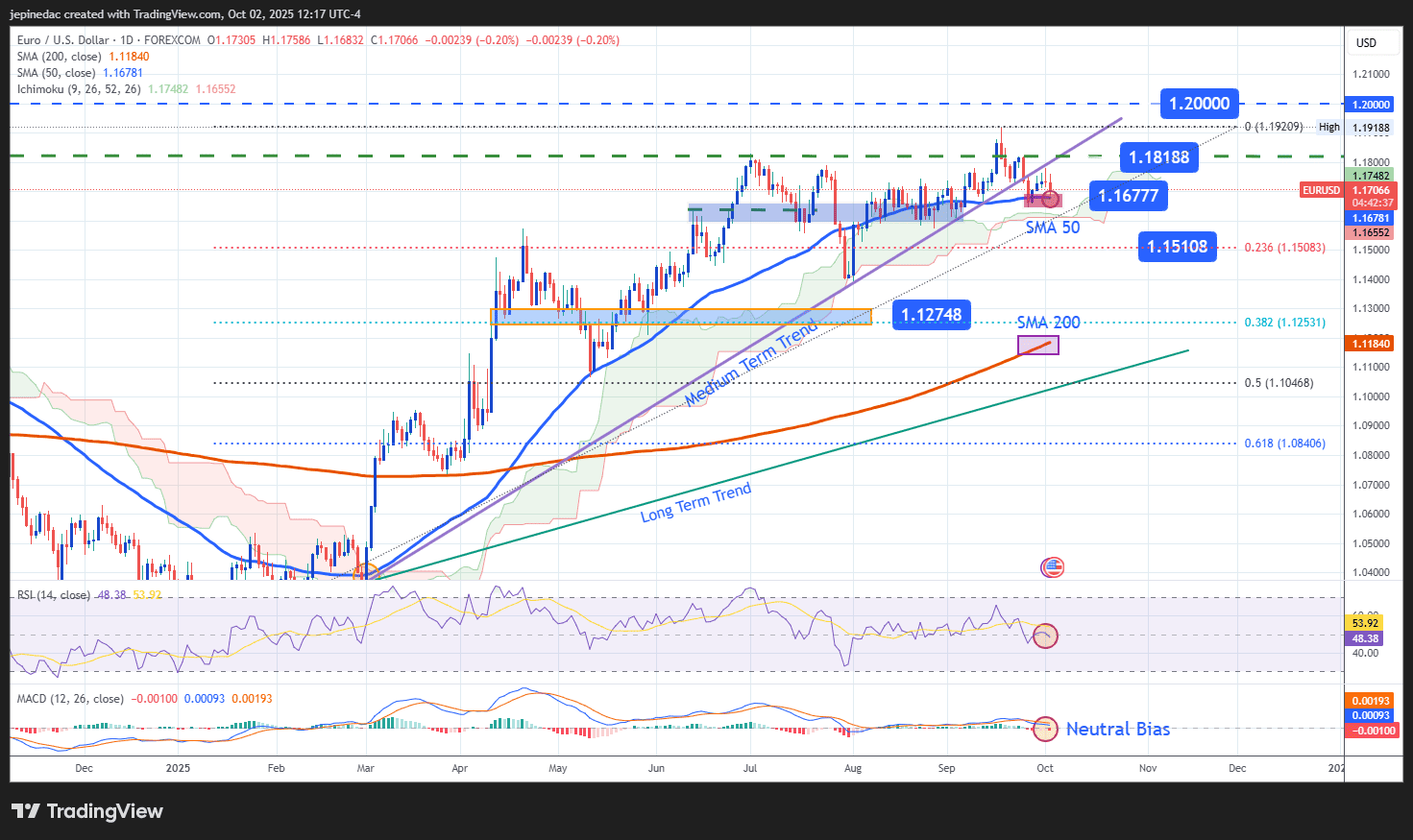
Source: StoneX, Tradingview
- Bearish momentum emerges: Since September 17, EUR/USD has been setting progressively lower lows, reinforcing a short-term bearish bias. However, the emergence of indecision candles around key support levels casts doubt on the strength of this move, which is not yet enough to establish a solid downtrend. Unless selling pressure breaks through key barriers, a neutral scenario could prevail in the short term.
- RSI: The RSI line has crossed below the 50 neutral level and continues to oscillate beneath it in recent sessions, signaling that bearish momentum has taken hold over the average of the last 14 sessions. As long as this downward slope persists, selling pressure could become more relevant in the coming days.
- MACD: The MACD shows a somewhat different picture. While the histogram continues to oscillate below the zero line, it remains close to neutrality, reflecting indecision in short-term moving averages. Unless the histogram pushes further into negative territory, this could indicate the formation of a neutral consolidation around the current EUR/USD support zone.
Key Levels:
- 1.16777 – Current Barrier: Corresponds to the zone marked by the 50-period simple moving average and is also near the Ichimoku cloud, making it the most important bearish barrier to watch. A sustained break below could mark a true reversal of the previous bullish trend and open the door to a new bearish phase.
- 1.18188 – Nearby Resistance: A zone of recent weekly highs where price has repeatedly retreated. As long as price action struggles to break this level, the pair could consolidate into a short-term sideways range.
- 1.20000 – Major Resistance: A key psychological level. A clean breakout above could trigger a more aggressive rally and reactivate the long-term bullish trendline that was broken in previous sessions.
Written by Julian Pineda, CFA – Market Analyst
Follow him: @julianpineda25
Related tags:



Open an account in minutes
Experience award-winning platforms with fast and secure execution.
Economic calendar
Web Trader platform
Our sophisticated web-based platform is packed with features.
Related articles

EUR/USD, EUR/JPY: Hawkish Fed Weighs on Euro as Yen Bulls Struggle
Hawkish Fed bets weigh on EUR/USD as ECB caution grows, while EUR/JPY's bullish wedge breakout keeps 181.50 in focus despite broader downside risks.


US Dollar Forecast: AUD/USD, Gold, EUR/USD Under Pressure
Could the US dollar rally accelerate? Matt Simpson examines the outlook for DXY, AUD/USD, EUR/USD and gold, plus key technical levels across forex markets.

EUR/USD, DXY, Silver Price Outlook: Bullish Rebounds on Hold?
EUR/USD, DXY, Silver Price Outlook: Bullish rebounds across currency markets, precious metals, and risk assets are facing renewed pressure as U.S. CPI comes in above expectations and oil-tanker attacks persist in the Strait of Hormuz.

The information on this web site is not targeted at the general public of any particular country. It is not intended for distribution to residents in any country where such distribution or use would contravene any local law or regulatory requirement. The information and opinions in this report are for general information use only and are not intended as an offer or solicitation with respect to the purchase or sale of any currency or CFD contract. All opinions and information contained in this report are subject to change without notice. This report has been prepared without regard to the specific investment objectives, financial situation and needs of any particular recipient. Any references to historical price movements or levels is informational based on our analysis and we do not represent or warranty that any such movements or levels are likely to reoccur in the future. While the information contained herein was obtained from sources believed to be reliable, author does not guarantee its accuracy or completeness, nor does author assume any liability for any direct, indirect or consequential loss that may result from the reliance by any person upon any such information or opinions.
Futures, Options on Futures, Foreign Exchange and other leveraged products involves significant risk of loss and is not suitable for all investors. Losses can exceed your deposits. Increasing leverage increases risk. Spot Gold and Silver contracts are not subject to regulation under the U.S. Commodity Exchange Act. Contracts for Difference (CFDs) are not available for US residents. Before deciding to trade forex, commodity futures, or digital assets, you should carefully consider your financial objectives, level of experience and risk appetite. Any opinions, news, research, analyses, prices or other information contained herein is intended as general information about the subject matter covered and is provided with the understanding that we do not provide any investment, legal, or tax advice. You should consult with appropriate counsel or other advisors on all investment, legal, or tax matters. References to FOREX.com or GAIN Capital refer to StoneX Group Inc. and its subsidiaries. Please read Characteristics and Risks of Standardized Options.