
- Gold forecast: Although buyers have defended the $4,500 area, for now, rising yields and firm oil prices are still weighing on sentiment
- XAU suffered a heavy weekly decline, slipping 3.7% and printing a bearish weekly reversal pattern last week
- The metal could now be heading towards a third straight monthly loss as momentum continues to deteriorate
It has been a rather volatile session for crude oil, and therefore everything else, including gold. Oil initially rallied sharply, extending the 10% gains from last week, after Trump warned Iran that the clock is ticking and that there “won’t be anything left” if there is no progress soon in the stalled U.S.-Iran talks. Prices then dropped $5 from its highs to turn red on reports Iran's oil sanctions during the negotiation period will be lifted, raising hopes for a deal. However, oil then turn higher again after Iran said that 'under no circumstances' will it give up its nuclear program to end the war. Consequently, the US dollar bounced back, while stocks and gold were coming off their highs at the time of writing.
Earlier, gold prices attempted to regain some composure at the start of the week following Friday’s sharp sell-off, though the broader tone across the market still felt distinctly cautious. Last week’s 3.7% decline added to an already weak technical backdrop, with gold continuing to carve out lower highs after March’s big 11.5% slump. Gold briefly slipped beneath the psychologically important $4,500 level overnight before bargain hunters stepped in to stabilise prices. Even so, the rebound has so far lacked real conviction and appears driven more by short covering than fresh bullish positioning. We maintain a cautious gold forecast for now.
Rising yields continue to undermine bullion
The macro backdrop remains particularly difficult for gold. Higher government bond yields continue to drain appeal from non-yielding assets, while elevated oil prices are reinforcing fears that inflation could remain stubbornly high for longer than markets had hoped.
At the same time, geopolitical tensions are preventing a deeper collapse in safe-haven demand. But for now markets appear more concerned about the direction of interest rates. Brent crude holding around $110 per barrel is adding to inflation concerns at a time when investors have already sharply scaled back expectations for Federal Reserve easing this year.
That shift in rate expectations has become increasingly problematic for precious metals. Last week’s rise in global bond yields triggered another round of liquidation across the metals complex, with traders reassessing the likelihood of rates staying elevated well into next year. Sticky US inflation readings and stronger energy prices have only strengthened that narrative.

Technical gold forecast: XAU/USD remains fragile
From a chart perspective, the gold forecast looks vulnerable despite today’s bounce from support.
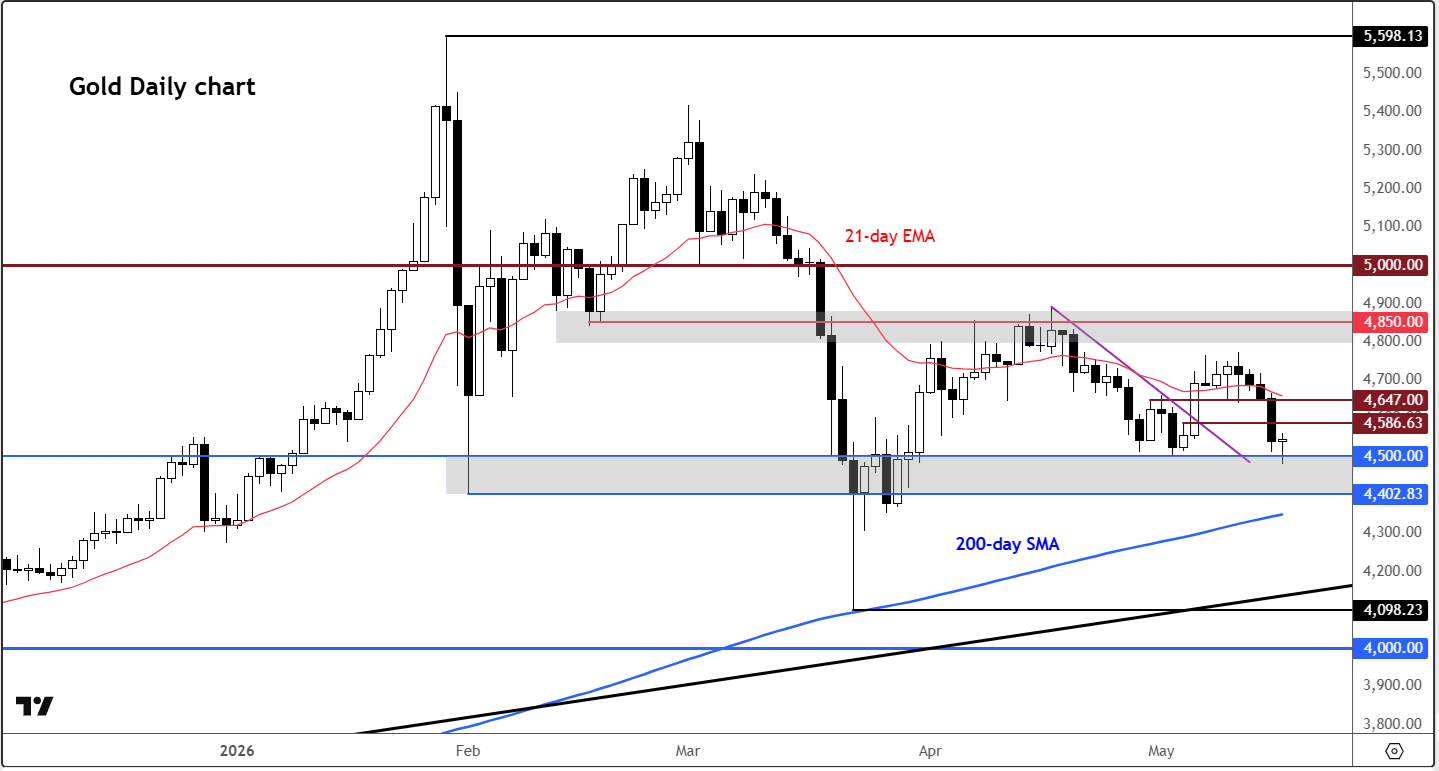
The defence of the $4,500 region may offer XAUUSD some temporary relief, but the market remains trapped beneath several former support levels that are now likely to act as resistance. Initial resistance can be seen around $4,586, followed by $4,638, while the key level remains closer to $4,660. Unless gold can reclaim that zone convincingly, rallies may continue to attract sellers.
A sustained move back below $4,500 would likely reopen the path towards the $4,400 region, where the next meaningful layer of support sits. Beneath that, attention would shift towards the 200-day moving average near $4,342, with the March lows just under $4,100 representing a more significant downside target.
More broadly, the market’s longer-term momentum has continued to deteriorate. March’s double-digit decline was followed by another monthly loss in April, and current price action suggests May could become the third consecutive negative month for gold. That sequence highlights a market that is still struggling to rebuild bullish momentum.
Safe-haven demand may not be enough
At this stage, gold still does not appear sufficiently oversold to suggest a durable bottom is in place. Much will depend on whether bond yields continue to push higher and whether geopolitical tensions escalate enough to revive stronger defensive flows into bullion.
Until there is a clearer shift in either of those themes, the overall bias for gold still appears skewed towards further weakness rather than a sustained recovery.
-- Written by Fawad Razaqzada, Market Analyst
Follow Fawad on Twitter @Trader_F_R