

Stocks Surge on USChina Ceasefire But Bonds Arent Buying It
As you’ve no doubt heard by now, US President Trump and Chinese President Xi were able to reach a ceasefire agreement at the G20 summit in Argentina over the weekend.
Share this:

As you’ve no doubt heard by now, US President Trump and Chinese President Xi were able to reach a ceasefire agreement at the G20 summit in Argentina over the weekend.
In exchange for the US agreeing postponing the scheduled escalation of tariffs (from 10% to 25%) for 90 days, China agreed to "purchase a not yet agreed upon, but very substantial, amount of agricultural, energy, industrial, and other products from the United States to reduce the trade imbalance.” Ideally, the two sides will be able to reach a longer-term trade agreement over those 90 day; in other words, this is not a suspension of the trade war but a suspension of the escalation of the trade war.
Nonetheless, investors have generally cheered the outcome, with the trade-dependent commodity currencies gaining 60-80 pips against the greenback, global stocks rising across the board, and oil rallying 3%. Interestingly, the yields on Treasury bonds are flat to falling across the curve, signalling that the “smartest market” is more skeptical that the weekend’s developments mark a turning point.
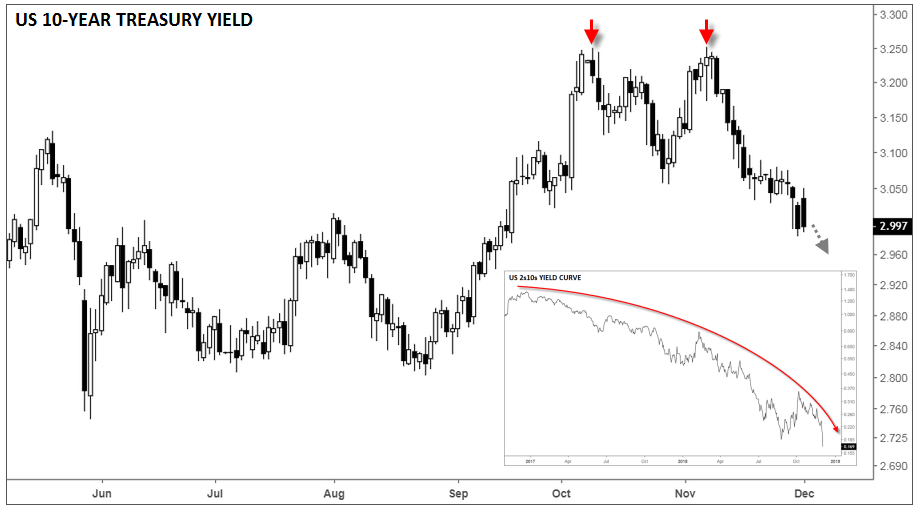
To wit, the benchmark 10-year Treasury bond is back to yielding just 2.99% after a brief gap higher to start the week. This level is exactly where the market closed Friday and represents the lowest interest rate since mid-September. While we’re generally cautious about technical analysis on fixed income markets, the yield appears to have formed a “double top” pattern around 3.25% earlier this quarter, suggesting that we could have further to fall from here.
Source: TradingView, FOREX.com
Concerningly, the yield on the 2-year Treasury is holding up better than the 10-year yield, meaning that the yield curve continues to flatten. For the uninitiated, the yield curve is a widely-watched indicator of an economy’s health. Historically, inversions in the yield curve (when the 2-year bill has a higher interest rate than the 10-year bond) have led to recessions. As the inset chart above shows, the widely-watched 2s10s spread has fallen to just 17bps, its lowest level since 2007. Basically, bond market traders are concerned about the longer-term prospects for the US economy, especially with the Fed on track to raise interest rates again next week.
Given its well-established trend, we expect the yield curve to continue to flatten and potentially invert as soon as next year. Of course, there’s no guarantee that the yield curve will invert, or that it will necessarily lead to a US recession even if it does. Nonetheless, with stocks and other risk assets in full-on rally mode, it’s important to note that the bond market is waving a big yellow flag. Unless we start to see interest rates participate in the post-G20 risk asset rally, bulls may want to tap the brakes on their optimism.
Related tags:


Open an account in minutes
Experience award-winning platforms with fast and secure execution.
Economic calendar
Web Trader platform
Our sophisticated web-based platform is packed with features.
Related articles

Iron ore bulls face a perfect storm as price tests major support
Deteriorating steelmaker profitability, seasonal weakness and bearish technicals are weighing on iron ore. But with the price testing critical support, there's genuine two-way directional risk despite the substantial headwinds facing bulls.
Silver Analysis Can XAGUSD hold above the 85 level
Recent price action in silver has been particularly relevant, as over the last five trading sessions XAG/USD has posted a significant gain, accumulating an increase of more than 18% over this period.


USD/CNH Forecast: New Year, Same Yu-an Strength
USD/CNH has been trending consistently lower within a bearish channel since the start of November, falling 2500 pips from near 7.14 to closer to 6.88 now – what are the levels to watch next?
The information on this web site is not targeted at the general public of any particular country. It is not intended for distribution to residents in any country where such distribution or use would contravene any local law or regulatory requirement. The information and opinions in this report are for general information use only and are not intended as an offer or solicitation with respect to the purchase or sale of any currency or CFD contract. All opinions and information contained in this report are subject to change without notice. This report has been prepared without regard to the specific investment objectives, financial situation and needs of any particular recipient. Any references to historical price movements or levels is informational based on our analysis and we do not represent or warranty that any such movements or levels are likely to reoccur in the future. While the information contained herein was obtained from sources believed to be reliable, author does not guarantee its accuracy or completeness, nor does author assume any liability for any direct, indirect or consequential loss that may result from the reliance by any person upon any such information or opinions.
Futures, Options on Futures, Foreign Exchange and other leveraged products involves significant risk of loss and is not suitable for all investors. Losses can exceed your deposits. Increasing leverage increases risk. Spot Gold and Silver contracts are not subject to regulation under the U.S. Commodity Exchange Act. Contracts for Difference (CFDs) are not available for US residents. Before deciding to trade forex, commodity futures, or digital assets, you should carefully consider your financial objectives, level of experience and risk appetite. Any opinions, news, research, analyses, prices or other information contained herein is intended as general information about the subject matter covered and is provided with the understanding that we do not provide any investment, legal, or tax advice. You should consult with appropriate counsel or other advisors on all investment, legal, or tax matters. References to FOREX.com or GAIN Capital refer to StoneX Group Inc. and its subsidiaries. Please read Characteristics and Risks of Standardized Options.