



USDBRL should reflect Copom's minutes, IPCA, fiscal fears, and Chinese data
Bullish factors Uncertainty about the feasibility of budget targets in 2024 may increase risk premium requirements by investors for Brazilian assets and decrease foreign investments, weakening the BRL. Moderation of IPCA in October may reinforce the perception that the Central Bank will maintain its pace of cuts to the basic interest rate (Selic), which would be detrimental to the national interest rate differential, weakening the Bearish factors Minutes of the Monetary Policy Committee (Copom) decision may acknowledge a more challenging foreign environment and higher Brazilian fiscal risks, which could cast doubt on its interest rate cuts trajectory and would benefit the national interest rate differential, strengthening the BRL. Disclosure of data on the Chinese economy can reinforce the perception of a faster recovery in the country, favoring the performance of currencies from commodity-exporting countries, such as Brazil.
Share this:

Bullish factors
- Uncertainty about the feasibility of budget targets in 2024 may increase risk premium requirements by investors for Brazilian assets and decrease foreign investments, weakening the BRL.
- Moderation of IPCA in October may reinforce the perception that the Central Bank will maintain its pace of cuts to the basic interest rate (Selic), which would be detrimental to the national interest rate differential, weakening the BRL.
Bearish factors
- Minutes of the Monetary Policy Committee (Copom) decision may acknowledge a more challenging foreign environment and higher Brazilian fiscal risks, which could cast doubt on its interest rate cuts trajectory and would benefit the national interest rate differential, strengthening the BRL.
- Disclosure of data on the Chinese economy can reinforce the perception of a faster recovery in the country, favoring the performance of currencies from commodity-exporting countries, such as Brazil.

Our Brazil team provides regular weekly coverage of the Brazilian economy and the outlook for the Real, accessible by clicking the link in the banner above.
The week in review
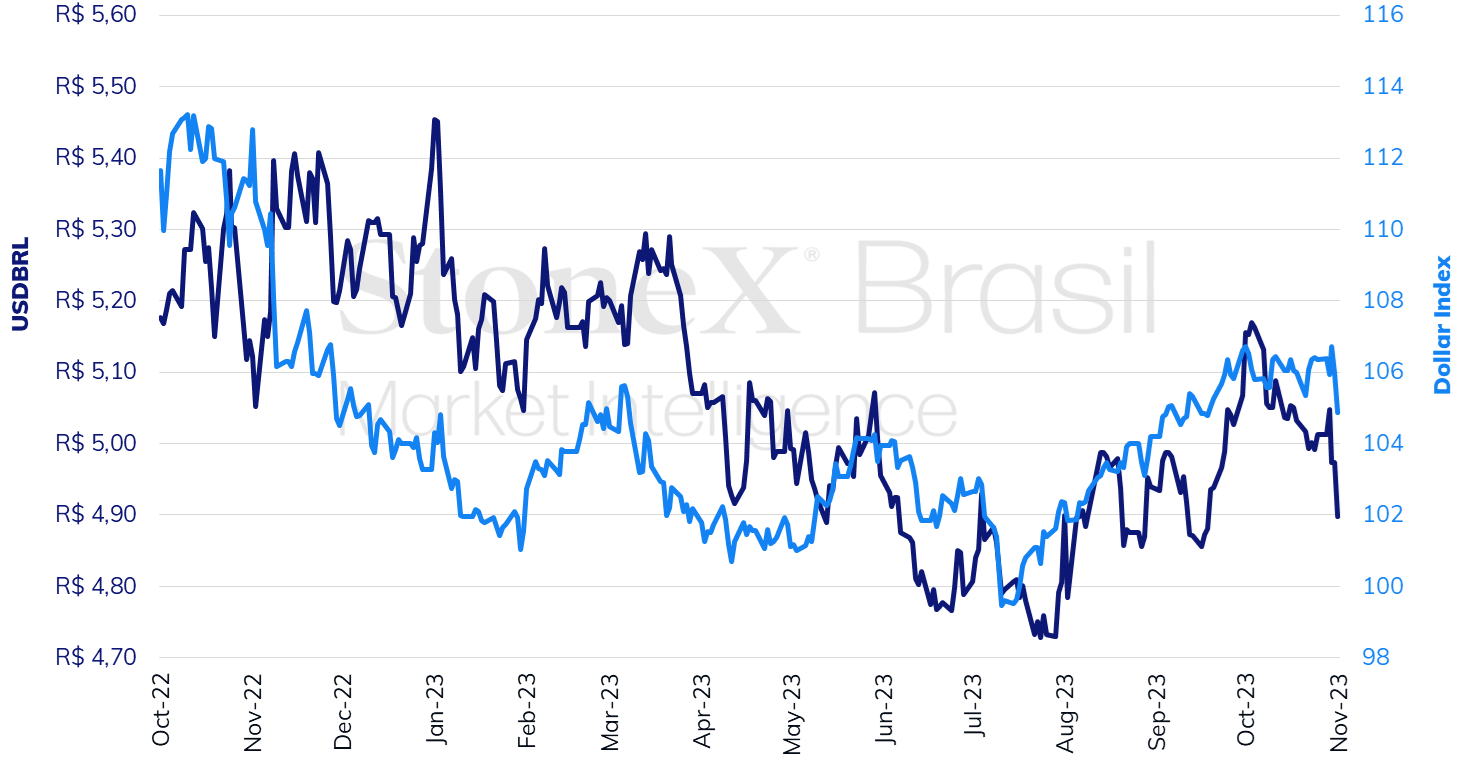
The USDBRL ended the week lower, closing Friday's session (03) at BRL 4.897, a weekly decline of 2.3%, a monthly decline of 3.0%, and an annual decline of 7.2%. The dollar index closed Friday's session at 104.9 points, a change of -1.4% for the week, -1.0% for the month, and +1.5% for the year. The foreign exchange market reacted to the monetary policy decisions of the Federal Reserve and the Central Bank of Brazil, the publication of moderate data for the American economy, concerns about Brazilian fiscal targets, and the formation of the end-of-month Ptax rate.
USDBRL and Dollar Index (points)
Source: StoneX cmdtyView. Design: StoneX
THE MOST IMPORTANT EVENT: Copom's minutes
Expected impact on USDBRL: bearish
The Monetary Policy Committee (Copom) carried out its third consecutive reduction of 0.50 p.p. for the basic interest rate (Selic), unanimously indicating that it should maintain the pace of cuts "in the next meetings" if the expected scenario is confirmed. However, the statement brought some gaps regarding recent comments by authorities from the Central Bank of Brazil, and the meeting minutes may provide a more detailed analysis of these points. Firstly, recent concerns about the Brazilian government's fiscal policy conduct did not enter the monetary authority's assessment of inflationary risks, receiving only a note on its importance for anchoring inflation expectations. However, fiscal concerns have significantly impacted market participants' future expectations regarding interest rates, exchange rates, and inflation, warranting a more careful assessment. Additionally, the statement states that "the current situation, particularly due to the international scenario, is more uncertain than usual and requires caution in conducting monetary policy." However, the risk balance continues to be presented as balanced, in an apparent contradiction.
Doubts about fiscal targets
Expected impact on USDBRL: bullish
Discussions about fiscal policy management under Luiz Inácio Lula da Silva's government should continue this week after what seemed to be a careless statement by the President of Brazil in a press conference that the federal government would "hardly" meet the target proposed by the new fiscal framework for 2024, namely, a zero primary result, last week, an economic team was observed unable to reaffirm the maintenance of the target and several reports from specialized media stating that the Planalto was seeking the best way to make the change. So, it seems that on this Tuesday (07), the text of the rapporteur of the Budget Guidelines Law (LDO) project, Congressman Danilo Forte (União-CE), should be presented to the Joint Budget Committee (CMO) of the Chamber of Deputies still with the original goal. However, at some point before the final report vote, scheduled for the week between November 13 and 17, an amendment is expected to suggest changing the 2024 primary deficit target from 0% of Gross Domestic Product (GDP) to probably 0.5% of GDP. If this movement is confirmed, investors' requirement for risk premiums is expected to increase, harming the performance of Brazilian assets.
IPCA Moderation in October
Expected impact on USDBRL: bullish
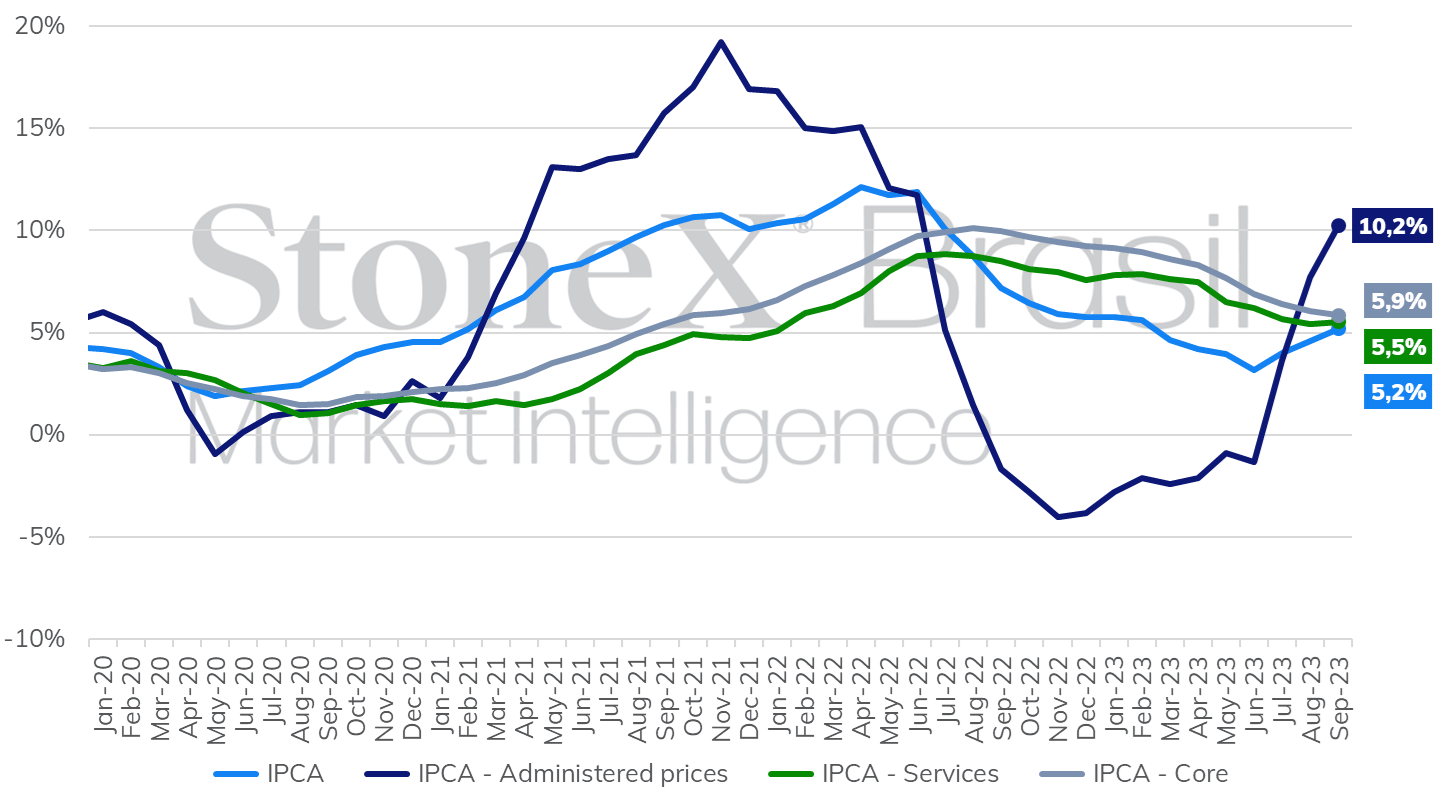
After a controlled IPCA-15 in October, with an increase of only 0.21%, the National Broad Consumer Price Index (IPCA) for the complete month is also expected to show moderate growth, around 0.3%. Food, industrial goods, and gasoline prices are expected to decrease compared to September, while airfare and service prices are expected to increase during this period.
12-month IPCA (%) according to selected groups
Source: Central Bank of Brazil. Design: StoneX.
Chinese economy data
Expected impact on USDBRL: bearish
This week, the Consumer Price Index (CPI) and Producer Price Index (PPI) for October in China and the trade balance data for the same month will be released. International investors are moderately more optimistic about the country's economic recovery after releasing some recent indicators that were better than anticipated, such as the Gross Domestic Product for the third quarter, the industrial production for September, and the retail sales for the same month. If the most favorable forecasts are confirmed, it should boost the performance of risky assets, such as stocks, commodities, and currencies of countries that export primary products, like Brazil.
Key Indicators

Analysis by: Leonel Oliveira Mattos ([email protected]), Alan Lima ([email protected]), and Vitor Andrioli ([email protected]).
Translation by Rodolfo Abachi ([email protected]).
Financial editor: Paul Walton ([email protected]).
Latest market news



Open an account in minutes
Experience award-winning platforms with fast and secure execution, and enjoy tight spreads from 0.5 pts on FX and 0.3 pts on indices.
Economic calendar
Web Trader platform
Our sophisticated web-based platform is packed with features.
Related articles

S&P 500 Forecast: SPX rises as oil prices fall, but treasuries remain at multi-decade highs
U.S. stocks are rising on Friday after a volatile week that saw a surge in Treasury yields ripple through financial markets.


USD/JPY Q4 2026 Outlook: Hawkish Fed Pricing Clashes With Intervention Risk
The year-end tug-of-war is clear: hawkish Fed pricing supports USD/JPY, while intervention risk limits the upside.


S&P 500 forecast: Stocks extend drop as correction risks grow
US and global equity markets have extended Wednesday’s sell-off, with Wall Street opening lower after a weak handover from Asia and Europe. The deterioration in risk appetite has been spreading across global markets. The dollar was firmer, Treasury yields were holding onto yesterday’s gains, while gold, silver and bitcoin were all under pressure alongside equities and major currencies.

This report is intended for general circulation only. It should not be construed as a recommendation, or an offer (or solicitation of an offer) to buy or sell any financial products. The information provided does not take into account your specific investment objectives, financial situation or particular needs. Before you act on any recommendation that may be contained in this report, independent advice ought to be sought from a financial adviser regarding the suitability of the investment product, taking into account your specific investment objectives, financial situation or particular needs.
StoneX Financial Pte. Ltd., may distribute reports produced by its respective foreign entities or affiliates within the StoneX group of companies or third parties pursuant to an arrangement under Regulation 32C of the Financial Advisers Regulations. Where the report is distributed to a person in Singapore who is not an accredited investor, expert investor or an institutional investor (as defined in the Securities Futures Act), StoneX Financial Pte. Ltd. accepts legal responsibility to such persons for the contents of the report only to the extent required by law. Singapore recipients should contact StoneX Financial Pte. Ltd. at 6826 9988 for matters arising from, or in connection with the report.
In the case of all other recipients of this report, to the extent permitted by applicable laws and regulations neither StoneX Financial Pte. Ltd. nor its associated companies will be responsible or liable for any loss or damage incurred arising out of, or in connection with, any use of the information contained in this report and all such liability is hereby expressly disclaimed. No representation or warranty is made, express or implied, that the content of this report is complete or accurate.
StoneX Financial Pte. Ltd. is not under any obligation to update this report.
Trading CFDs carries a high level of risk that may not be suitable for some investors. Consider your investment objectives, level of experience, financial resources, risk appetite and other relevant circumstances carefully. The possibility exists that you could lose some or all of your investments, including your initial deposits. If in doubt, please seek independent expert advice. Visit www.forex.com/en-sg/terms-and-policies for the complete Risk Disclosure Statement.