



EasyJet dives after silence on outlook
EasyJet's silence on the outlook for next year is not golden
Share this:

EasyJet's silence on the outlook for next year is not golden
EasyJet appears to have navigated, more fortunately than expected, around another summer of disruption, rival business collapses and barely relenting seat capacity that continues to weigh on prices. Passenger revenues and ancillary sales (AKA ‘extras’) outperformed, enabling the group to steer expectations to the upper end of 2019/20 earnings that will be released next month. Trouble is, its fourth-quarter trading statement is conspicuously silent about the outlook for the forthcoming 2020/21 year. That undermines the group’s attempt to emit a halo of confidence following investments in “operational resilience” that reduced the impact of disruptions. Investors, whose patience has been worn thin after years of geopolitical and labour disruptions plus over-capacity, aren’t impressed. That’s led to searing share price punishment, with a drop of as much as 6%, EZJ’s biggest since May. With the stock having gained as much as 32% from mid-August lows, the group either had to demonstrate a solid basis for a re-rating, or, at worst, face a return towards the year’s lows.
Silence on the outlook shifts attention back to less than solid aspects of recent trading and outlook comments limited to the current year. Headline costs are set to rise 12%, driven by fuel and adverse FX movements. Excluding fuel and using flat FX rates, cost per seat is falling. This suggests EZJ is currently on the wrong side of its fuel price hedges and that its intermittently poor currency risk management has returned.
The question of how firm revenue momentum was on an underlying basis in peak months also arises. The group has been clear about benefits from BA and Ryanair strikes and Thomas Cook’s collapse. Speaking of the latter, there are signs that some of the recent share price optimism, predicated on capacity reduction, may have run too far. The bankrupt group accounted for just 1.5% of medium-haul, according to Bloomberg data. That means airlines will need to keep statements about potential advantages quite limited. Furthermore, Thomas Cook’s exit is also expected to reduce airline lease rates, tempting capacities even higher. The anticipated return of Boeing’s Max in Q1 2020 should tend towards a similar effect.
Against that backdrop, easyJet’s tacit message about the forthcoming year, still speaks volumes.
EasyJet Plc. chart
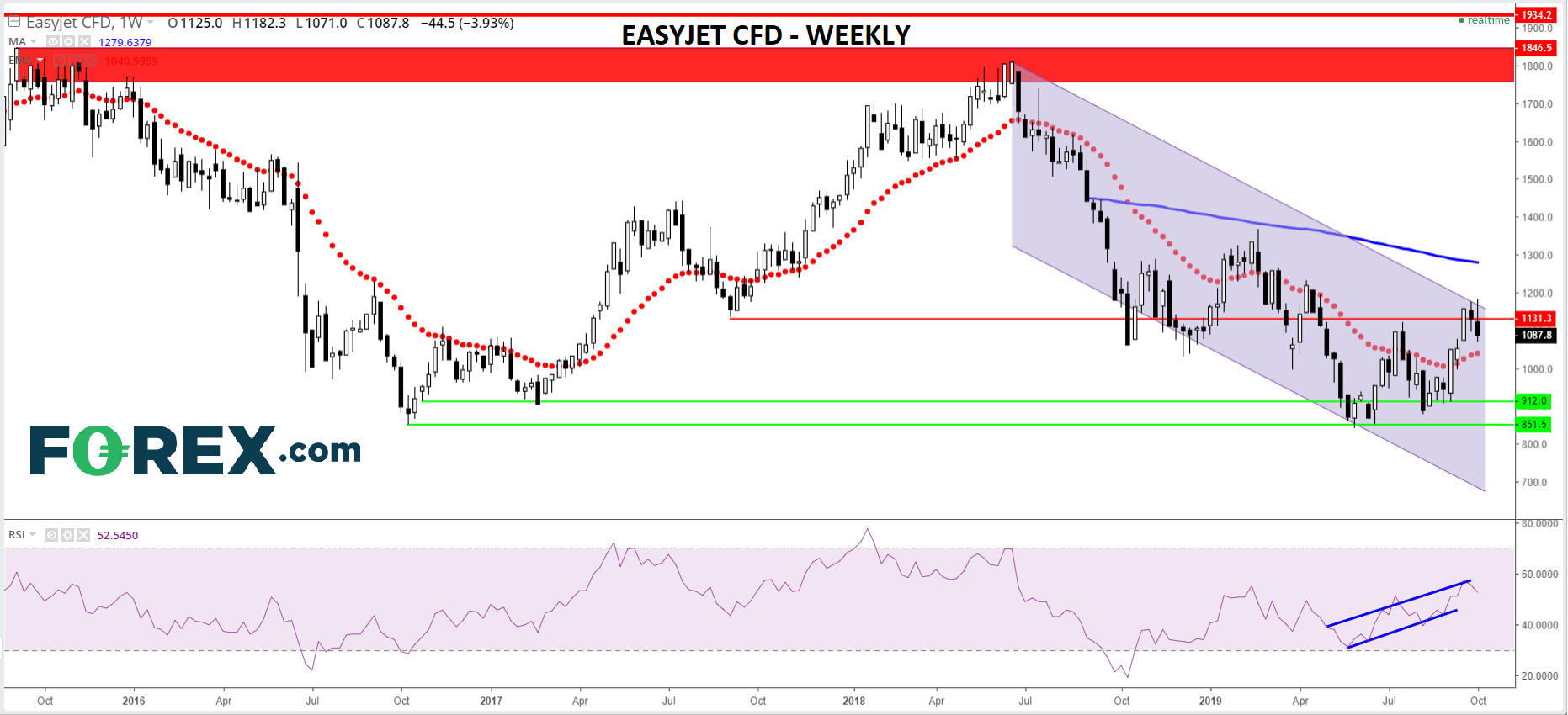
Indications that the shares were about to pull out of their dive since June have been disproved on Tuesday. The stock traded right into the top of its declining channel, backed by a rising RSI and 21-day exponential average, before being overcome. Price action confirms the validity of 1135p as resistance: it was initially an undeniable support on in September 2017, then resistance again earlier this year. Failure to stabilise here tends to suggest EZJ is on its way back down to long-term supports roughly between 850p-912p.
EasyJet plc. CFD – Weekly
Source: FOREX.com
EasyJet's silence on the outlook for next year is not golden
EasyJet appears to have navigated, more fortunately than expected, around another summer of disruption, rival business collapses and barely relenting seat capacity that continues to weigh on prices. Passenger revenues and ancillary sales (AKA ‘extras’) outperformed, enabling the group to steer expectations to the upper end of 2019/20 earnings that will be released next month. Trouble is, its fourth-quarter trading statement is conspicuously silent about the outlook for the forthcoming 2020/21 year. That undermines the group’s attempt to emit a halo of confidence following investments in “operational resilience” that reduced the impact of disruptions. Investors, whose patience has been worn thin after years of geopolitical and labour disruptions plus over-capacity, aren’t impressed. That’s led to searing share price punishment, with a drop of as much as 6%, EZJ’s biggest since May. With the stock having gained as much as 32% from mid-August lows, the group either had to demonstrate a solid basis for a re-rating, or, at worst, face a return towards the year’s lows.
Silence on the outlook shifts attention back to less than solid aspects of recent trading and outlook comments limited to the current year. Headline costs are set to rise 12%, driven by fuel and adverse FX movements. Excluding fuel and using flat FX rates, cost per seat is falling. This suggests EZJ is currently on the wrong side of its fuel price hedges and that its intermittently poor currency risk management has returned.
The question of how firm revenue momentum was on an underlying basis in peak months also arises. The group has been clear about benefits from BA and Ryanair strikes and Thomas Cook’s collapse. Speaking of the latter, there are signs that some of the recent share price optimism, predicated on capacity reduction, may have run too far. The bankrupt group accounted for just 1.5% of medium-haul, according to Bloomberg data. That means airlines will need to keep statements about potential advantages quite limited. Furthermore, Thomas Cook’s exit is also expected to reduce airline lease rates, tempting capacities even higher. The anticipated return of Boeing’s Max in Q1 2020 should tend towards a similar effect.
Against that backdrop, easyJet’s tacit message about the forthcoming year, still speaks volumes.
EasyJet Plc. chart
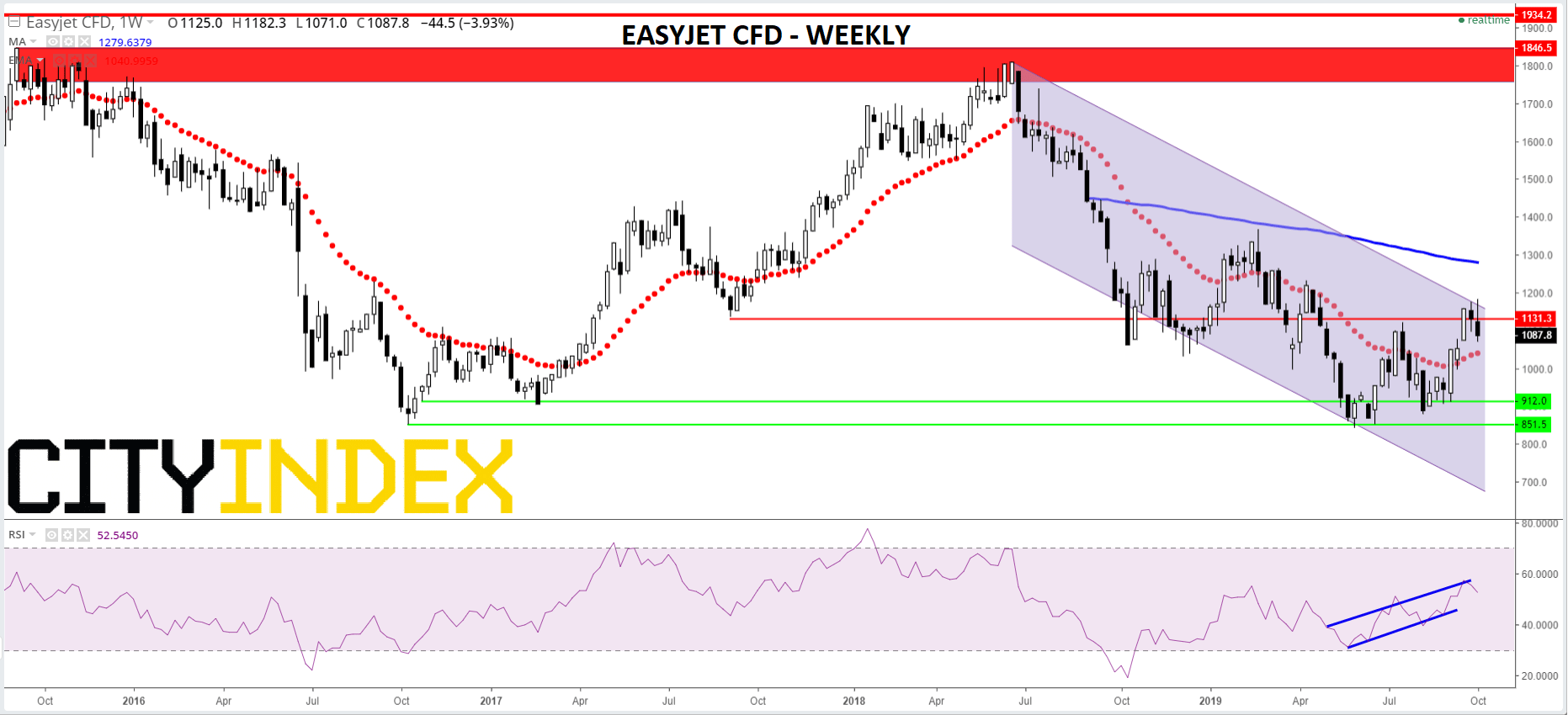
Indications that the shares were about to pull out of their dive since June have been disproved on Tuesday. The stock traded right into the top of its declining channel, backed by a rising RSI and 21-day exponential average, before being overcome. Price action confirms the validity of 1135p as resistance: it was initially an undeniable support on in September 2017, then resistance again earlier this year. Failure to stabilise here tends to suggest EZJ is on its way back down to long-term supports roughly between 850p-912p.
EasyJet plc. CFD – Weekly
Source: City Index
Related tags:
Latest market news




Open an account in minutes
Experience award-winning platforms with fast and secure execution, and enjoy tight spreads from 0.5 pts on FX and 0.3 pts on indices.
Economic calendar
Web Trader platform
Our sophisticated web-based platform is packed with features.
Related articles

EUR/USD Update: Will Fed Expectations Keep Pressure on the Euro?
The week continues to present challenges for the euro's short-term strength. This is reflected in the recent performance of EUR/USD, which has declined by nearly 0.6% over the last three trading sessions


EUR/USD Forecast: Euro Extends Losses Ahead of Fed Rate Decision
The euro has started to face a more challenging period in the short term. The EUR/USD pair has already declined by nearly 0.81% over the last four trading sessions, a move that has begun to reinforce a meaningful bearish bias in favor of the U.S. dollar.
EUR/USD Analysis: Euro Attempts to Recover Following the ECB Decision
Today's session has been particularly relevant for the euro's performance in the short term. After the EUR/USD registered a decline of nearly 0.3% during the session, the European currency has managed to recover a large part of its losses.
This report is intended for general circulation only. It should not be construed as a recommendation, or an offer (or solicitation of an offer) to buy or sell any financial products. The information provided does not take into account your specific investment objectives, financial situation or particular needs. Before you act on any recommendation that may be contained in this report, independent advice ought to be sought from a financial adviser regarding the suitability of the investment product, taking into account your specific investment objectives, financial situation or particular needs.
StoneX Financial Pte. Ltd., may distribute reports produced by its respective foreign entities or affiliates within the StoneX group of companies or third parties pursuant to an arrangement under Regulation 32C of the Financial Advisers Regulations. Where the report is distributed to a person in Singapore who is not an accredited investor, expert investor or an institutional investor (as defined in the Securities Futures Act), StoneX Financial Pte. Ltd. accepts legal responsibility to such persons for the contents of the report only to the extent required by law. Singapore recipients should contact StoneX Financial Pte. Ltd. at 6826 9988 for matters arising from, or in connection with the report.
In the case of all other recipients of this report, to the extent permitted by applicable laws and regulations neither StoneX Financial Pte. Ltd. nor its associated companies will be responsible or liable for any loss or damage incurred arising out of, or in connection with, any use of the information contained in this report and all such liability is hereby expressly disclaimed. No representation or warranty is made, express or implied, that the content of this report is complete or accurate.
StoneX Financial Pte. Ltd. is not under any obligation to update this report.
Trading CFDs carries a high level of risk that may not be suitable for some investors. Consider your investment objectives, level of experience, financial resources, risk appetite and other relevant circumstances carefully. The possibility exists that you could lose some or all of your investments, including your initial deposits. If in doubt, please seek independent expert advice. Visit www.forex.com/en-sg/terms-and-policies for the complete Risk Disclosure Statement.