



EUR/USD outlook: Crude oil remains the key driving force for now
The euro was coming off its earlier highs at the time of writing, after it staged a decent recovery against the dollar as markets digest the sharp reversal in energy prices and a rebound in broader risk sentiment. While the move has helped stabilise the pair after recent volatility, the near-term EUR/USD outlook remains closely tied to developments in the Middle East and the direction of oil markets.
Share this:
The euro was coming off its earlier highs at the time of writing, after it staged a decent recovery against the dollar as markets digest the sharp reversal in energy prices and a rebound in broader risk sentiment. While the move has helped stabilise the pair after recent volatility, the near-term EUR/USD outlook remains closely tied to developments in the Middle East and the direction of oil markets. That’s because the eurozone is an energy importer and therefore any sharp moves in energy prices will make a massive difference on the economy and inflation. The sudden drop in oil prices since Monday’s peak has eased immediate inflation concerns, but traders remain cautious given the fragile backdrop.
Oil and geopolitics still driving the dollar
Despite the apparent calm, the bigger question for markets is whether energy flows in the region can return to normal. The Strait of Hormuz remains the critical focal point. As one of the world’s most important oil shipping routes, any disruption to traffic through the strait would immediately reignite supply fears and likely send crude prices sharply higher again.
Until traders see clear confirmation that shipping routes are secure and production across the region is stabilising, oil prices are unlikely to retreat significantly further from current levels. That matters for currencies because elevated oil prices tend to strengthen the dollar indirectly. Higher energy costs can push inflation expectations higher and encourage safe-haven flows into the US currency when global growth risks intensify.
For now, the pullback in crude has offered some breathing space for risk assets, which in turn has allowed the EUR/USD to claw back some lost ground.
“TACO trade” makes another appearance
One narrative gaining traction again among traders is the so-called “TACO trade” — short for “Trump Always Chickens Out.” The phrase has become something of a market shorthand during the presidency of Donald Trump.
During his second term, markets have repeatedly seen a familiar pattern: strong rhetoric around tariffs or policy threats followed by a softer outcome. After initially signalling aggressive tariffs against several trading partners, Trump often scaled back those measures, ultimately settling on something far less damaging than feared.
That dynamic helped traders confidently buy the sharp equity market dip that followed the tariff announcements last April, and the same logic has guided positioning during subsequent bouts of trade-related volatility.
This time, the playbook appears to have extended beyond equities. As crude prices spiked on fears of supply disruptions in the Middle East, many traders quickly moved to fade the rally by shorting oil while simultaneously buying stocks after their steep decline.
Part of that thinking stems from the belief that the White House is acutely aware of the economic risks posed by a prolonged energy shock. Sustained high oil prices could quickly feed into inflation, undermining already fragile global growth and complicating the job of central banks.
It is precisely the sort of scenario policymakers would prefer to avoid — and that helps explain why markets reacted so sharply when signals emerged from Trump – the man that started the war – that tensions might cool.
EUR/USD outlook: Recovery faces technical hurdles
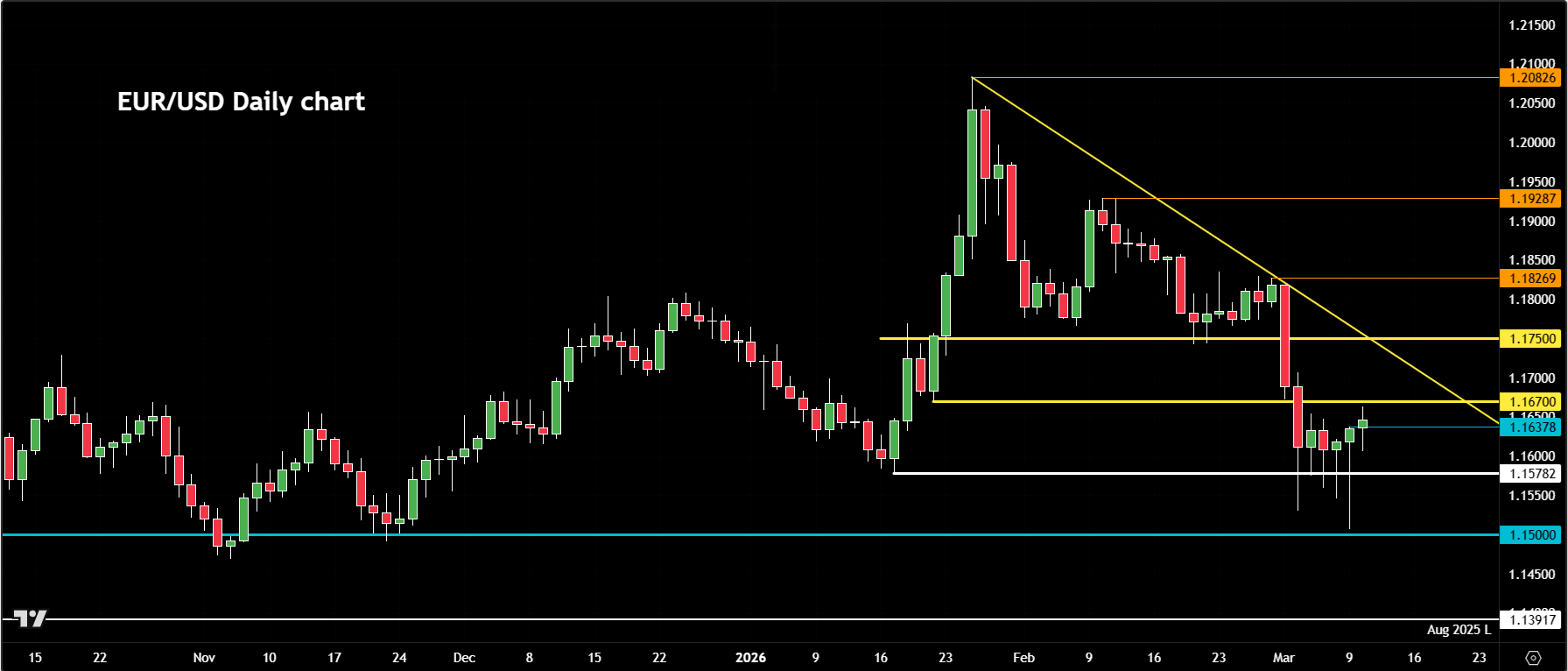
From a technical perspective, the recovery in EUR/USD still looks tentative. The pair has bounced from recent lows, but it remains below an important resistance zone around 1.1670–1.1700.
Unless that area is convincingly cleared, the rebound risks losing momentum. Short-term support is now seen around 1.1620 zone, followed by the January low of 1.1578. If we go below the latter, then a revisit of this week’s lows and 1.1500 could be on the cards.


-- Written by Fawad Razaqzada, Market Analyst
Follow Fawad on Twitter @Trader_F_R
How to trade with City Index
You can trade with City Index by following these four easy steps:
- Open an account, or log in if you’re already a customer
• Open an account in the UK
• Open an account in Australia
• Open an account in Singapore
- Search for the company you want to trade in our award-winning platform
- Choose your position and size, and your stop and limit levels
- Place the trade
Related tags:


Open an account in minutes
Experience award-winning platforms with fast and secure execution, and enjoy tight spreads from 0.5 pts on FX and 0.3 pts on indices.
Economic calendar
Web Trader platform
Our sophisticated web-based platform is packed with features.
Related articles
AUD/USD hammered by US yields and fading RBA hike bets
US yields, dollar strength and fading RBA hike bets have combined to drive AUD/USD to fresh multi-month lows. The macro and technical bias remains bearish, although history suggests parts of the move are now reaching unusually stretched levels.

Japanese Yen Outlook: USD/JPY, GBP/JPY, AUD/JPY Setups
USD/JPY and GBP/JPY show signs of stabilising, while AUD/JPY remains vulnerable as yen crosses deliver mixed technical signals.

EUR/USD Forecast: Euro Struggles to Find Support Even After U.S. PCE Data
The euro continues to face a challenging environment in the short term. The currency has struggled to regain ground against a U.S. dollar that remains firmly supported, a dynamic reflected in EUR/USD, which has now recorded three consecutive losing sessions and a decline of roughly 0.6%.

This report is intended for general circulation only. It should not be construed as a recommendation, or an offer (or solicitation of an offer) to buy or sell any financial products. The information provided does not take into account your specific investment objectives, financial situation or particular needs. Before you act on any recommendation that may be contained in this report, independent advice ought to be sought from a financial adviser regarding the suitability of the investment product, taking into account your specific investment objectives, financial situation or particular needs.
StoneX Financial Pte. Ltd., may distribute reports produced by its respective foreign entities or affiliates within the StoneX group of companies or third parties pursuant to an arrangement under Regulation 32C of the Financial Advisers Regulations. Where the report is distributed to a person in Singapore who is not an accredited investor, expert investor or an institutional investor (as defined in the Securities Futures Act), StoneX Financial Pte. Ltd. accepts legal responsibility to such persons for the contents of the report only to the extent required by law. Singapore recipients should contact StoneX Financial Pte. Ltd. at 6826 9988 for matters arising from, or in connection with the report.
In the case of all other recipients of this report, to the extent permitted by applicable laws and regulations neither StoneX Financial Pte. Ltd. nor its associated companies will be responsible or liable for any loss or damage incurred arising out of, or in connection with, any use of the information contained in this report and all such liability is hereby expressly disclaimed. No representation or warranty is made, express or implied, that the content of this report is complete or accurate.
StoneX Financial Pte. Ltd. is not under any obligation to update this report.
Trading CFDs carries a high level of risk that may not be suitable for some investors. Consider your investment objectives, level of experience, financial resources, risk appetite and other relevant circumstances carefully. The possibility exists that you could lose some or all of your investments, including your initial deposits. If in doubt, please seek independent expert advice. Visit www.forex.com/en-sg/terms-and-policies for the complete Risk Disclosure Statement.