



EURCAD could be heading to new 2019 low
The EUR/CAD remains in a bearish trend and judging by today’s price action, it could end 2019 with a whimper.
Share this:

The EUR/CAD remains in a bearish trend and judging by today’s price action, it could end 2019 with a whimper. The euro has failed to respond too positively to a small improvement in Eurozone data of late and remains one of the weakest major currencies of 2019. At the same time, the Canadian dollar continues to ignore weak domestic data to remain one of the strongest major currencies of the year. We think there is a good chance we may see a new swing low in this pair, possibly before the year is out.
So why is the EUR/CAD falling?
Well, as far the euro is concerned, the European Central Bank’s recent decision to restart bond buying to the tune of €20 billion per month means the single currency will struggle to sustain any rebound, even if we see – as we have – some improvement in Eurozone data.
The Canadian dollar, meanwhile, is supported on several fronts. First, the decision by a House committee to clear the USMCA – the new North American trade deal that replaces NAFTA – means it is likely to be approved in the full chamber on Thursday. Second, oil prices have been rising of late thanks mainly to OPEC’s ongoing efforts to restrict supply – this is giving a big boost to the commodity dollar with Canada being the world’s fourth largest oil exporter. Then you have the Bank of Canada, which was nowhere near as dovish in its last policy meeting as had been expected. Finally, the agreement between the US and China to agree to a phase one trade deal has lifted sentiment towards risk assets across the board, including crude oil and Canadian dollar.
Canadian data not so strong
However, there are some concerns over Canadian data, although the latest CPI report, released earlier today, was a touch higher than expected. Though Common and Trimmed measures of CPI were in line at 1.9% and 2.2% y/y respectively, Median CPI beat at 2.4% y/y vs. 2.2% expected and last. Other Canadian data releases have been poor of late, with Manufacturing Sales disappointing on Tuesday, printing a negative 0.7% m/m vs. flat expected. Last week, Building Permits showed a surprise drop of 1.5% m/m vs. a gain of 3.5% expected, while in the week before the monthly employment report showed jobs tanked by 71,200 last month when a rise of 10,00 was expected.
Coming up
Traders bullish on the Loonie will be hoping that the rest of this week’s Canadian data releases will not disappoint. The Canadian ADP Non-Farm Employment Change and Wholesale Sales will be published on Thursday, while Retail Sales are reported on Friday, with headline sales expected to have rebounded +0.5% m/m and core sales seen printing +0.2%.
EUR/CAD breaks down
Source: Trading View and FOREX.com
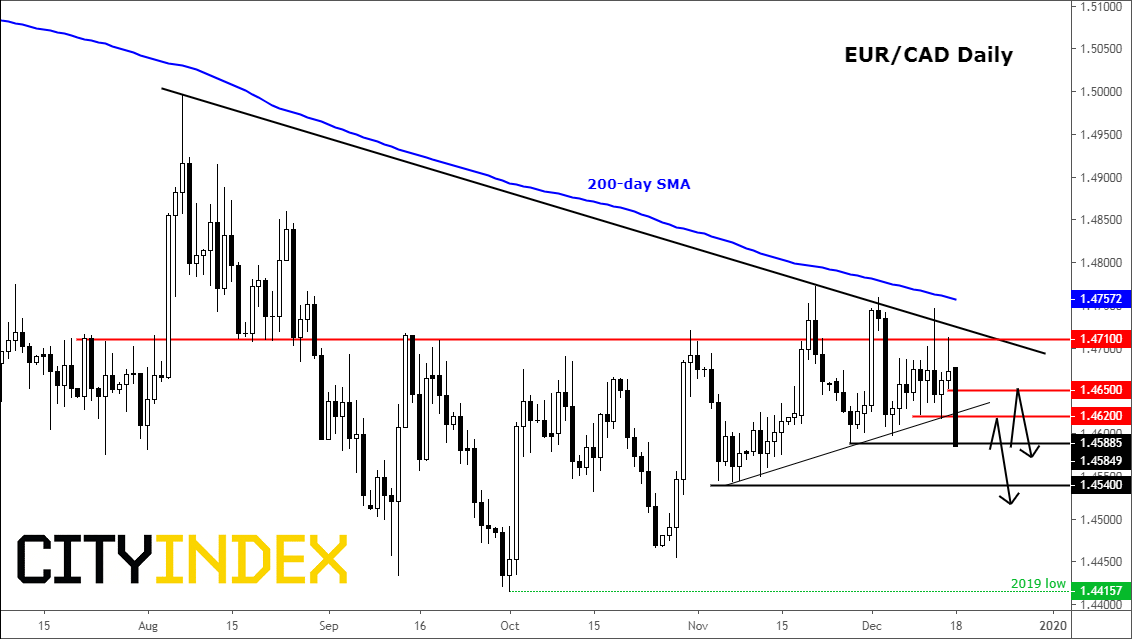
From a technical point of view, the EUR/CAD has broken below a short-term bearish trend line, thus resuming its longer-term bearish trend. Indeed, the long-term trend is negative given that price is holding below the long-term downwardly –sloping trend line and 200-day moving average, among other things. With the path of least resistance being to the downside, we expect resistance levels (such as 1.4620 and 1.4650) to hold and supports (such as 1.4590 and 1.4540) to break down. The bears’ main objective is the liquidity below 1.4415 – this year’s earlier low, hit in early October. We would drop our bearish view on this pair in the event rates break above the bearish trend line and key resistance in the range between 1.3710 and 1.3750.
The EUR/CAD remains in a bearish trend and judging by today’s price action, it could end 2019 with a whimper. The euro has failed to respond too positively to a small improvement in Eurozone data of late and remains one of the weakest major currencies of 2019. At the same time, the Canadian dollar continues to ignore weak domestic data to remain one of the strongest major currencies of the year. We think there is a good chance we may see a new swing low in this pair, possibly before the year is out.
So why is the EUR/CAD falling?
Well, as far the euro is concerned, the European Central Bank’s recent decision to restart bond buying to the tune of €20 billion per month means the single currency will struggle to sustain any rebound, even if we see – as we have – some improvement in Eurozone data.
The Canadian dollar, meanwhile, is supported on several fronts. First, the decision by a House committee to clear the USMCA – the new North American trade deal that replaces NAFTA – means it is likely to be approved in the full chamber on Thursday. Second, oil prices have been rising of late thanks mainly to OPEC’s ongoing efforts to restrict supply – this is giving a big boost to the commodity dollar with Canada being the world’s fourth largest oil exporter. Then you have the Bank of Canada, which was nowhere near as dovish in its last policy meeting as had been expected. Finally, the agreement between the US and China to agree to a phase one trade deal has lifted sentiment towards risk assets across the board, including crude oil and Canadian dollar.
Canadian data not so strong
However, there are some concerns over Canadian data, although the latest CPI report, released earlier today, was a touch higher than expected. Though Common and Trimmed measures of CPI were in line at 1.9% and 2.2% y/y respectively, Median CPI beat at 2.4% y/y vs. 2.2% expected and last. Other Canadian data releases have been poor of late, with Manufacturing Sales disappointing on Tuesday, printing a negative 0.7% m/m vs. flat expected. Last week, Building Permits showed a surprise drop of 1.5% m/m vs. a gain of 3.5% expected, while in the week before the monthly employment report showed jobs tanked by 71,200 last month when a rise of 10,00 was expected.
Coming up
Traders bullish on the Loonie will be hoping that the rest of this week’s Canadian data releases will not disappoint. The Canadian ADP Non-Farm Employment Change and Wholesale Sales will be published on Thursday, while Retail Sales are reported on Friday, with headline sales expected to have rebounded +0.5% m/m and core sales seen printing +0.2%.
EUR/CAD breaks down
Source: Trading View and FOREX.com
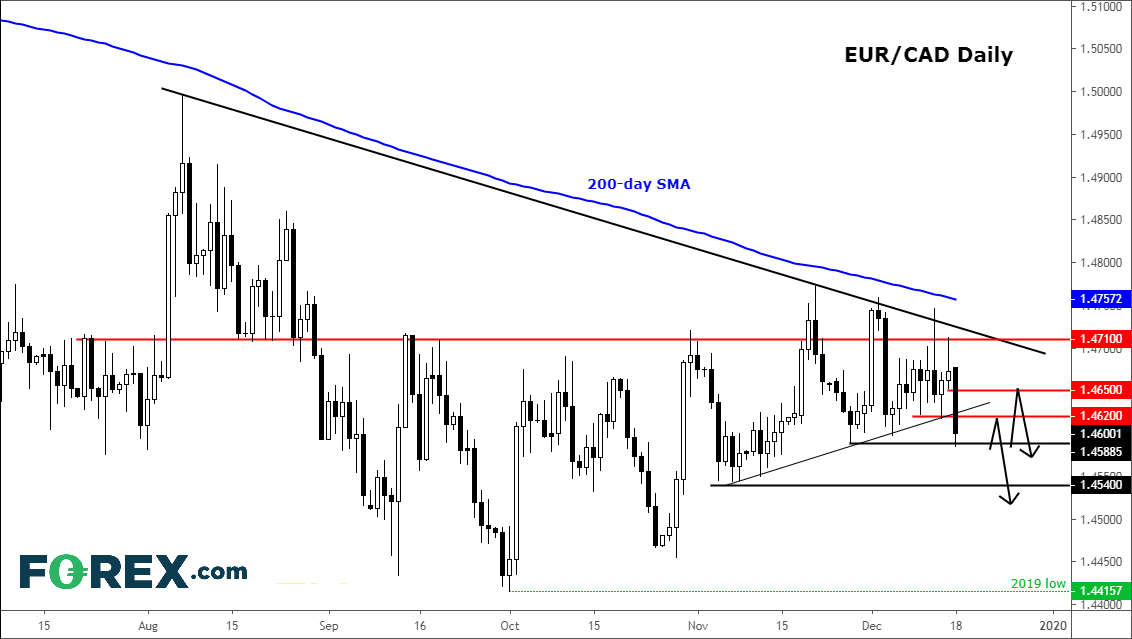
From a technical point of view, the EUR/CAD has broken below a short-term bearish trend line, thus resuming its longer-term bearish trend. Indeed, the long-term trend is negative given that price is holding below the long-term downwardly –sloping trend line and 200-day moving average, among other things. With the path of least resistance being to the downside, we expect resistance levels (such as 1.4620 and 1.4650) to hold and supports (such as 1.4590 and 1.4540) to break down. The bears’ main objective is the liquidity below 1.4415 – this year’s earlier low, hit in early October. We would drop our bearish view on this pair in the event rates break above the bearish trend line and key resistance in the range between 1.3710 and 1.3750.


Open an account in minutes
Experience award-winning platforms with fast and secure execution, and enjoy tight spreads from 0.5 pts on FX and 0.3 pts on indices.
Economic calendar
Web Trader platform
Our sophisticated web-based platform is packed with features.
Related articles
Japanese Yen Forecast: USD/JPY 4% Rally Challenges Post-Intervention Downtrend 9 24 2026
USD/JPY momentum has shifted sharply higher, putting a major resistance confluence in focus as U.S. and Japanese event risk builds.

Oil Quietly Hands the Fed a Reason to Stay Hawkish
Oil prices and the U.S. dollar are both on the front foot as elevated energy costs feed Fed warnings that inflation may prove sticky.


USD/JPY outlook: Hawkish Fed recalibration pressures the yen
Stronger US growth momentum and rising Treasury yields are keeping USD/JPY pointed higher, even as Japanese policymakers try to limit the pressure building across domestic markets.

This report is intended for general circulation only. It should not be construed as a recommendation, or an offer (or solicitation of an offer) to buy or sell any financial products. The information provided does not take into account your specific investment objectives, financial situation or particular needs. Before you act on any recommendation that may be contained in this report, independent advice ought to be sought from a financial adviser regarding the suitability of the investment product, taking into account your specific investment objectives, financial situation or particular needs.
StoneX Financial Pte. Ltd., may distribute reports produced by its respective foreign entities or affiliates within the StoneX group of companies or third parties pursuant to an arrangement under Regulation 32C of the Financial Advisers Regulations. Where the report is distributed to a person in Singapore who is not an accredited investor, expert investor or an institutional investor (as defined in the Securities Futures Act), StoneX Financial Pte. Ltd. accepts legal responsibility to such persons for the contents of the report only to the extent required by law. Singapore recipients should contact StoneX Financial Pte. Ltd. at 6826 9988 for matters arising from, or in connection with the report.
In the case of all other recipients of this report, to the extent permitted by applicable laws and regulations neither StoneX Financial Pte. Ltd. nor its associated companies will be responsible or liable for any loss or damage incurred arising out of, or in connection with, any use of the information contained in this report and all such liability is hereby expressly disclaimed. No representation or warranty is made, express or implied, that the content of this report is complete or accurate.
StoneX Financial Pte. Ltd. is not under any obligation to update this report.
Trading CFDs carries a high level of risk that may not be suitable for some investors. Consider your investment objectives, level of experience, financial resources, risk appetite and other relevant circumstances carefully. The possibility exists that you could lose some or all of your investments, including your initial deposits. If in doubt, please seek independent expert advice. Visit www.forex.com/en-sg/terms-and-policies for the complete Risk Disclosure Statement.