



GBP/USD 2026 Outlook: Can the Pound Extend its Gains in 2026? (Fundamental)
GBP/USD rose 6.5% in 2025; however, this was driven by U.S. dollar weakness rather than by notable strength in the pound, as evidenced by the pound's mixed performance against its major peers. However, with questions over how much lower the USD could go, GBP/USD may struggle to book another strong year in 2026.
Share this:

Introduction
GBP/USD rose 6.5% in 2025; however, this was driven by U.S. dollar weakness rather than by notable strength in the pound, as evidenced by the pound's mixed performance against its major peers. The USD index fell 10% across 2025, marking its worst yearly performance since 1979. Meanwhile, the pound fell 5% against the euro and 6% against the Swiss Franc, although GBP was flat against the Australian dollar and gained against the Japanese yen.
GBP/USD experienced one of its strongest annual gains in years, rising 6.5% year to date by mid-December. This move followed a 1.7% decline in the previous year and marks the strongest yearly rally since 2017. The pair booked most of its gains during the first six months of the year, as the USD experienced its steepest decline since 1979.
GBP/USD rose from 1.21, a 15-month low, to a four-year high of 1.3790 by July 1, before consolidating across the summer. The pair fell between September and November before bouncing back in the final weeks of the year. However, with questions over how much lower the USD could go, GBP/USD may struggle to book another strong year in 2026
UK economic outlook
-
Inflation & wage growth
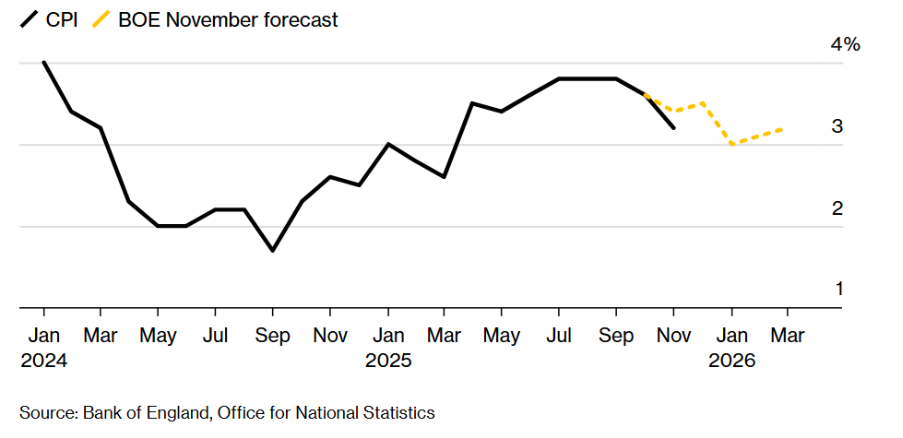
UK inflation eased to 3.2% YoY in November, cooling by more than expected after peaking at 3.8% YoY in September. This was below the 4% peak forecast by the central bank. While inflation remains 1.2% above the BoE’s 2% target, the BoE acknowledged that it expects Inflation to fall closer to its 2% target next spring as CPI cools faster than expected. This, combined with an expected deflationary impact from the Budget, could lead to CPI easing further towards levels consistent with looser BoE monetary policy.
UK CPI falls below BoE forecasts
The labour market is showing more signs of weakening. The unemployment rate rose to 5.1%, an almost 5-year high. Wage growth also cooled to 4.6%, with private-sector pay falling below 4% for the first time since 2020. While some of this weakness may be due to caution ahead of the Budget, these figures indicate that the UK labour market is loosening. The BoE forecasts that unemployment could rise to 5.5% in Q2 2026 owing to higher labour costs. A continued weakening in the labour market could prompt the BoE to cut rates further, although wage growth, while slowing, remains too high to be consistent with a 2% inflation target.
-
Growth
UK GDP grew 0.1% QoQ in Q3, down from 0.3% growth in Q2. According to the OECD, the UK is expected to grow by 1.2% in 2026, rising to 1.3% in 2027. This is a modest pace of growth, below long-term averages, indicating a slow-moving recovery rather than robust expansion. The slow growth is expected to be supported by easing monetary policy and improved confidence, but constrained by fiscal headwinds, weak productivity, and global economic uncertainty.
-
Fiscal outlook
With the long-awaited November budget in the rear-view mirror, concerns over the UK’s fiscal position have eased. Chancellor Rachel Reeve calmed market worries by giving herself more headroom than expected, pulling gilt yields lower. The market was unfazed by the prospect of the government front-loading spending while back-loading tax increases to finance it. However, this indicates that the fiscal position remains fragile, even if the market is looking through this for now. Government spending has been at record levels across the latter part of 2025. Markets will continue to monitor government spending and public sector net borrowing closely throughout 2026. Persistent high spending could unnerve the bond market, lifting gilt yields and weighing on GBP. Any indication that spending is being reined in could help lower gilt yields while boosting the pound.
-
Political volatility
Political unease in the UK could weigh on sentiment towards the pound. Prime Minister Kier Starmer looks far from secure.
Both PM Starmer and Rachel Reeves have been under pressure, and while the Budget appears to have given them more time, there is a sense that a single misstep could result in either being out. Names of potential alternative leaders in the press keep the spotlight on Starmer’s long-term position. Should Labour underperform in the May 2026 local elections, Starmer’s leadership could be challenged.
BoE rate outlook
The Bank of England cut interest rates four times in 2025 and a total of six times since starting its monetary easing cycle in August last year. The central bank reduced rates by 25 basis points in March, June, August, and November, taking the benchmark rate to its current level of 3.75%
In the final MPC meeting of the year, the BoE adopted a cautious tone towards further rate cuts. The BoE statement reiterated that rates will likely continue to ease gradually. However, the BoE Governor warned that there is limited room for further cuts as the rate approaches a neutral level. Interestingly, the BoE's stance was unchanged following the significantly cooler-than-expected inflation data, with a 5-4 vote.
The market is currently pricing in another 25-basis-point rate cut to bring rates to a terminal level of 3.5%. Should inflation cool faster than expected amid slow growth, the BoE could cut rates more quickly to 3% by the end of 2026. Under this scenario, GBP could fall.
US economic outlook
The markets remain sceptical about the US economic outlook amid data distortions from the longest-ever US government shutdown.
Q2 GDP data showed the US economy grew at an annualised rate of 3.8%, the fastest pace since Q3 of 2023. Q3 GDP data are due to be released and are expected to show that growth remained robust at 3.2% annualised.
However, the US labour market is weakening. The November non-farm payrolls report showed that 64k jobs were added, after 105k were lost in October. The unemployment rate rose to an almost four-year high of 4.6%.
Meanwhile, US core CPI rose 2.6% YoY in November, falling short of the 3% forecast. While inflation remains above the 2% target, a potential weakening of the labour market could further cool inflation toward the Federal Reserve’s 2% target. In such a scenario, multiple rate cuts may be justified.
Federal Reserve rate cut path
The Federal Reserve cut rates three times in 2025. The central bank reduced rates by 25 basis points in September, November, and December, bringing the range to 3.5%-3.75% by the end of 2025.
In the final meeting of 2025, the Federal Reserve's dot plot forecasted one rate cut in 2026, below market expectations for two rate reductions from the Fed.
The question here is whether the market is too optimistic about rate cuts. Inflation cooled by more than expected at the end of 2025, and the labour market is cooling. Should these trends continue, the Fed could cut in line with market expectations.
It's also worth noting that Trump will announce a new Federal Reserve Chair to replace Jerome Powell at the end of his term in May. The next Federal Reserve Chair is expected to be announced in early January and will likely favour lower interest rates. Expectations surrounding a more dovish Federal Reserve chair could be contributing to the market's more dovish outlook.
Conclusion
GBP/USD’s strong performance in 2025 was largely driven by U.S. dollar weakness rather than broad-based pound strength, raising doubts about whether a similar rally can be repeated in 2026. Easing UK inflation and a cooling labour market give the Bank of England some scope to cut rates further, Meanwhile, slow growth, fiscal fragility, and political uncertainty could also limit GBP upside. Meanwhile, the U.S. outlook hinges on whether weakening labour data and cooling inflation could lead the Fed to cut more aggressively than it currently signals. While a notably stronger USD appears unlikely, GBP/USD may struggle to extend its advance significantly without clearer UK-specific support.
Related tags:




Open an account in minutes
Experience award-winning platforms with fast and secure execution, and enjoy tight spreads from 0.5 pts on FX and 0.3 pts on indices.
Economic calendar
Web Trader platform
Our sophisticated web-based platform is packed with features.
Related articles

British Pound Technical Outlook: GBP/USD Rebound Challenges September Downtrend 9 30 2026
Sterling has rallied sharply from key support, with GBP/USD at an inflection point that could determine whether a larger recovery is underway.


GBP/USD, Oil Forecast: Two trades to watch 300926
GBP/USD: Can Stronger UK Growth Offset the Dollar’s Advantage? Oil: Supply Recovery Challenges the Geopolitical Premium.
GBP/USD Q4 Outlook: Can the Pound Turn the Tide Against a Hawkish Fed?
GBP/USD hovers around a 3-month low. Can the pound turn the tide against a hawkish Fed or will widening policy divergence keep GBP/USD under pressure in Q4?
This report is intended for general circulation only. It should not be construed as a recommendation, or an offer (or solicitation of an offer) to buy or sell any financial products. The information provided does not take into account your specific investment objectives, financial situation or particular needs. Before you act on any recommendation that may be contained in this report, independent advice ought to be sought from a financial adviser regarding the suitability of the investment product, taking into account your specific investment objectives, financial situation or particular needs.
StoneX Financial Pte. Ltd., may distribute reports produced by its respective foreign entities or affiliates within the StoneX group of companies or third parties pursuant to an arrangement under Regulation 32C of the Financial Advisers Regulations. Where the report is distributed to a person in Singapore who is not an accredited investor, expert investor or an institutional investor (as defined in the Securities Futures Act), StoneX Financial Pte. Ltd. accepts legal responsibility to such persons for the contents of the report only to the extent required by law. Singapore recipients should contact StoneX Financial Pte. Ltd. at 6826 9988 for matters arising from, or in connection with the report.
In the case of all other recipients of this report, to the extent permitted by applicable laws and regulations neither StoneX Financial Pte. Ltd. nor its associated companies will be responsible or liable for any loss or damage incurred arising out of, or in connection with, any use of the information contained in this report and all such liability is hereby expressly disclaimed. No representation or warranty is made, express or implied, that the content of this report is complete or accurate.
StoneX Financial Pte. Ltd. is not under any obligation to update this report.
Trading CFDs carries a high level of risk that may not be suitable for some investors. Consider your investment objectives, level of experience, financial resources, risk appetite and other relevant circumstances carefully. The possibility exists that you could lose some or all of your investments, including your initial deposits. If in doubt, please seek independent expert advice. Visit www.forex.com/en-sg/terms-and-policies for the complete Risk Disclosure Statement.