



GBP/USD outlook: Impressive rebound arrives at key technical test
Cable has rallied steadily since UK prime minister-in-waiting Andy Burnham pledged to stick to the country's existing fiscal rules. But after a strong recovery over the past fortnight, the pair has arrived at a major technical test that will help determine whether the move is more than just a corrective bounce.
Share this:

- Cable extends impressive corrective bounce
- Waller keeps inflation centre stage
- Markets continue to unwind Fed tightening bets
- Resistance now stands directly overhead
Cable continues to motor higher, defying a macro backdrop that was broadly dollar-supportive on Monday. Fed Governor Christopher Waller reiterated that inflation remains the Fed's primary concern, while the latest ISM services PMI pointed to continued resilience in the world's largest economy. Yet neither was enough to derail sterling's advance, with GBP/USD approaching a major technical test.
Burnham calms fiscal concerns
Part of sterling’s recent resilience may reflect improving sentiment towards the UK fiscal outlook. While UK prime minister-in-waiting Andy Burnham's commitment last week to stick to the country's existing fiscal rules didn't mark the exact bottom in cable, it came close. Since then, GBP/USD hasn't posted a single down session, with the pair steadily extending its recovery.
The move may reflect relief that Burnham's policy agenda is shaping up to be less fiscally expansionary than some had feared. With concerns lingering over the UK's fiscal trajectory, his commitment to maintain budget discipline may have appeased traders for now, helping underpin sterling not just against the dollar but also the major crosses.
Hawkish Fed rhetoric, softer pricing
The ongoing resilience in cable was all the more notable given developments in the US on Monday. Influential Fed Governor Christopher Waller argued that risks facing the Fed had "completely flipped around", saying the labour market had stabilised while inflation had picked up. Having advocated rate cuts a year ago because of concerns over employment, Waller indicated inflation was now the dominant consideration when thinking about policy.
The ISM services PMI for June only reinforced the narrative of US economic exceptionalism. The headline index held comfortably above the 50 level separating expansion from contraction, with employment returning to expansion after three months of contraction while new orders remained firm.
Source: TradingView
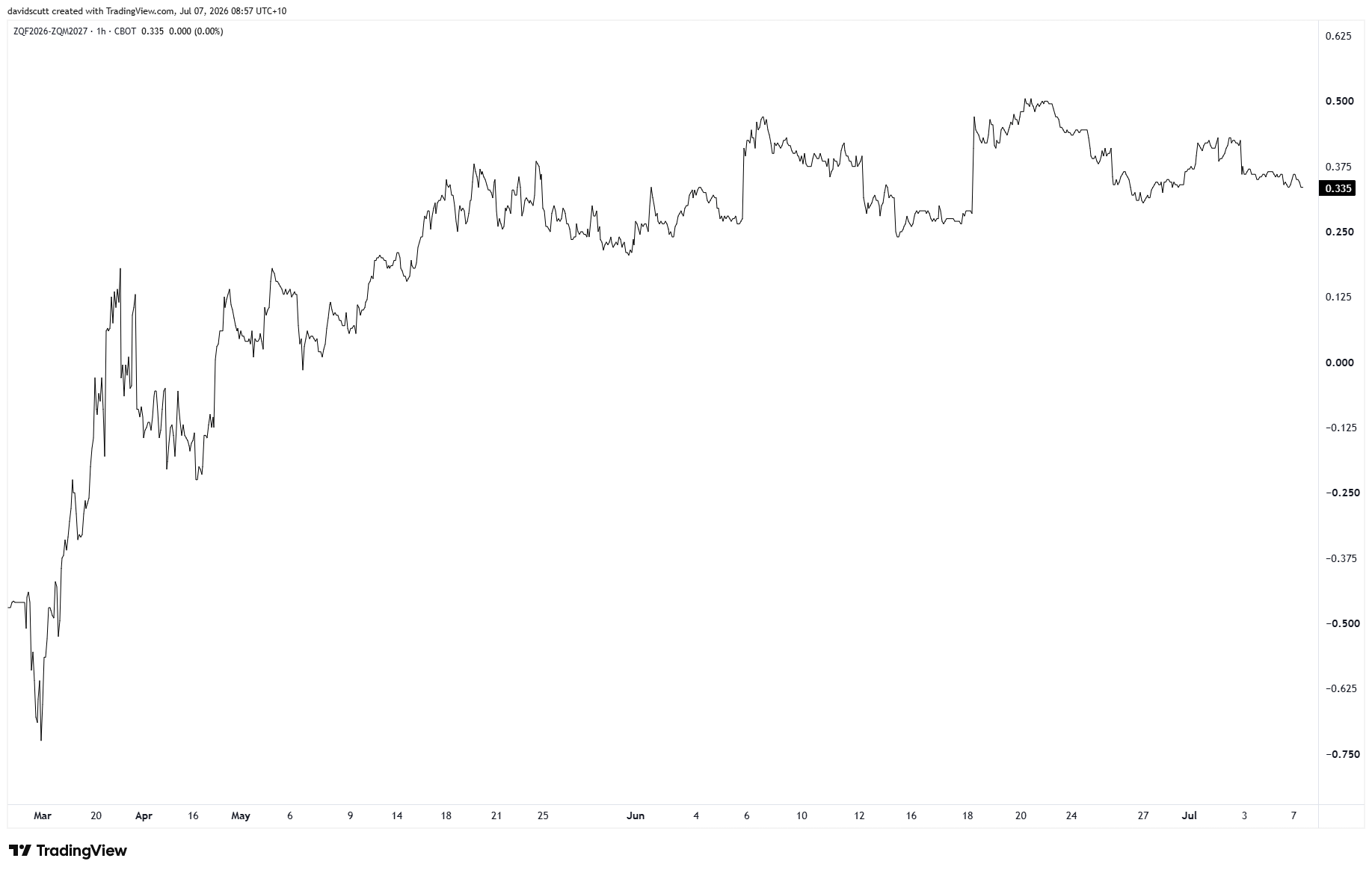
In other regimes, that combination would have been expected to support the dollar. Instead, markets continued to pare Fed tightening expectations, as seen in the graphic above, with pricing over the next 12 months falling to around 33.5 basis points, down from around 43 basis points only a week ago.
Attention now turns to Wednesday's release of the June FOMC minutes. Given nine of the 18 policymakers who submitted economic projections expected at least one rate hike this year, including six looking for multiple increases, the tone is likely to be hawkish. But that's should be entirely expected. With energy prices having retraced sharply and market-based inflation expectations continuing to ease since the meeting, traders may view the minutes as somewhat dated, leaving next week's US CPI report as the more important event for the dollar.
Recovery meets resistance
Source: TradingView
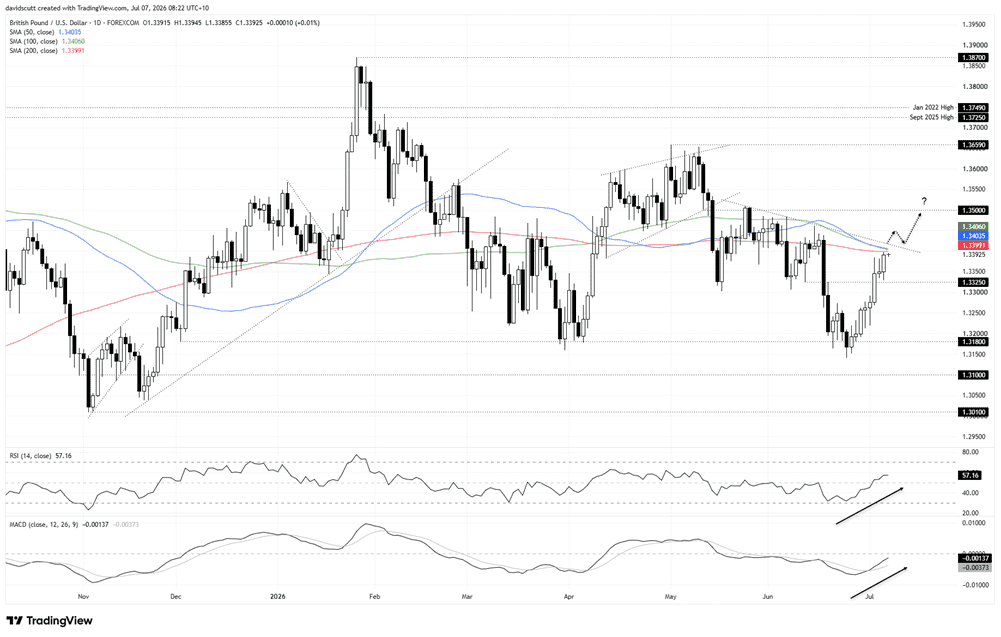
From a technical perspective, cable's recovery has seen it arrive at an important juncture, sitting just beneath a confluence of the 50, 100 and 200-day moving averages, along with a minor downtrend running from the highs set back in the middle of May. After what's been a decent run over the past fortnight, that creates a tough test for the bulls.
Looking at the oscillators, momentum has shifted back in favour of the bulls, but it's not yet a definitive signal. RSI (14) has pushed above 57, while MACD has crossed above its signal line from below and is now motoring towards positive territory. Together, they suggest momentum may be in the early stages of swinging back in favour of longs.
Importantly, though, the move over the past fortnight should be viewed as a corrective bounce rather than the beginning of a new, longer-lasting uptrend. While the bounce has been impressive, the pair has yet to take out the sequence of lower highs. Until the confluence of resistance overhead gives way, there's little to suggest the broader trend has changed.
Should cable break above the resistance zone, ideally followed by a successful backtest and bounce or a close above it, it would strengthen the case for a move towards 1.3500, a level that has repeatedly acted as both support and resistance in recent months. A break above there would shift the focus to the May high of 1.3659. On the downside, 1.3325 is the first level to watch. Having acted as both support and resistance recently, the pair has so far managed to hold above it following last week's breakout.
Latest market news




Open an account in minutes
Experience award-winning platforms with fast and secure execution, and enjoy tight spreads from 0.5 pts on FX and 0.3 pts on indices.
Economic calendar
Web Trader platform
Our sophisticated web-based platform is packed with features.
Related articles
EUR/USD Q4 2026 Outlook: Euro at a Crossroads as Fed, ECB Tighten 9 25 2026
EUR/USD enters Q4 at a pivotal inflection point as competing Fed-ECB policy paths and persistent inflation risks collide with major technical support.

AUD/USD Q4 Outlook: RBA and Fed Hikes Set the Tone
AUD/USD enters Q4 with RBA and Fed hikes in focus as sticky inflation, rising unemployment and US dollar strength shape the Australian dollar.


USD/JPY Q4 2026 Outlook: Hawkish Fed Pricing Clashes With Intervention Risk
The year-end tug-of-war is clear: hawkish Fed pricing supports USD/JPY, while intervention risk limits the upside.
This report is intended for general circulation only. It should not be construed as a recommendation, or an offer (or solicitation of an offer) to buy or sell any financial products. The information provided does not take into account your specific investment objectives, financial situation or particular needs. Before you act on any recommendation that may be contained in this report, independent advice ought to be sought from a financial adviser regarding the suitability of the investment product, taking into account your specific investment objectives, financial situation or particular needs.
StoneX Financial Pte. Ltd., may distribute reports produced by its respective foreign entities or affiliates within the StoneX group of companies or third parties pursuant to an arrangement under Regulation 32C of the Financial Advisers Regulations. Where the report is distributed to a person in Singapore who is not an accredited investor, expert investor or an institutional investor (as defined in the Securities Futures Act), StoneX Financial Pte. Ltd. accepts legal responsibility to such persons for the contents of the report only to the extent required by law. Singapore recipients should contact StoneX Financial Pte. Ltd. at 6826 9988 for matters arising from, or in connection with the report.
In the case of all other recipients of this report, to the extent permitted by applicable laws and regulations neither StoneX Financial Pte. Ltd. nor its associated companies will be responsible or liable for any loss or damage incurred arising out of, or in connection with, any use of the information contained in this report and all such liability is hereby expressly disclaimed. No representation or warranty is made, express or implied, that the content of this report is complete or accurate.
StoneX Financial Pte. Ltd. is not under any obligation to update this report.
Trading CFDs carries a high level of risk that may not be suitable for some investors. Consider your investment objectives, level of experience, financial resources, risk appetite and other relevant circumstances carefully. The possibility exists that you could lose some or all of your investments, including your initial deposits. If in doubt, please seek independent expert advice. Visit www.forex.com/en-sg/terms-and-policies for the complete Risk Disclosure Statement.