



NFP Preview Mixed Report Expected Stationary Fed May Limit Market Reaction
We believe the odds are tilted toward a near-consensus reading in overall job growth...
Share this:

Background
Every month, we remind traders that the Non-Farm Payrolls report is significant because of how it impacts monetary policy. In other words, the Federal Reserve is the “transmission mechanism” between US economic reports and market prices, so any discussion about NFP should start with a look at the state of the US central bank.
Even though we’ve flipped the calendar to a new year (and decade), the Fed remains in the same decidedly neutral posture, with little chance of tweaking interest rates in either direction until at least the second quarter, if not until after November’s election! Accordingly, even an outlier NFP reading for a single month is unlikely to meaningfully impact Fed policy, and by extension, market pricing. That said, the jobs report remains one of the best measures of the health of the labor market and provides insight into overall activity in the world’s largest economy, so it’s still likely to provide some short-term trading opportunities.
NFP Forecast
From our perspective, there have been four historically-reliable leading indicators for the NFP report:
- The ISM Manufacturing PMI Employment component fell to 45.1, down from last month’s 46.6 reading.
- The ISM Non-Manufacturing PMI Employment component came in at 55.2, essentially flat from last month’s 55.5 reading.
- The ADP Employment report rose to 202k, a big improvement over last month’s upwardly-revised 124k reading.
- The 4-week moving average of initial unemployment claims rose to 224,00, up from 217,750 last month.
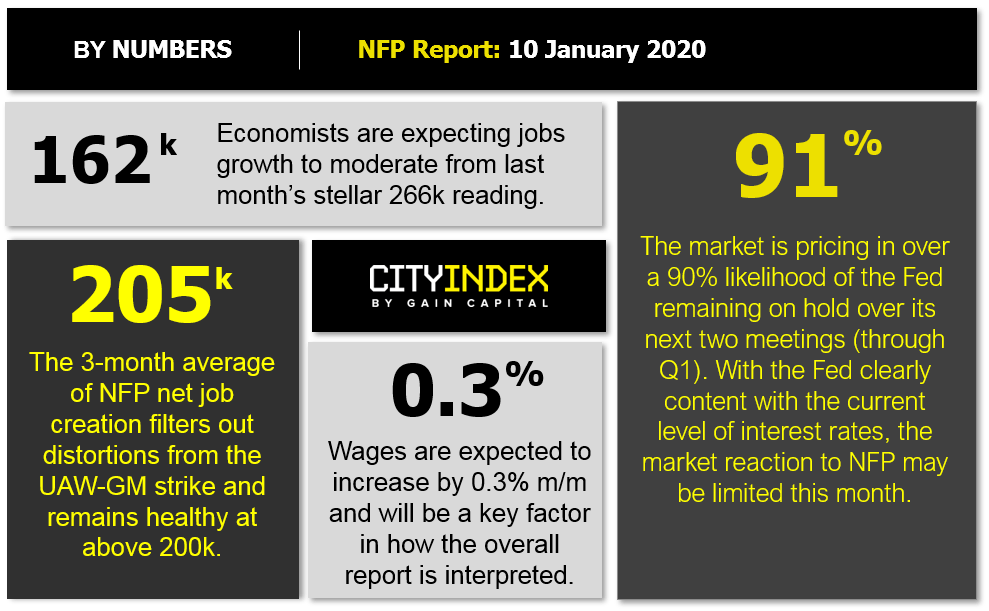
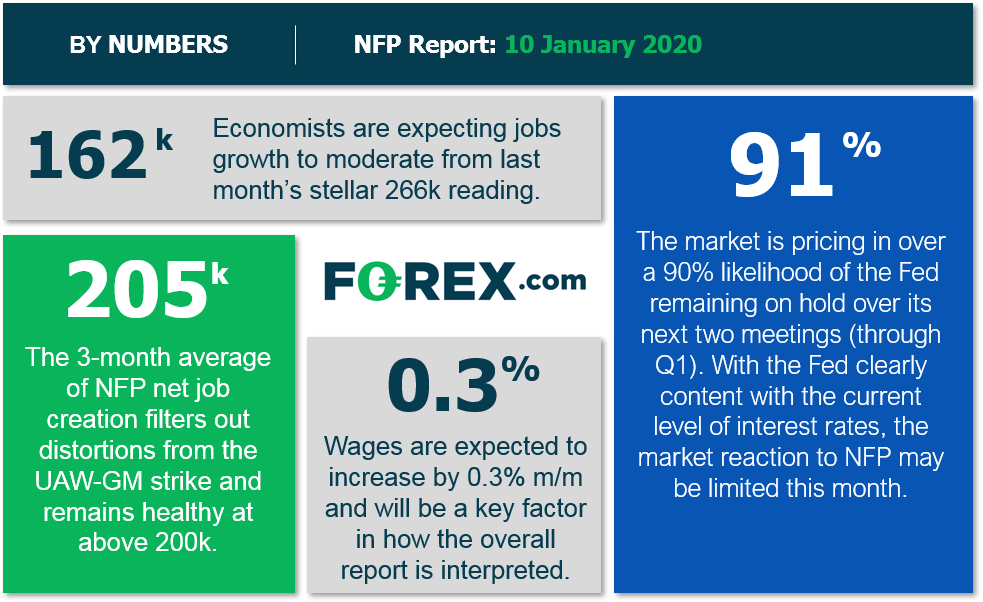
In other words, the leading indicators are fairly mixed this month, with two deteriorating, one effectively holding steady and one improving. In addition, this month’s report won’t benefit from nearly 50,000 United Auto Workers employees returning from strikes to General Motors factories. Weighing these factors, we believe the odds are tilted toward a near-consensus reading in overall job growth, with internal models pointing toward headline job creation in the 140-200k range.
Regardless, the month-to-month fluctuations in this report are notoriously difficult to predict, so we wouldn’t put too much stock into any forecasts (including ours). Most importantly, readers should note that the unemployment rate and (especially) the wages component of the report will also influence how traders interpret the strength of the reading.
Source: GAIN Capital
Potential Market Reaction
See wage and job growth scenarios, along with the potential bias for the US dollar below:
| Earnings < 0.2% m/m | Earnings = 0.3% m/m | Earnings > 0.4% m/m | |
| < 130k jobs | Bearish USD | Neutral USD | Neutral USD |
| 130k-190k jobs | Slightly Bearish USD | Neutral USD | Slightly Bullish USD |
| > 190k jobs | Neutral USD | Slightly Bullish USD | Bullish USD |
In the event the jobs and the wage data beat expectations, then we would favor looking for short-term bearish trades in EUR/USD, which remains in a longer-term bearish channel after testing resistance last week. But if the jobs data misses expectations, then we would favor looking for bullish trades in NZD/USD, which has formed a clear uptrend over the past few months and has recently pulled back from overbought territory.
Background
Every month, we remind traders that the Non-Farm Payrolls report is significant because of how it impacts monetary policy. In other words, the Federal Reserve is the “transmission mechanism” between US economic reports and market prices, so any discussion about NFP should start with a look at the state of the US central bank.
Even though we’ve flipped the calendar to a new year (and decade), the Fed remains in the same decidedly neutral posture, with little chance of tweaking interest rates in either direction until at least the second quarter, if not until after November’s election! Accordingly, even an outlier NFP reading for a single month is unlikely to meaningfully impact Fed policy, and by extension, market pricing. That said, the jobs report remains one of the best measures of the health of the labor market and provides insight into overall activity in the world’s largest economy, so it’s still likely to provide some short-term trading opportunities.
NFP Forecast
From our perspective, there have been four historically-reliable leading indicators for the NFP report:
- The ISM Manufacturing PMI Employment component fell to 45.1, down from last month’s 46.6 reading.
- The ISM Non-Manufacturing PMI Employment component came in at 55.2, essentially flat from last month’s 55.5 reading.
- The ADP Employment report rose to 202k, a big improvement over last month’s upwardly-revised 124k reading.
- The 4-week moving average of initial unemployment claims rose to 224,00, up from 217,750 last month.
In other words, the leading indicators are fairly mixed this month, with two deteriorating, one effectively holding steady and one improving. In addition, this month’s report won’t benefit from nearly 50,000 United Auto Workers employees returning from strikes to General Motors factories. Weighing these factors, we believe the odds are tilted toward a near-consensus reading in overall job growth, with internal models pointing toward headline job creation in the 140-200k range.
Regardless, the month-to-month fluctuations in this report are notoriously difficult to predict, so we wouldn’t put too much stock into any forecasts (including ours). Most importantly, readers should note that the unemployment rate and (especially) the wages component of the report will also influence how traders interpret the strength of the reading.
Source: GAIN Capital
Potential Market Reaction
See wage and job growth scenarios, along with the potential bias for the US dollar below:
| Earnings < 0.2% m/m | Earnings = 0.3% m/m | Earnings > 0.4% m/m | |
| < 130k jobs | Bearish USD | Neutral USD | Neutral USD |
| 130k-190k jobs | Slightly Bearish USD | Neutral USD | Slightly Bullish USD |
| > 190k jobs | Neutral USD | Slightly Bullish USD | Bullish USD |
In the event the jobs and the wage data beat expectations, then we would favor looking for short-term bearish trades in EUR/USD, which remains in a longer-term bearish channel after testing resistance last week. But if the jobs data misses expectations, then we would favor looking for bullish trades in NZD/USD, which has formed a clear uptrend over the past few months and has recently pulled back from overbought territory.

Open an account in minutes
Experience award-winning platforms with fast and secure execution, and enjoy tight spreads from 0.5 pts on FX and 0.3 pts on indices.
Economic calendar
Web Trader platform
Our sophisticated web-based platform is packed with features.
Related articles

USD/JPY outlook: Hawkish Fed recalibration pressures the yen
Stronger US growth momentum and rising Treasury yields are keeping USD/JPY pointed higher, even as Japanese policymakers try to limit the pressure building across domestic markets.


AUD/USD Crushed Ahead of Jobs Report as US Dollar, Yields Surge
AUD/USD slumps towards 70c as surging US yields and a stronger dollar overshadow Australian jobs data and the RBA outlook.

USD/MXN Forecast: Peso Loses Momentum Ahead of Banxico Decision
Over recent trading sessions, the Mexican peso has started to show signs of losing strength against the U.S. dollar. This can be seen in the performance of USD/MXN, which has gained more than 1.7% over the last three sessions, highlighting the dollar's renewed strength against the peso.

This report is intended for general circulation only. It should not be construed as a recommendation, or an offer (or solicitation of an offer) to buy or sell any financial products. The information provided does not take into account your specific investment objectives, financial situation or particular needs. Before you act on any recommendation that may be contained in this report, independent advice ought to be sought from a financial adviser regarding the suitability of the investment product, taking into account your specific investment objectives, financial situation or particular needs.
StoneX Financial Pte. Ltd., may distribute reports produced by its respective foreign entities or affiliates within the StoneX group of companies or third parties pursuant to an arrangement under Regulation 32C of the Financial Advisers Regulations. Where the report is distributed to a person in Singapore who is not an accredited investor, expert investor or an institutional investor (as defined in the Securities Futures Act), StoneX Financial Pte. Ltd. accepts legal responsibility to such persons for the contents of the report only to the extent required by law. Singapore recipients should contact StoneX Financial Pte. Ltd. at 6826 9988 for matters arising from, or in connection with the report.
In the case of all other recipients of this report, to the extent permitted by applicable laws and regulations neither StoneX Financial Pte. Ltd. nor its associated companies will be responsible or liable for any loss or damage incurred arising out of, or in connection with, any use of the information contained in this report and all such liability is hereby expressly disclaimed. No representation or warranty is made, express or implied, that the content of this report is complete or accurate.
StoneX Financial Pte. Ltd. is not under any obligation to update this report.
Trading CFDs carries a high level of risk that may not be suitable for some investors. Consider your investment objectives, level of experience, financial resources, risk appetite and other relevant circumstances carefully. The possibility exists that you could lose some or all of your investments, including your initial deposits. If in doubt, please seek independent expert advice. Visit www.forex.com/en-sg/terms-and-policies for the complete Risk Disclosure Statement.