


Rare earth squeeze will do abundant damage
Global manufacturers would be hit hard…and China would be dented too
Share this:

Global manufacturers would be hit hard…and China would be dented too
Rare earths weigh heavily
China's signal that it is "seriously" considering restricting exports of rare earths to the U.S. and that it has a detailed plan on how to do so, has helped extend the global stock market malaise beyond the one-month mark. As per other inflection points throughout the U.S.-China trade conflict, investors potential economic impact from disruptions to global supply chains whilst bracing for possible further escalation.
Rare earths are 17 minerals with highly sought-after properties that are difficult to synthesize on an industrial scale. The materials therefore see huge demand by manufactures of an ever-growing list of goods. Everything from batteries, lasers, lighting, automobiles (electric and combustion-driven) to electronic components, mobile phones, cameras, aircraft parts, X-ray and MRI equipment, require forms of ‘rare’ materials. And then there are the myriad military applications like missile guidance systems, satellites, night vision devices and beyond. Consequently, global supply chains could suffer severe disruptions that upend corporate profits and drag global economies into outright recession if China opts for aggressive restrictions.
Two-way street
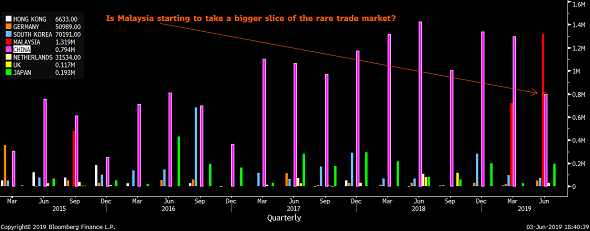
Still, if the world’s third-largest economy carries out its threat, recent history shows the damage wouldn’t be a one-way street. Sure, China dominates rare earth production, mining around 70% last year, whilst controlling 40% of global reserves. But it's more accurate to define rare earths as difficult and costly to mine than truly rare. As such, similar restrictions in the past enabled other countries attempting to scale production to grab market share. Malaysia and Japan itself are now also notable producers. Malaysia’s output has ramped in recent quarters as shown in the graphic below. With plentiful reserves in Brazil, Vietnam, Russia and elsewhere, such regions are likely to be inundated with incentives to hike their currently modest output; though that will of course take time.
Volume chart: principal country exporters of rare earth metals, including inorganic/organic compounds – March 2015 to June 2018
Source: Bloomberg / City Index
Unintended consequences
The history of attempts to ‘weaponize’ market resources also shows consumers generally reduce dependence, which eventually calls into question the benefits of any blockade relative to costs. China last attempted to leverage dominance of rare earths in 2010, when Beijing fell out with Tokyo over ownership of certain Islands south of Taiwan. China slashed export quotas and stopped shipments to Japan, but in many ways the move backfired. China went from 97% of global production to 71% in the five years that followed. Global consumption reversed from growth of 27% between 2005 and 2010 to a 7.2% fall in 2010-2015. China also faces erosion of an already patchy store of goodwill and reputation for reliability if it messes with rare earths.
Partly with these risks in mind, China is unlikely to immediately go all in with cuts. Instead, Beijing will probably burnish its leverage to Washington by curbing a little at first, as a deterrent.
Deep impact
Either way, rare earth prices will probably still spike. The cost of dysprosium oxide, a compound of a rare metal used in lasers and lighting, soared from $109 a kilogram on average in 2009, to $1,508/kg in 2011. There’s little reason why a jump in coming months would be more measured.
The 'cold trade war' between the world's two largest economies is unlikely to be resolved for several months. So stocks will be on the back foot for the foreseeable future, regardless of whether China takes a more aggressive stance or not. But the near future for risky assets will be even more turbulent with an added rare earth dimension.
The immediate stock market impact will probably be focused on sectors like tech hardware - including semiconductors and other components; automobiles and parts as well as large industrial manufacturers in general. That implicates the Asia-Pacific and European markets that dominate those spheres as well as the U.S.
Related tags:
Latest market news


Open an account in minutes
Experience award-winning platforms with fast and secure execution, and enjoy tight spreads from 0.5 pts on FX and 0.3 pts on indices.
Economic calendar
Web Trader platform
Our sophisticated web-based platform is packed with features.
Related articles

WTI Crude Oil Mulls Bounce from $90
Having fallen 17% from its cycle highs in just five days and now holding above $90, perhaps it could be time for crude oil to bounce over the near term.

EUR/USD Update: Will Fed Expectations Keep Pressure on the Euro?
The week continues to present challenges for the euro's short-term strength. This is reflected in the recent performance of EUR/USD, which has declined by nearly 0.6% over the last three trading sessions

Gold, silver shrug off a brutal macro stress test
A hawkish Fed, surging short-dated Treasury yields and a firmer dollar failed to deliver the kind of damage usually seen in precious metals.

This report is intended for general circulation only. It should not be construed as a recommendation, or an offer (or solicitation of an offer) to buy or sell any financial products. The information provided does not take into account your specific investment objectives, financial situation or particular needs. Before you act on any recommendation that may be contained in this report, independent advice ought to be sought from a financial adviser regarding the suitability of the investment product, taking into account your specific investment objectives, financial situation or particular needs.
StoneX Financial Pte. Ltd., may distribute reports produced by its respective foreign entities or affiliates within the StoneX group of companies or third parties pursuant to an arrangement under Regulation 32C of the Financial Advisers Regulations. Where the report is distributed to a person in Singapore who is not an accredited investor, expert investor or an institutional investor (as defined in the Securities Futures Act), StoneX Financial Pte. Ltd. accepts legal responsibility to such persons for the contents of the report only to the extent required by law. Singapore recipients should contact StoneX Financial Pte. Ltd. at 6826 9988 for matters arising from, or in connection with the report.
In the case of all other recipients of this report, to the extent permitted by applicable laws and regulations neither StoneX Financial Pte. Ltd. nor its associated companies will be responsible or liable for any loss or damage incurred arising out of, or in connection with, any use of the information contained in this report and all such liability is hereby expressly disclaimed. No representation or warranty is made, express or implied, that the content of this report is complete or accurate.
StoneX Financial Pte. Ltd. is not under any obligation to update this report.
Trading CFDs carries a high level of risk that may not be suitable for some investors. Consider your investment objectives, level of experience, financial resources, risk appetite and other relevant circumstances carefully. The possibility exists that you could lose some or all of your investments, including your initial deposits. If in doubt, please seek independent expert advice. Visit www.forex.com/en-sg/terms-and-policies for the complete Risk Disclosure Statement.