




RBA Headed For A Cut In Feb 2020
We highlighted after their statement earlier this month that the RBA could ‘ease’ their way into 2020, and the release of today’s minutes reaffirms this view.
Share this:

We highlighted after their statement earlier this month that the RBA could ‘ease’ their way into 2020, and the release of today’s minutes reaffirms this view. Noting February as a key date for them to “reassess the economic outlook”, data heading into next year is of vital importance to establish if February will be a live meeting.
There’s a plethora of data between now and RBA’s February meeting we need to keep a close eye on, and it kicks off with employment data on Thursday. To wrap up December there’s also job ads, housing credit and PMI’s ahead of trade data, business sentiment, retail sales, consumer sentiment, employment and CPI in January. So, there is a lot that can swing the needle but, unless we see data miraculously pick-up, a cut in February is likely on the cards.
Yet curiously, the RBA still see lower rates as stimulatory to the economy, despite flagging low business loan demand, low appetite for risk and acknowledging that low rates are weighing on consumer confidence (and therefore, spending). Still, it’s not for me to argue with them, but I do need to decipher where they stand and the message is clear: We’ll ease if data doesn’t pick up.
Despite the negative feedback loop with low rates, RBA could lower still:
- Despite the accommodative funding conditions for large businesses, growth in business debt had slowed, suggesting that demand for finance had softened
- Households' expectations about future economic conditions had declined significantly since June
- The Australian economy appeared to have reached a gentle turning point
- Weak growth in household income continued to present a downside risk to consumer spending
- Low appetite for risk could be constraining businesses' willingness to invest
- Members also discussed community concerns about the effect of lower interest rates on confidence, noting the decline in business confidence and consumer sentiment this year
- While members recognised the negative confidence effects for some parts of the community arising from lower interest rates, they judged that the impact of these effects was unlikely to outweigh the stimulus to the economy from lower interest rates
- It would be important to reassess the economic outlook in February 2020, when the Bank would prepare updated forecasts
- The Board had the ability to provide further stimulus to the economy, if required.
- [The RBA is] prepared to ease monetary policy further if needed.
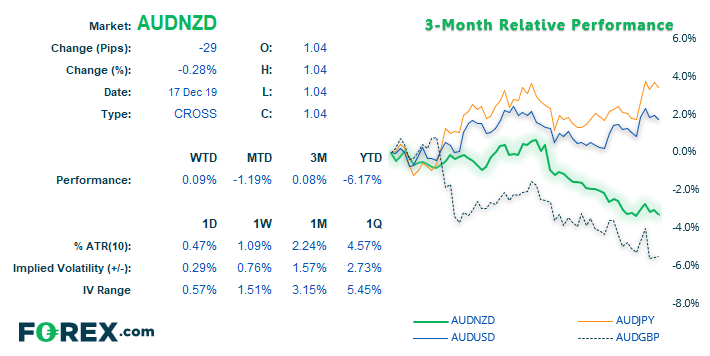
AUD/NZD has refused every opportunity to properly retrace. Yet despite heading into the back of the year as volatility dies down, there’s still potential for further downside as we head into January. Just today, business confidence and activity in NZ hit its highest level this year and RBNZ have all but said they won’t cut in February. Therefore, any signs of weaker data from Australia will surely weigh on AUD/NZD as part of the ideal divergent theme we require as FX traders.
- Bias remains bearish below 1.0488 / 1.0550 and a break below 1.0388 opens-up a run for the lows around 1.0300.
ASX200 traders in a narrow range just off its record high. It appears to be waiting for trade deal confirmation, as it was the weekend hype which saw it rally back into the highs yesterday. Yet we have seen the ASX roll over from current levels previously after printing three small hammers around ATH’s, so bulls are not out of the woods yet.
Like most (if not all) indices, December is generally a positive month for the ASX200, having posted positive averages returns over 50% of the time the past 5, 10, 15 and 30 years. Moreover, December closes higher 77.8% of the time these past 30 years in December, making it the most bullish month on average.
Yet at time of writing, the monthly candle has is currently forming a bearish pinbar whilst the daily struggles at the highs. With less than two weeks to go, it remains on a knife edge as to whether it can enjoy its Santas’s rally. But whilst it trades beneath the ATH, another bump could be expected (especially if trade deal takes another step back). Whereas a break above 6893.70 assumes further upside and a happier close for December.
Related Analysis:
RBA Hold Rates, Yet Could 'Ease' Their Way Into 2020
AU GDP Miss Undermines RBA’s ‘Gentle Turning Point’
We highlighted after their statement earlier this month that the RBA could ‘ease’ their way into 2020, and the release of today’s minutes reaffirms this view. Noting February as a key date for them to “reassess the economic outlook”, data heading into next year is of vital importance to establish if February will be a live meeting.
There’s a plethora of data between now and RBA’s February meeting we need to keep a close eye on, and it kicks off with employment data on Thursday. To wrap up December there’s also job ads, housing credit and PMI’s ahead of trade data, business sentiment, retail sales, consumer sentiment, employment and CPI in January. So, there is a lot that can swing the needle but, unless we see data miraculously pick-up, a cut in February is likely on the cards.
Yet curiously, the RBA still see lower rates as stimulatory to the economy, despite flagging low business loan demand, low appetite for risk and acknowledging that low rates are weighing on consumer confidence (and therefore, spending). Still, it’s not for me to argue with them, but I do need to decipher where they stand and the message is clear: We’ll ease if data doesn’t pick up.
Despite the negative feedback loop with low rates, RBA could lower still:
- Despite the accommodative funding conditions for large businesses, growth in business debt had slowed, suggesting that demand for finance had softened
- Households' expectations about future economic conditions had declined significantly since June
- The Australian economy appeared to have reached a gentle turning point
- Weak growth in household income continued to present a downside risk to consumer spending
- Low appetite for risk could be constraining businesses' willingness to invest
- Members also discussed community concerns about the effect of lower interest rates on confidence, noting the decline in business confidence and consumer sentiment this year
- While members recognised the negative confidence effects for some parts of the community arising from lower interest rates, they judged that the impact of these effects was unlikely to outweigh the stimulus to the economy from lower interest rates
- It would be important to reassess the economic outlook in February 2020, when the Bank would prepare updated forecasts
- The Board had the ability to provide further stimulus to the economy, if required.
- [The RBA is] prepared to ease monetary policy further if needed.
AUD/NZD has refused every opportunity to properly retrace. Yet despite heading into the back of the year as volatility dies down, there’s still potential for further downside as we head into January. Just today, business confidence and activity in NZ hit its highest level this year and RBNZ have all but said they won’t cut in February. Therefore, any signs of weaker data from Australia will surely weigh on AUD/NZD as part of the ideal divergent theme we require as FX traders.
- Bias remains bearish below 1.0488 / 1.0550 and a break below 1.0388 opens-up a run for the lows around 1.0300.
ASX200 traders in a narrow range just off its record high. It appears to be waiting for trade deal confirmation, as it was the weekend hype which saw it rally back into the highs yesterday. Yet we have seen the ASX roll over from current levels previously after printing three small hammers around ATH’s, so bulls are not out of the woods yet.
Like most (if not all) indices, December is generally a positive month for the ASX200, having posted positive averages returns over 50% of the time the past 5, 10, 15 and 30 years. Moreover, December closes higher 77.8% of the time these past 30 years in December, making it the most bullish month on average.
Yet at time of writing, the monthly candle has is currently forming a bearish pinbar whilst the daily struggles at the highs. With less than two weeks to go, it remains on a knife edge as to whether it can enjoy its Santas’s rally. But whilst it trades beneath the ATH, another bump could be expected (especially if trade deal takes another step back). Whereas a break above 6893.70 assumes further upside and a happier close for December.
Related Analysis:
RBA Hold Rates, Yet Could 'Ease' Their Way Into 2020
AU GDP Miss Undermines RBA’s ‘Gentle Turning Point’
Related tags:
Latest market news




Open an account in minutes
Experience award-winning platforms with fast and secure execution, and enjoy tight spreads from 0.5 pts on FX and 0.3 pts on indices.
Economic calendar
Web Trader platform
Our sophisticated web-based platform is packed with features.
Related articles
EUR/USD Q4 2026 Outlook: Euro at a Crossroads as Fed, ECB Tighten 9 25 2026
EUR/USD enters Q4 at a pivotal inflection point as competing Fed-ECB policy paths and persistent inflation risks collide with major technical support.

AUD/USD Q4 Outlook: RBA and Fed Hikes Set the Tone
AUD/USD enters Q4 with RBA and Fed hikes in focus as sticky inflation, rising unemployment and US dollar strength shape the Australian dollar.


USD/JPY Q4 2026 Outlook: Hawkish Fed Pricing Clashes With Intervention Risk
The year-end tug-of-war is clear: hawkish Fed pricing supports USD/JPY, while intervention risk limits the upside.

This report is intended for general circulation only. It should not be construed as a recommendation, or an offer (or solicitation of an offer) to buy or sell any financial products. The information provided does not take into account your specific investment objectives, financial situation or particular needs. Before you act on any recommendation that may be contained in this report, independent advice ought to be sought from a financial adviser regarding the suitability of the investment product, taking into account your specific investment objectives, financial situation or particular needs.
StoneX Financial Pte. Ltd., may distribute reports produced by its respective foreign entities or affiliates within the StoneX group of companies or third parties pursuant to an arrangement under Regulation 32C of the Financial Advisers Regulations. Where the report is distributed to a person in Singapore who is not an accredited investor, expert investor or an institutional investor (as defined in the Securities Futures Act), StoneX Financial Pte. Ltd. accepts legal responsibility to such persons for the contents of the report only to the extent required by law. Singapore recipients should contact StoneX Financial Pte. Ltd. at 6826 9988 for matters arising from, or in connection with the report.
In the case of all other recipients of this report, to the extent permitted by applicable laws and regulations neither StoneX Financial Pte. Ltd. nor its associated companies will be responsible or liable for any loss or damage incurred arising out of, or in connection with, any use of the information contained in this report and all such liability is hereby expressly disclaimed. No representation or warranty is made, express or implied, that the content of this report is complete or accurate.
StoneX Financial Pte. Ltd. is not under any obligation to update this report.
Trading CFDs carries a high level of risk that may not be suitable for some investors. Consider your investment objectives, level of experience, financial resources, risk appetite and other relevant circumstances carefully. The possibility exists that you could lose some or all of your investments, including your initial deposits. If in doubt, please seek independent expert advice. Visit www.forex.com/en-sg/terms-and-policies for the complete Risk Disclosure Statement.