





USD/JPY, Nikkei 225: Narrowing yield differentials with the US amplify downside risks
If you believe the Fed is done hiking rates and will be forced to ease policy aggressively next year, it’s hard to be bullish USD/JPY or the Nikkei 225 given the role yield differentials and FX fluctuations have played in underpinning both this year.
Share this:

- Markets are pricing more than 100 basis points of cuts from the Fed next year
- Bond markets have responded by sending yields sharply lower
- Narrowing yield differentials between the US and Japan could lead to downside for USD/JPY
- A stronger JPY may create headwinds for Japan’s Nikkei 225
If you believe the Federal Reserve is done hiking rates and will be forced to ease policy aggressively next year as a new US economic downturn begins, it’s hard to be bullish USD/JPY or the Nikkei 225 given the role yield differentials and FX fluctuations have played in underpinning both this year.
Base case scenario is no more Fed hikes, plenty of cuts next year, according to markets
The scenario detailed above is, except for uncertainty about the trajectory for the US economy, now the accepted base case scenario based on recent market movements. In the wake of the Federal Reserve’s November interest rates decision, softer ISM services and nonfarm payrolls reports, markets are pricing in over 100 basis points of cuts next year, nearly 50 basis points more than what was priced in following the Fed’s last meeting six weeks ago.
US yield curve sees unusually large bull flattening
With the short-end of the US interest rate curve moving lower rapidly, it’s combined with improved sentiment towards longer-dated bonds to send US yields five year and out cascading lower. From the cyclical highs, five-year yields have fallen 50 basis points. For benchmark 10-year debt, it’s over 46 basis points. 30-years are off 42 basis points. It’s been a massive move, only really seen in the past in times of extreme market turbulence.
That’s what make this move unusual; it’s not been caused by something breaking in financial markets or the real economy, at least not yet. It’s occurred when markets have been in a near euphoric mood as short covering helped fuel one of the largest weekly gains in risker assets in years.
While there may be grounds for near-term consolidation or a partial reversal of last week’s moves given how quickly the move occurred, at face value, evidence is building to suggest the highs for US yields may be in. It would be wrong to dismiss the move, arriving in a week that was laden with major risk events. It appears meaningful.
USD/JPY vulnerable to lower US yields
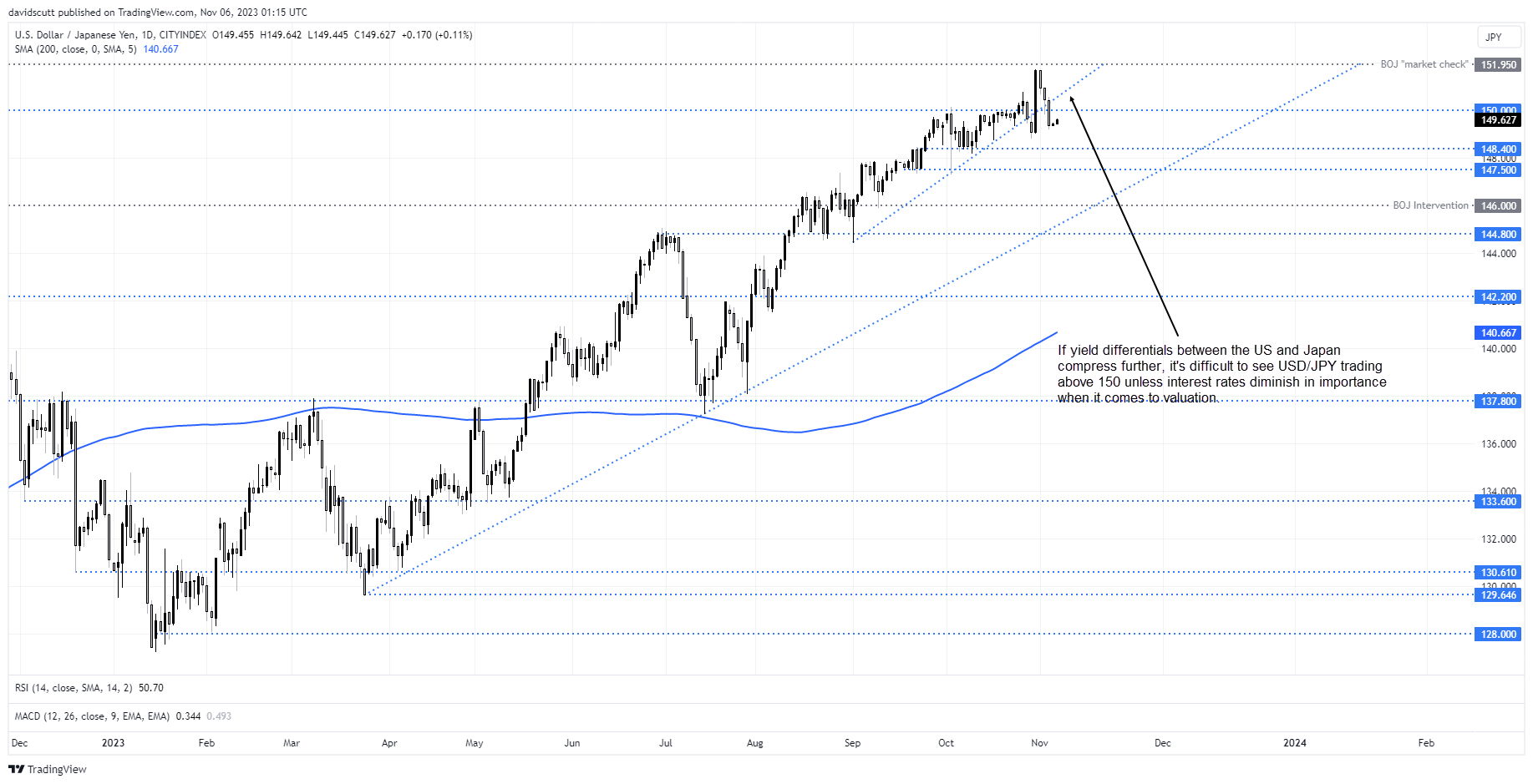
For a FX pair such as USD/JPY, beholden to shifts in rate differentials with the US, the implications may also be meaningful. Relative to where it was sitting in late October, the yield differential for 10-year debt has narrowed by around 50 basis points, leaving it levels last seen in late September. As seen in the daily chart below, USD/JPY was trading below 148 around then, not 149.60 where it trades today.
Source: Refinitiv
While there are numerous considerations that go into FX valuations, purely from a rate differentials perspective, risks appear to be building on the downside. And given the proximity to the recent highs, unless the drivers of USD/JPY switch away from interest rates, it’s not difficult to see the pair trading lower.
For those who expect yields will continue to dictate direction with differentials with the US likely to narrow further, you could consider initiating a short position below 150 with a stop loss order above for protection. Outside last week, the pair has had little success above the figure this cycle even when rate differentials meaningfully higher than what they are today. On the downside, the 50-day moving average looms as the first big technical test given it’s been respected on multiple occasions over the past few years. Below that, 148.50 and 147.50 are the next levels to watch with more meaningful support likely to kick in around 144.80.
Stronger JPY unlikely to help Nikkei 225
Should USD/JPY start to move lower, it would also lessen earnings tailwinds for Japanese exporters from the weaker yen, likely weighing on the Nikkei 225 given the mix of its constituents. Other risks are the potential for the US economy to experience a hard economic landing, creating an environment where demand for Japanese manufactured good would likely soften.
Looking at the Nikkei 225 daily, the bounce off the intersection of the 200-day moving average and 2021 double top support has been powerful, seeing the index punch through numerous resistance layers before stalling around 32640. The index has done a lot of work either side of this level, meaning what happens near-term may be influential for the longer-term trajectory.
Should the index fail to extend its rally, traders could initiate shorts with a stop placed between 32800 and 33,000, depending on the entry level. Former channel resistance just below 32400, 31700 and 31250 are the initial downside levels to watch.
-- Written by David Scutt
Follow David on Twitter @scutty
How to trade with City Index
You can trade with City Index by following these four easy steps:
- Open an account, or log in if you’re already a customer
• Open an account in the UK
• Open an account in Australia
• Open an account in Singapore
- Search for the market you want to trade in our award-winning platform
- Choose your position and size, and your stop and limit levels
- Place the trade
Latest market news




Open an account in minutes
Experience award-winning platforms with fast and secure execution, and enjoy tight spreads from 0.5 pts on FX and 0.3 pts on indices.
Economic calendar
Web Trader platform
Our sophisticated web-based platform is packed with features.
Related articles
USD/JPY Weekly Outlook: Payrolls loom as US rates remain the dominant driver
Strong US growth and hawkish Fed pricing continue to support USD/JPY, while intervention risk appears to be kicking in at lower levels

USD/JPY Q4 2026 Outlook: Hawkish Fed Pricing Clashes With Intervention Risk
The year-end tug-of-war is clear: hawkish Fed pricing supports USD/JPY, while intervention risk limits the upside.

Japanese Yen Forecast: USD/JPY 4% Rally Challenges Post-Intervention Downtrend 9 24 2026
USD/JPY momentum has shifted sharply higher, putting a major resistance confluence in focus as U.S. and Japanese event risk builds.

This report is intended for general circulation only. It should not be construed as a recommendation, or an offer (or solicitation of an offer) to buy or sell any financial products. The information provided does not take into account your specific investment objectives, financial situation or particular needs. Before you act on any recommendation that may be contained in this report, independent advice ought to be sought from a financial adviser regarding the suitability of the investment product, taking into account your specific investment objectives, financial situation or particular needs.
StoneX Financial Pte. Ltd., may distribute reports produced by its respective foreign entities or affiliates within the StoneX group of companies or third parties pursuant to an arrangement under Regulation 32C of the Financial Advisers Regulations. Where the report is distributed to a person in Singapore who is not an accredited investor, expert investor or an institutional investor (as defined in the Securities Futures Act), StoneX Financial Pte. Ltd. accepts legal responsibility to such persons for the contents of the report only to the extent required by law. Singapore recipients should contact StoneX Financial Pte. Ltd. at 6826 9988 for matters arising from, or in connection with the report.
In the case of all other recipients of this report, to the extent permitted by applicable laws and regulations neither StoneX Financial Pte. Ltd. nor its associated companies will be responsible or liable for any loss or damage incurred arising out of, or in connection with, any use of the information contained in this report and all such liability is hereby expressly disclaimed. No representation or warranty is made, express or implied, that the content of this report is complete or accurate.
StoneX Financial Pte. Ltd. is not under any obligation to update this report.
Trading CFDs carries a high level of risk that may not be suitable for some investors. Consider your investment objectives, level of experience, financial resources, risk appetite and other relevant circumstances carefully. The possibility exists that you could lose some or all of your investments, including your initial deposits. If in doubt, please seek independent expert advice. Visit www.forex.com/en-sg/terms-and-policies for the complete Risk Disclosure Statement.