



USD/JPY Outlook: The rules of intervention just changed
The USD/JPY playbook just changed. Early, pre-emptive and potentially coordinated intervention has lowered the bar for action, injecting political risk into a trade long dominated by yields and carry.
Share this:

- Intervention risk is no longer conditional on stress or volatility
- Political incentives generate downside risks
- Coordination risk makes fading yen strength dangerous
- Selling rallies beats buying dips until proven otherwise
Summary
Friday’s move marked a decisive shift in how intervention risk must be priced in USD/JPY. Authorities acted early, under calm conditions, and likely in coordination, signalling that tolerance for further yen weakness has materially declined. With Japan facing an election, US incentives tilting towards a softer dollar, and traditional drivers losing influence, the asymmetry has flipped. Until there is clear evidence this episode is over, selling rallies is preferred.
The game has changed
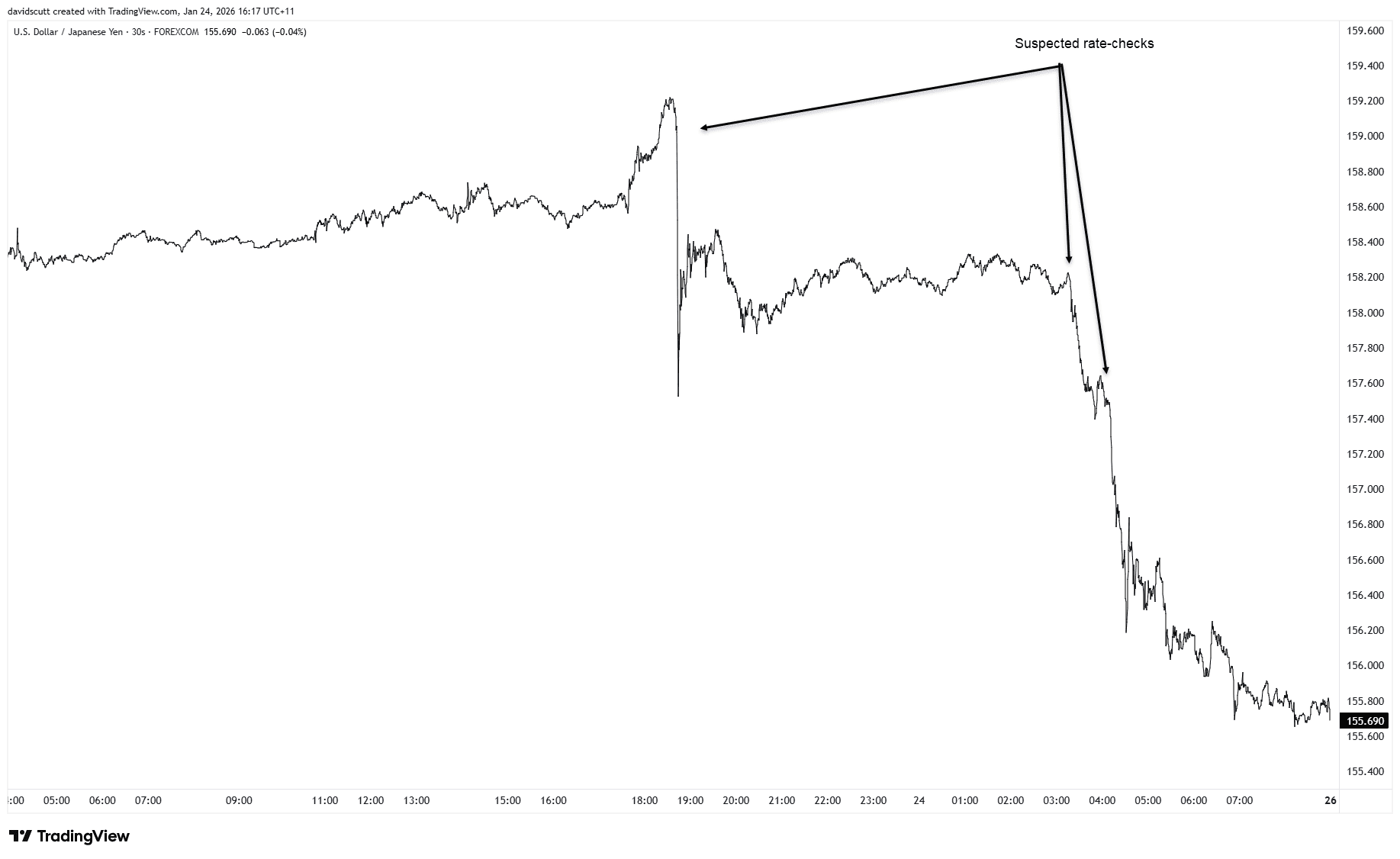
The game changed for USD/JPY on Friday, because the rules around intervention appear to have shifted in a way that works politically for both Japan and the United States. Support for the yen now looks coordinated and pre-emptive rather than reactive and unilateral, likely delivered through market signalling rather than the use of currency reserves, and deployed despite relatively calm conditions rather than in response to stress.
From Japan’s perspective, the incentives are clear. Yen weakness has become a political issue, not just a market outcome, feeding directly into higher food and import prices at a time when voters are already under pressure. With a lower house election scheduled for early February, tolerance for further yen depreciation looks increasingly limited. Acting early through the FX channel allows the Ministry of Finance to show resolve without forcing the Bank of Japan into more aggressive rate hikes, something Prime Minister Takaichi has been openly sceptical of in the past. Stabilising the yen via signalling rather than monetary tightening is the least disruptive option available, both economically and politically.
Source: TradingView
The mechanics of Friday’s move support that interpretation. The price action bore all the hallmarks of a rate check rather than outright intervention, a familiar tool used to send a message without deploying reserves. That this occurred below previous intervention levels and without a volatility spike points to a deliberate effort to shape behaviour rather than defend a specific level. In other words, this was about changing expectations, not fighting momentum.
What elevates this episode beyond a familiar Tokyo warning shot is the apparent US dimension. Speculation that the New York Fed may also have conducted rate checks introduces the possibility that Washington is at least tolerant of yen strength. That would not be incidental. A softer dollar against major Asian currencies aligns with broader US objectives around competitiveness at a time when higher long-end yields are tightening financial conditions and limiting the effectiveness of policy via rates. This is entirely speculative, but the absence of resistance can be as powerful as explicit endorsement.
The near-term risk is whether Friday stands alone or is reinforced. Early Asia on Monday, particularly with Australian markets closed for a public holiday, will see thinner liquidity. That creates a tempting window for follow-up rate checks or even outright intervention should authorities wish to push the message further without expending significant firepower.
The implication is that USD/JPY can no longer be treated as a one-way expression of yield differentials and carry. The political incentives are obvious, the threshold for action appears lower, and the risk of coordination higher, materially changing the payoff for those still leaning on yen weakness as a default trade.
The Fed succession wildcard
Friday may not have been the only potential game changer for USD/JPY, with growing focus on who may become the next Federal Reserve chair adding another potential headwind for the dollar.
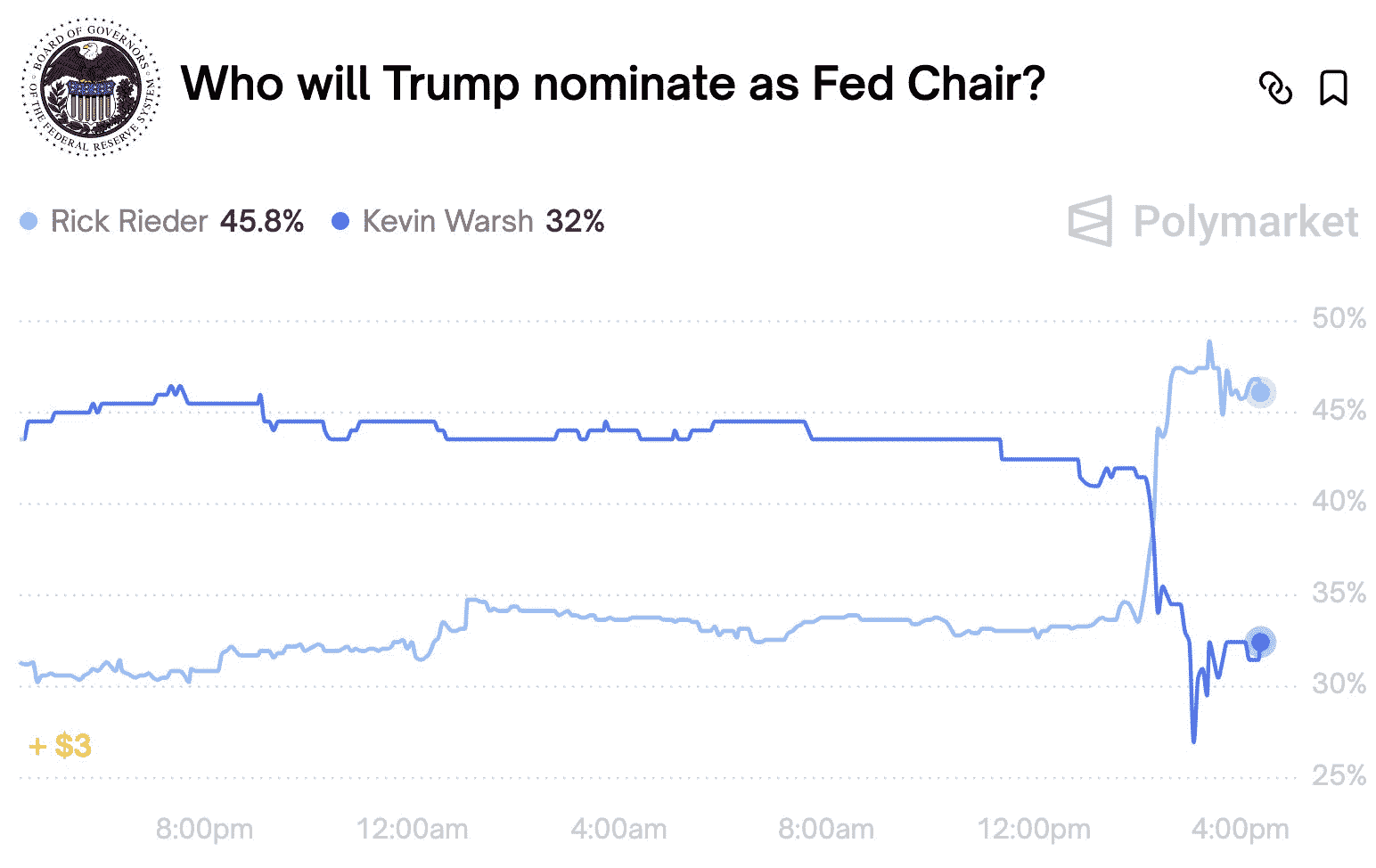
Pricing on Polymarket shows Rick Rieder moving sharply into the lead, with implied odds near 46%, overtaking Kevin Warsh at around 32%. Up until Friday, Warsh had been the clear favourite, making the speed of the shift notable.
Source: Polymarket, X
Rieder is widely viewed as the most market-friendly candidate among the leading contenders. He has extensive experience operating inside financial markets as a managing director at BlackRock, rather than coming from an academic or policy background. That matters for perception. Markets tend to assume a chair with deep markets experience would be more inclined to favour easier financial conditions, be quicker to respond to stress, and lean more dovish at the margin than alternatives with a more traditional central banking mindset.
There is also a political dimension. Donald Trump has repeatedly framed economic success through the performance of financial markets, particularly equities. A chair perceived as pragmatic and responsive to market conditions would sit comfortably within that framework.

Source: TradingView
Despite rampant speculation, this has not yet translated into a major repricing of rate expectations. Fed funds futures still imply only around 44.5bp of cuts this year, up marginally from roughly 41bp before the leadership odds flipped. That suggests this is about expectations for the future reaction function rather than imminent easing, but even so, it adds to downside risks for the dollar.
What used to matter, matters less

Source: TradingView
The correlation analysis above helps frame what had been driving USD/JPY before last week, and why those relationships are now starting to lose relevance. In the left-hand pane, USD/JPY in blue is overlaid against the shape of Japan’s 2s10s curve in black, while the middle and right-hand panes show rolling 10-day and 60-day correlations respectively, capturing relationships over the past fortnight and quarter.
Until recently, Japanese factors were doing most of the heavy lifting. USD/JPY had been strongly linked to the shape of Japan’s yield curve, reflecting how expectations around domestic reflation and fiscal policy under the new government were feeding directly into the currency. Over the past quarter, the correlation between USD/JPY and Japan's 2s10s curve sat at 0.82, strong evidence this had become a largely Japan-driven trade.
That relationship, however, has weakened noticeably over shorter horizons. The rolling 10-day correlation has rolled over sharply, suggesting the link between curve shape and USD/JPY price action may be breaking down.
What is equally striking is what has not mattered for USD/JPY. Across both timeframes, correlations with risk appetite, proxied by S&P 500 and VIX futures, have been largely non-existent. The same is true for US-Japan yield differentials and outright US yields. This had been a Japanese story, but after Friday, even that anchor is starting to shift.
Events now play second fiddle
After the events of late last week, the importance of scheduled data and policy events has dropped a notch or three. That does not make them irrelevant, but it does mean they are less likely to dictate direction.

Source: TradingView (U.S. ET)
In the US, the key focus is the Federal Reserve’s rate decision on Wednesday afternoon. With no updated projections and virtually no chance of a move priced, the meeting itself may not generate outsized volatility. Instead, the market’s reaction will hinge on the wording of the statement and the tone struck by Jerome Powell, particularly whether he retains a dovish stance towards the labour market.
Elsewhere, US producer price data on Friday will help shape expectations for the Fed’s preferred underlying inflation gauge, the PCE deflator for December. Weekly jobless claims on Thursday also warrant caution, with the Martin Luther King Jr public holiday likely to distort the signal. Consumer confidence data on Tuesday, along with auctions of two, five and seven-year Treasury notes, round out a busy but largely secondary US calendar.
Source: TradingView (U.S. ET)
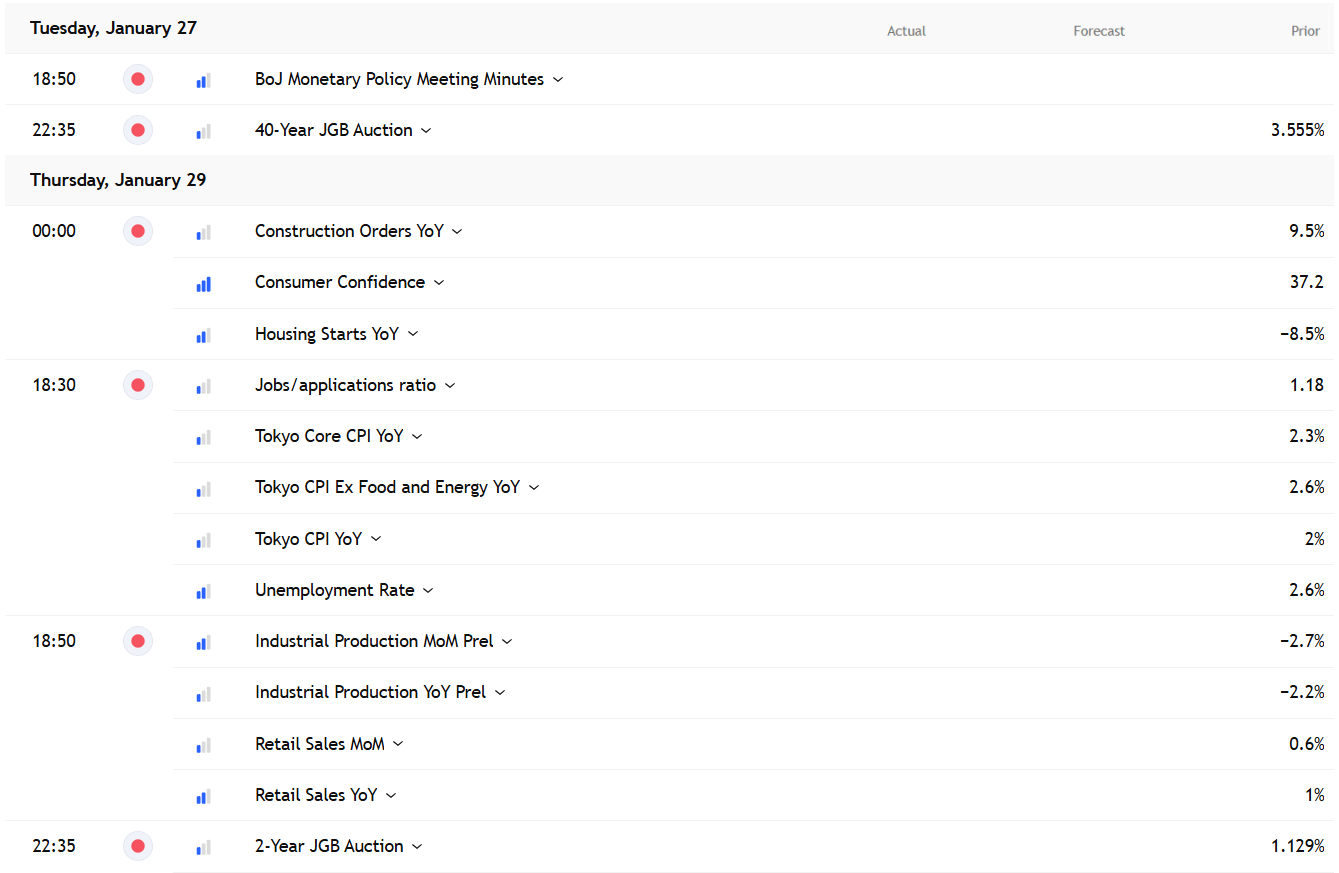
In Japan, attention turns to a 40-year JGB auction on Wednesday. Given last week’s wild moves in long-dated yields, the result matters for the yen, with a strong outcome likely supportive with a weak result likely to weigh. Tokyo CPI on Friday is the other key risk event, with core and core-core measures the focus, especially with another BOJ rate hike essentially fully priced by June.
Technical damage confirmed
Source: TradingView
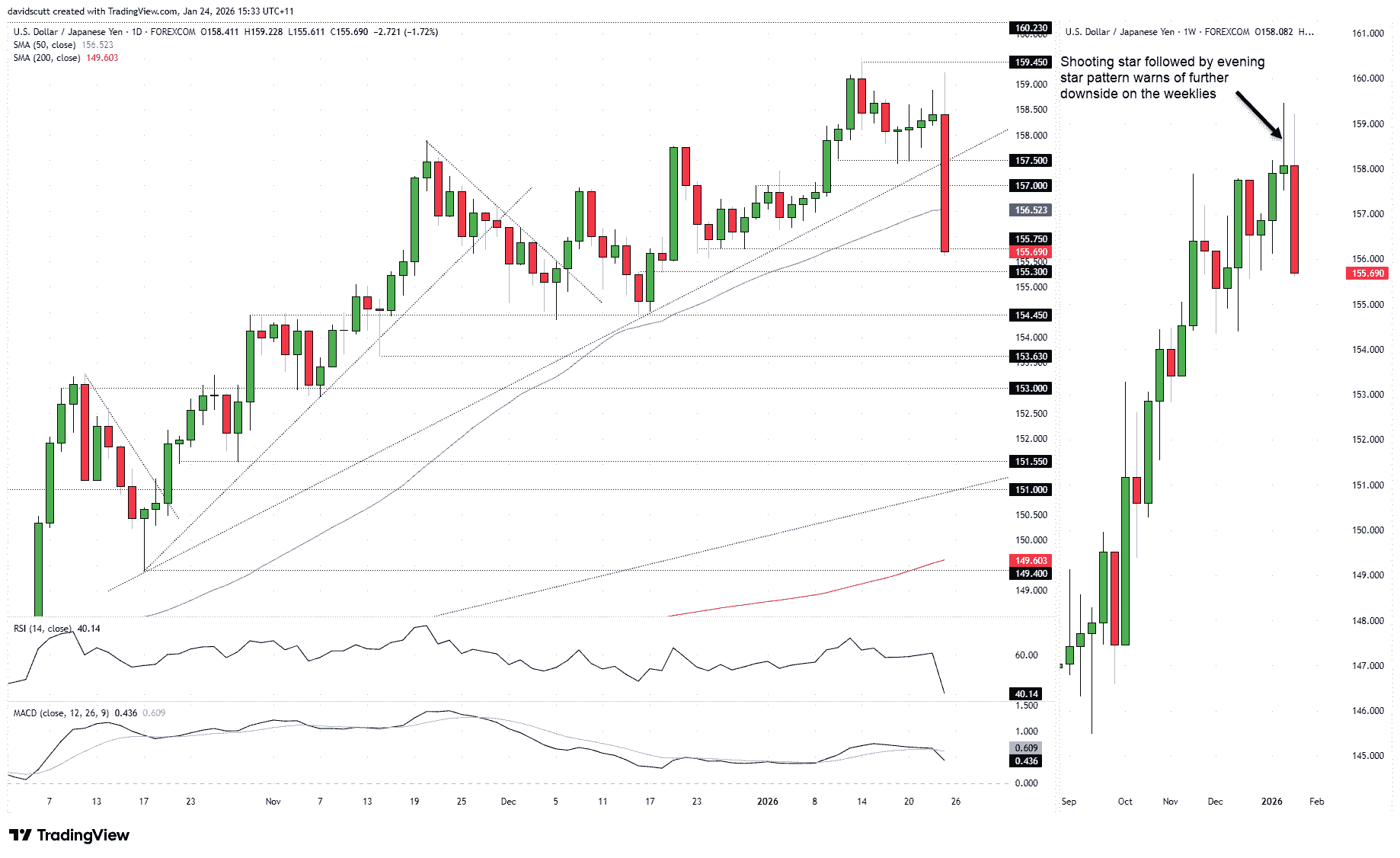
As you would expect, Friday delivered meaningful technical damage to USD/JPY, seeing it slice through horizontal supports at 157.50 and 157.00, the October uptrend, along with the 50DMA. The move eventually stalled around 155.75, a level the pair bounced from on several occasions late last year. Those are the levels of note on the upside should we see some form of bounce over the coming days. But if suspected rate checks were only the entrée to the main event, it could be a while before they’re seen again. That would also make downside levels largely irrelevant, especially if outright intervention is involved. For now, 155.30 is a minor level ahead of more pronounced support at 154.45 and 153.00, with 153.63 another minor level wedged in between.
Even though far less weight should be placed on the indicators in this environment, RSI (14) and MACD have shifted rapidly on the daily. The former has slipped below 50 and is pushing lower, while the latter has crossed its signal line from above but remains in positive territory for now. It’s not an outright bearish message, but that is clearly the direction of travel.
More ominously, the prior week’s shooting star was followed last week by the completion of an evening star bearish reversal pattern, warning of further downside risk. When you’re going up against the Fed and the BoJ, I tend to agree. The game has changed. Selling rallies is now the preferred strategy until there is clear evidence the intervention episode is over.

Open an account in minutes
Experience award-winning platforms with fast and secure execution, and enjoy tight spreads from 0.5 pts on FX and 0.3 pts on indices.
Economic calendar
Web Trader platform
Our sophisticated web-based platform is packed with features.
Related articles
GBP/USD, DJIA Outlook: Support Levels Meet Oversold Risks
GBP/USD and the Dow test key support levels as rising Treasury yields, Fed rate-hike expectations and oversold momentum increase reversal risks.

Oil, USD/JPY Forecast: Two trades to watch
Oil recovers above $90 amid a lack of progress in US-Iran diplomacy. USD/JPY rises to 158 on widening Fed-BoJ policy outlook.


USD/JPY outlook: Hawkish Fed recalibration pressures the yen
Stronger US growth momentum and rising Treasury yields are keeping USD/JPY pointed higher, even as Japanese policymakers try to limit the pressure building across domestic markets.
This report is intended for general circulation only. It should not be construed as a recommendation, or an offer (or solicitation of an offer) to buy or sell any financial products. The information provided does not take into account your specific investment objectives, financial situation or particular needs. Before you act on any recommendation that may be contained in this report, independent advice ought to be sought from a financial adviser regarding the suitability of the investment product, taking into account your specific investment objectives, financial situation or particular needs.
StoneX Financial Pte. Ltd., may distribute reports produced by its respective foreign entities or affiliates within the StoneX group of companies or third parties pursuant to an arrangement under Regulation 32C of the Financial Advisers Regulations. Where the report is distributed to a person in Singapore who is not an accredited investor, expert investor or an institutional investor (as defined in the Securities Futures Act), StoneX Financial Pte. Ltd. accepts legal responsibility to such persons for the contents of the report only to the extent required by law. Singapore recipients should contact StoneX Financial Pte. Ltd. at 6826 9988 for matters arising from, or in connection with the report.
In the case of all other recipients of this report, to the extent permitted by applicable laws and regulations neither StoneX Financial Pte. Ltd. nor its associated companies will be responsible or liable for any loss or damage incurred arising out of, or in connection with, any use of the information contained in this report and all such liability is hereby expressly disclaimed. No representation or warranty is made, express or implied, that the content of this report is complete or accurate.
StoneX Financial Pte. Ltd. is not under any obligation to update this report.
Trading CFDs carries a high level of risk that may not be suitable for some investors. Consider your investment objectives, level of experience, financial resources, risk appetite and other relevant circumstances carefully. The possibility exists that you could lose some or all of your investments, including your initial deposits. If in doubt, please seek independent expert advice. Visit www.forex.com/en-sg/terms-and-policies for the complete Risk Disclosure Statement.