



USD/CAD Forecast: Canadian dollar shows indecision ahead of employment data
Since the final days of June, the Canadian dollar has been unable to build relevant strength against the U.S. dollar. Now, average USD/CAD movements remain close to 0.2% in the short term, showing a neutral bias that has become evident again in the behavior of both currencies.
Share this:

Since the final days of June, the Canadian dollar has been unable to build relevant strength against the U.S. dollar. Now, average USD/CAD movements remain close to 0.2% in the short term, showing a neutral bias that has become evident again in the behavior of both currencies.
For now, CAD has not managed to regain confidence ahead of the employment data release. An additional slowdown in this indicator could keep the Bank of Canada on a neutral policy path, limiting the support from higher rates and making it harder for the Canadian dollar to regain appeal in the short term.
In addition, new updates around the conflict in the Middle East could be key for USD strength. Together, these events could continue to highlight a phase of indecision, or even relevant buying pressure, around USD/CAD over the next few sessions.


What to expect from employment in Canada?
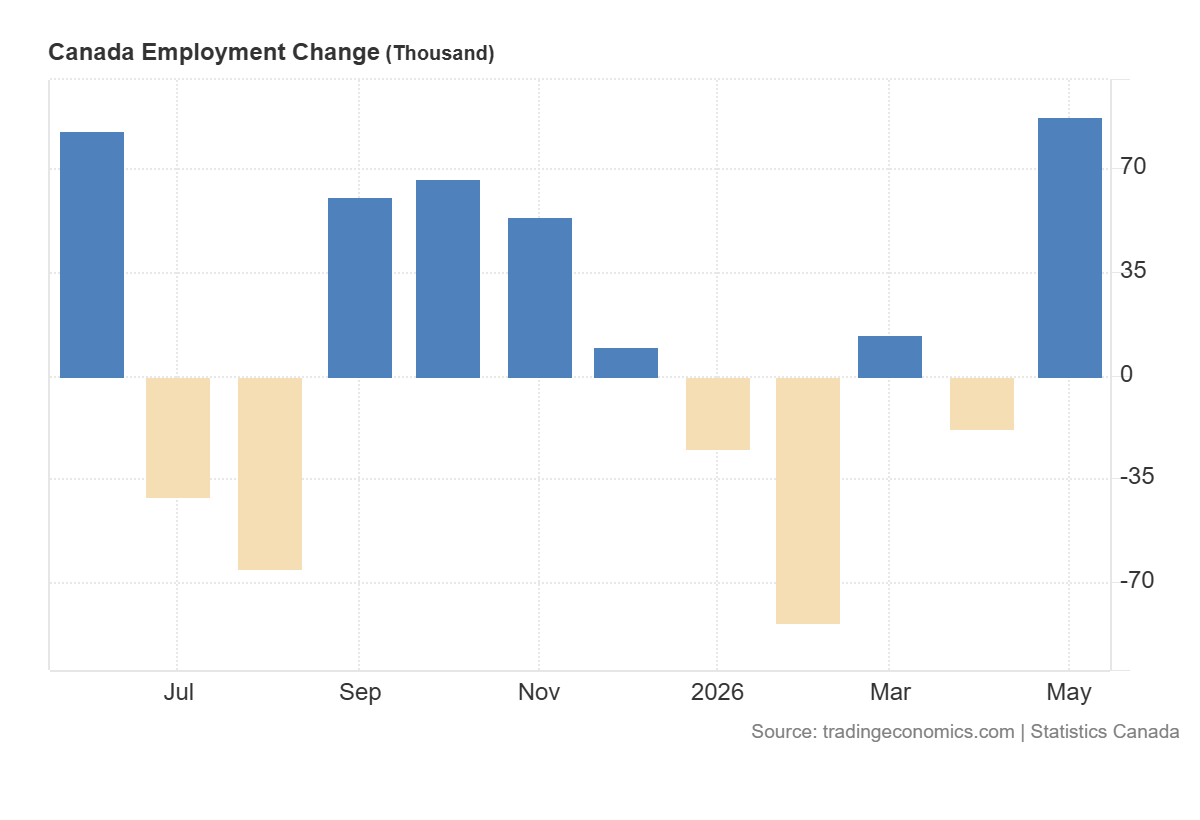
Tomorrow’s session is expected to bring the release of Canada’s employment change data. So far, expectations point to a significant decline from the previous reading, with the creation of around 11.2 thousand jobs in June. This figure would come in well below the May reading, which stood near 87.8 thousand jobs created.
Looking at the broader behavior of employment in Canada over the last few months, the data shows a mixed dynamic, with consistent signs of weakness. May was the only month that managed to post a solid figure, but overall, employment data has shown fragility. This trend could be confirmed with tomorrow’s release, especially if the result comes in below expectations, as it would reaffirm a relevant labor market problem in Canada compared to other countries where the slowdown is not as significant.
Source: TradingEconomics
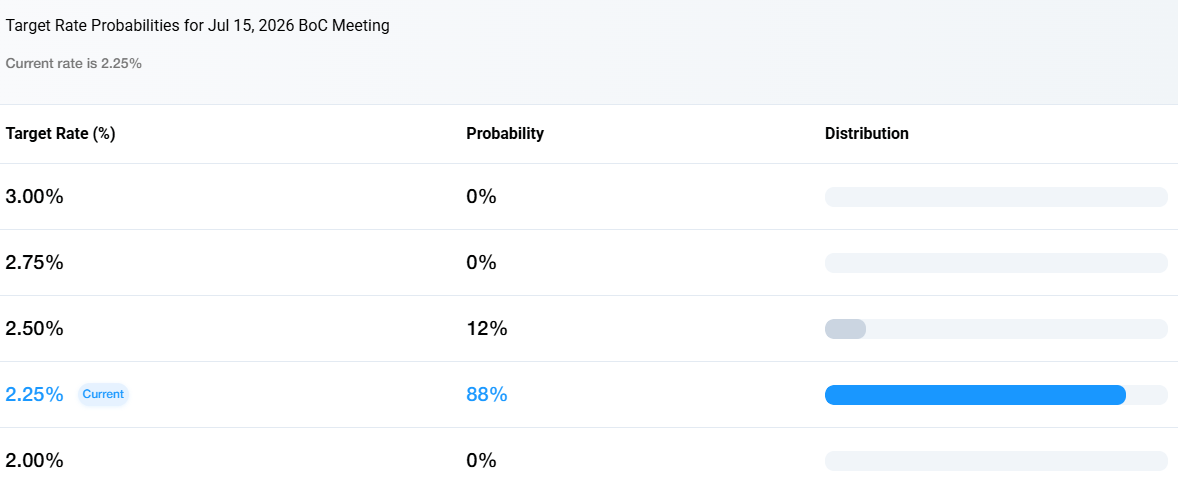
This outlook could be relevant for the Bank of Canada, as weaker employment, or even a reading below expectations, could reduce the need to raise the interest rate, which currently remains around 2.25%. This could lead the central bank to maintain a wait-and-see stance before considering meaningful changes to monetary policy.
In fact, so far, the probability table shows an 88% chance that the interest rate will remain unchanged at the July 15 decision. For the September decision, a probability above 70% has also started to emerge that this dynamic will persist.
Source: Bankofcanadaodds
The employment data release is key. If the report confirms a sharper-than-expected slowdown, expectations for a neutral monetary policy stance from the Bank of Canada could be reinforced over the coming months.
This would limit the appeal of rates in Canada, especially compared to a Federal Reserve that is still approaching scenarios of potential rate hikes. In this context, the differential against the 3.75% rate in the United States could continue to favor USD-denominated investments over those denominated in CAD.
For this reason, a significant decline in employment change could maintain a phase of indecision or even relevant buying pressure in USD/CAD over the next few sessions.
Does the Middle East matter?
Another important event to consider is the situation in the Middle East. The latest updates have shown that the United States would be willing to sit down for negotiations, while Trump’s comments continue to point toward maintaining a diplomatic path.
However, an environment of confusion has developed, as during the last 2 sessions a new escalation of the conflict seemed inevitable amid fresh attacks. This has increased doubts over whether a potential peace agreement can take place in the short term.
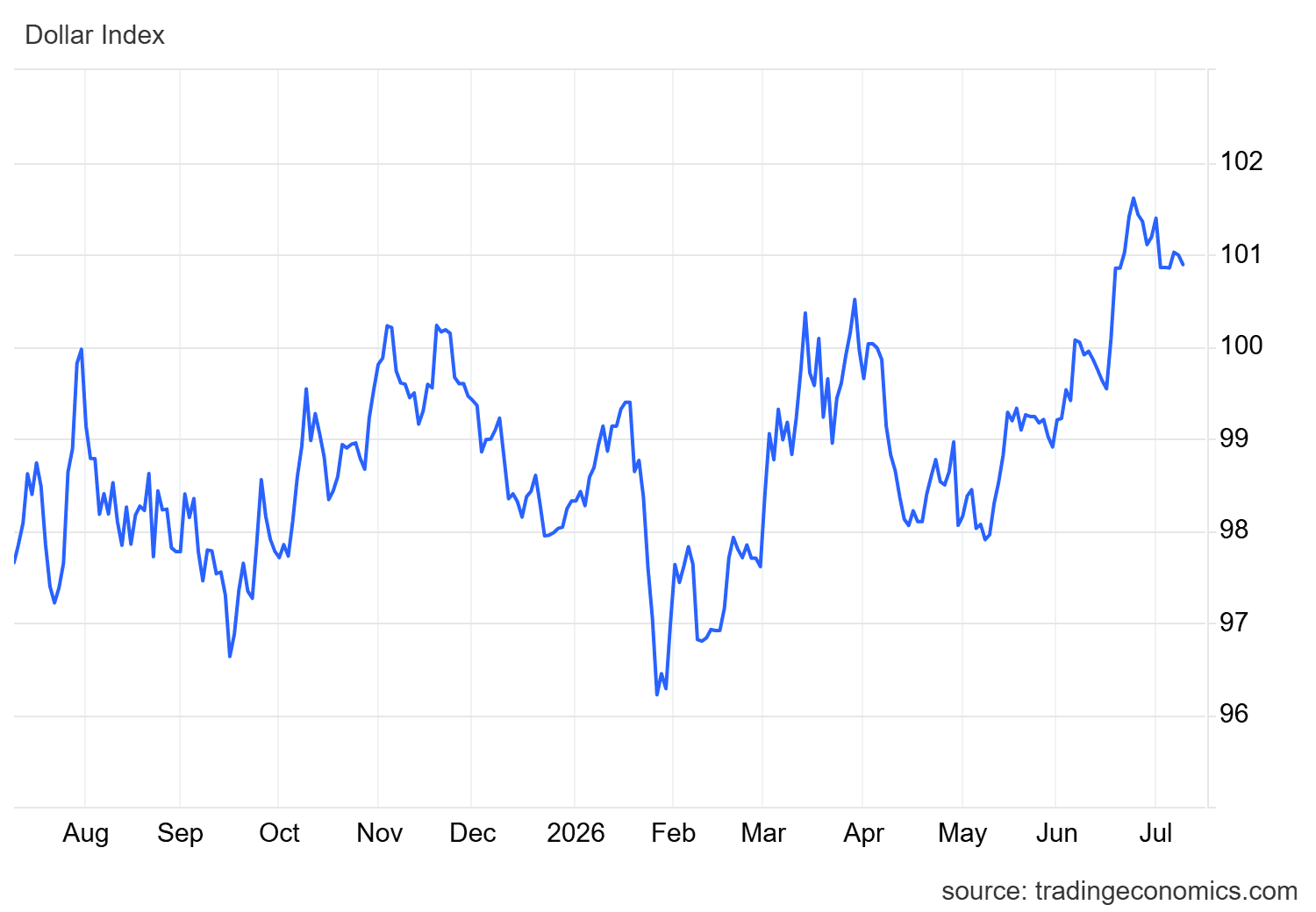
In this scenario, the behavior of the U.S. dollar is key. The DXY index, which measures the dollar’s strength, showed a relevant increase above the 101-point area in previous sessions as new attacks returned. During the latest session, however, it weakened again amid the relative calm generated by additional comments from the United States.
Source: TradingEconomics
This point is important because, for months, the dollar has been considered a liquidity safe-haven currency during repeated escalations of the conflict. This could become relevant again if no concrete negotiations are seen in the short term.
In that scenario, additional safe-haven demand for the U.S. dollar could appear, making it harder for the Canadian dollar to recover ground in the short term. This could also open the door to relevant buying pressure around USD/CAD over the next few sessions.
Technical outlook for USD/CAD
Source: StoneX, Tradingview
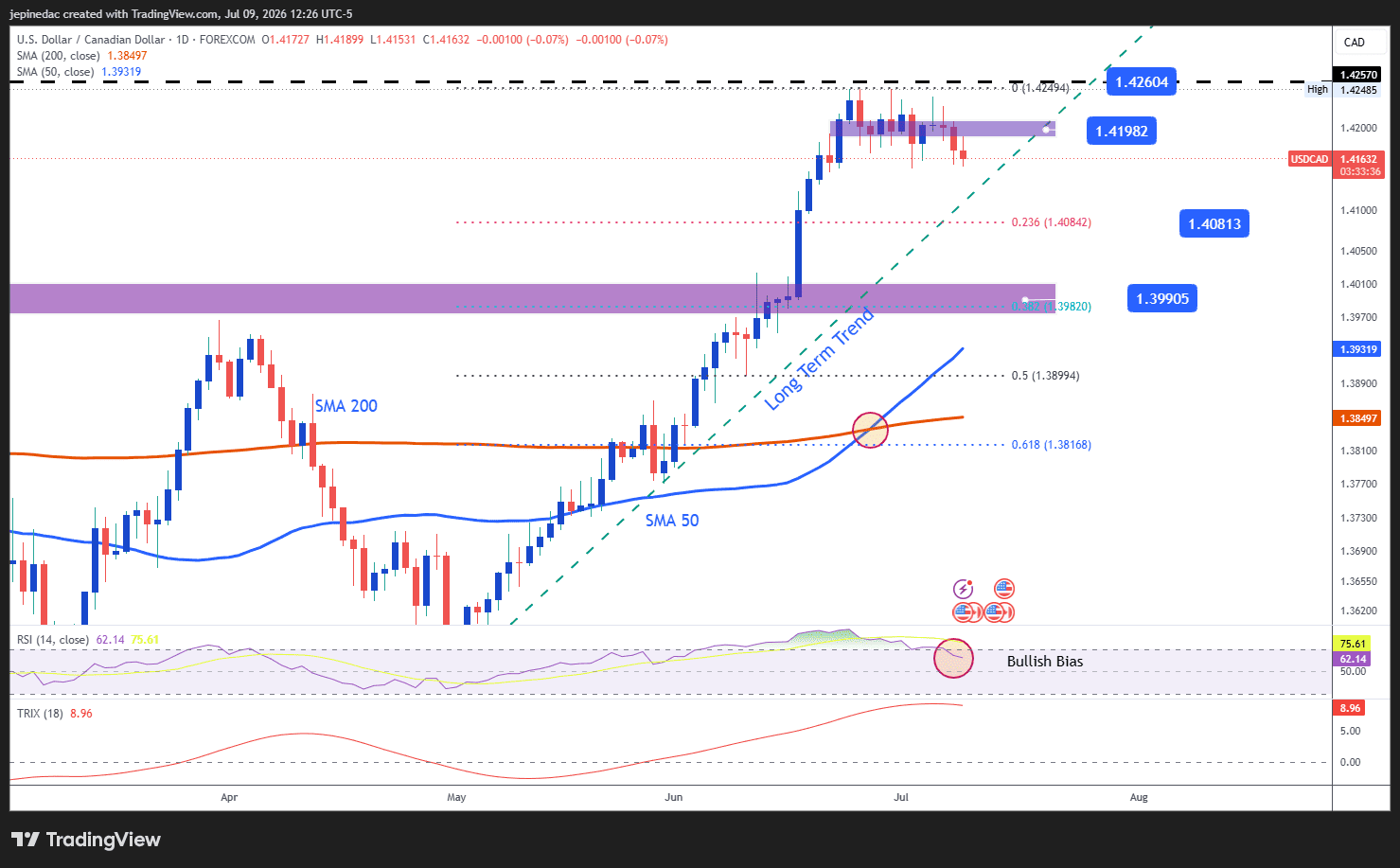
- Bullish trend continues to dominate: Since the first days of May, USD/CAD has maintained a relevant bullish trend line. This structure has marked an important buying bias, also reinforced by the bullish crossover of the 50-period moving average above the 200-period moving average, signaling a shift from a bearish structure to a more relevant bullish structure. For now, there is no bearish correction strong enough to put this technical pattern at risk, which is why it remains the most important structure to watch and could continue to dominate movements over the next few sessions.
- RSI: The RSI remains above the 50 level, suggesting that buying momentum has remained relevant over the last 14 sessions. If the indicator continues to hold above the neutral area, this could continue to reflect an important buying bias over the next few sessions.
- TRIX: The TRIX line maintains a bullish slope above its neutral zone, reinforcing the presence of buying strength in long-term exponential moving averages and highlighting the importance of a broad buying bias. However, the curve has also started to flatten steadily, which may be signaling exhaustion in buying strength. This could reflect a relevant phase of indecision over the next few sessions or a possible pause in the buying bias seen in previous weeks.
Key levels:
- 1.42604 – Relevant resistance: This important high has not been seen consistently since April 2025 and represents the main short-term bullish barrier. Moves toward this zone would reinforce the current buying bias and could open room for an extension of the bullish trend line over the next few sessions.
- 1.41982 – Near-term barrier: This is the most relevant neutral and retracement zone from recent trading sessions. Price movements too close to this level could highlight consistent neutrality and even open room for a possible short-term sideways range.
- 1.40813 – Crucial support: This bearish barrier coincides with the area marked by the 23.6% Fibonacci level. Price movements that begin to approach this level could end the bullish trend line and open room for a more dominant selling bias over the coming trading weeks.
Written by Julian Pineda, CFA, CMT – Market Analyst
Follow him on: @julianpineda25


Open an account in minutes
Experience award-winning platforms with fast and secure execution, and enjoy tight spreads from 0.5 pts on FX and 0.3 pts on indices.
Economic calendar
Web Trader platform
Our sophisticated web-based platform is packed with features.
Related articles

AUD/USD hammered by US yields and fading RBA hike bets
US yields, dollar strength and fading RBA hike bets have combined to drive AUD/USD to fresh multi-month lows. The macro and technical bias remains bearish, although history suggests parts of the move are now reaching unusually stretched levels.

Japanese Yen Outlook: USD/JPY, GBP/JPY, AUD/JPY Setups
USD/JPY and GBP/JPY show signs of stabilising, while AUD/JPY remains vulnerable as yen crosses deliver mixed technical signals.


EUR/USD Forecast: Euro Struggles to Find Support Even After U.S. PCE Data
The euro continues to face a challenging environment in the short term. The currency has struggled to regain ground against a U.S. dollar that remains firmly supported, a dynamic reflected in EUR/USD, which has now recorded three consecutive losing sessions and a decline of roughly 0.6%.
This report is intended for general circulation only. It should not be construed as a recommendation, or an offer (or solicitation of an offer) to buy or sell any financial products. The information provided does not take into account your specific investment objectives, financial situation or particular needs. Before you act on any recommendation that may be contained in this report, independent advice ought to be sought from a financial adviser regarding the suitability of the investment product, taking into account your specific investment objectives, financial situation or particular needs.
StoneX Financial Pte. Ltd., may distribute reports produced by its respective foreign entities or affiliates within the StoneX group of companies or third parties pursuant to an arrangement under Regulation 32C of the Financial Advisers Regulations. Where the report is distributed to a person in Singapore who is not an accredited investor, expert investor or an institutional investor (as defined in the Securities Futures Act), StoneX Financial Pte. Ltd. accepts legal responsibility to such persons for the contents of the report only to the extent required by law. Singapore recipients should contact StoneX Financial Pte. Ltd. at 6826 9988 for matters arising from, or in connection with the report.
In the case of all other recipients of this report, to the extent permitted by applicable laws and regulations neither StoneX Financial Pte. Ltd. nor its associated companies will be responsible or liable for any loss or damage incurred arising out of, or in connection with, any use of the information contained in this report and all such liability is hereby expressly disclaimed. No representation or warranty is made, express or implied, that the content of this report is complete or accurate.
StoneX Financial Pte. Ltd. is not under any obligation to update this report.
Trading CFDs carries a high level of risk that may not be suitable for some investors. Consider your investment objectives, level of experience, financial resources, risk appetite and other relevant circumstances carefully. The possibility exists that you could lose some or all of your investments, including your initial deposits. If in doubt, please seek independent expert advice. Visit www.forex.com/en-sg/terms-and-policies for the complete Risk Disclosure Statement.