The Australian dollar reclaimed 70c last week, despite asset managers and large speculators increasing their record gross-short exposure. And with AUD/USD bouncing from a potential head-and-shoulders neckline, it raises the question of whether bearish sentiment has reached an extreme. Australian Q3 CPI and the Fed's interest rate decision now provide two major catalysts that could either fuel a short squeeze or bring bears back into control.
View related analysis:
- Japanese Yen Surges Across FX Majors as Risk Aversion Intensifies
- NZD/CAD Ponders Swing Low Ahead of BoC, RBNZ as Hike Bets Firm
- AUD/USD Bears Denied a Big, Bearish Breakout via Hawkish RBA, Weak USD
- AUD/USD: Are Record Short Bets a Breakout Signal or Sentiment Extreme?
AUD/USD Rebounds Despite Record Bearish Bets Ahead of CPI and Fed
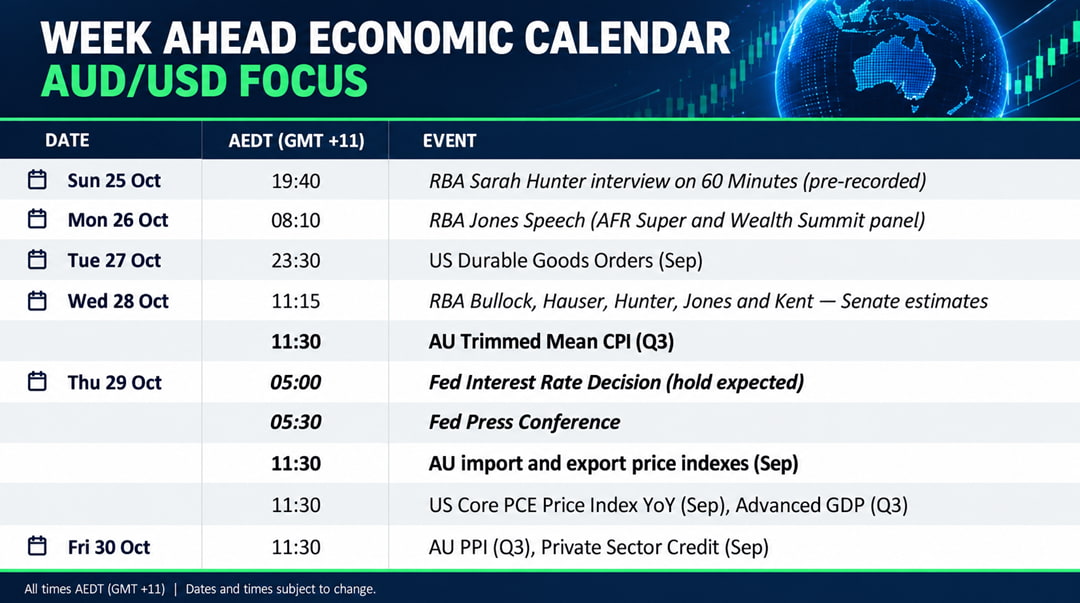
Australian Q3 CPI Could Bring Forward RBA Rate Hike Expectations
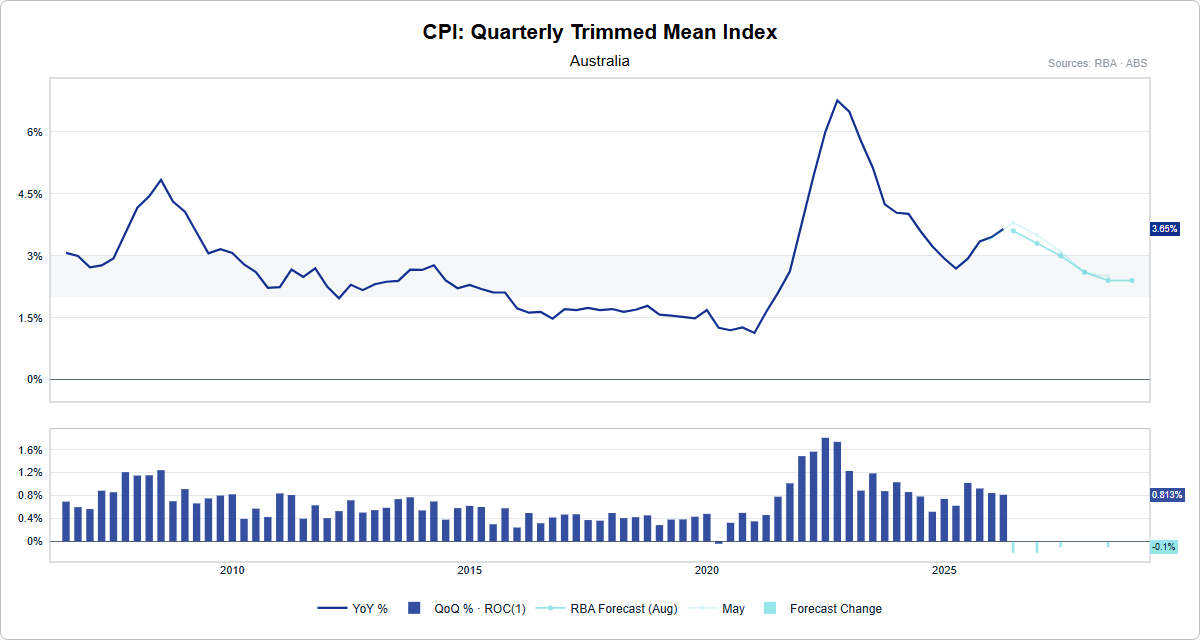
Australian Q3 CPI is arguably the biggest domestic event of the week, particularly with the RBA meeting again on 3 November. Annual inflation reached 4% in August, while trimmed mean remained elevated at 3.6%. Westpac expects quarterly headline CPI to rise 1.3% q/q and trimmed mean by 0.9%. The latter will be particularly important, as the RBA will want to establish whether inflationary pressures are broadening beyond higher energy costs. A hot print could bring a November hike firmly into play and support AUD/USD, although weaker employment data complicates the decision. A softer trimmed mean could see those expectations pushed back towards December.
RBA Officials Face Senate Estimates Ahead of CPI
RBA commentary also deserves attention following Deputy Governor Hauser's warning that the inflation outlook has become "materially worse" than anticipated in August. Governor Bullock and several senior officials face Senate estimates on Wednesday, shortly before CPI is released. With unemployment having risen to 4.7%, traders will be listening for how the RBA balances growing inflation risks against signs that its previous hikes are slowing the economy. Sarah Hunter's pre-recorded interview on Sunday and Brad Jones' appearance on Monday provide additional opportunities for RBA headlines.
Australian Import Prices and PPI Offer Further Inflation Clues
Australian import and export price indexes are also released on Thursday. Import prices will be worth watching for signs that higher energy and manufacturing costs are feeding into domestic inflation, while export prices could provide some insight into Australia's terms of trade. Friday's PPI figures should offer further clues about upstream inflationary pressures, although both releases are likely to play second fiddle to CPI and the Fed.
This content was created by an affiliate of FOREX.com and represents the views and opinions of the author/speakers, not the views and opinions of FOREX.com, StoneX Group Inc., or its subsidiaries. The content has not been independently reviewed by FOREX.com.
Fed Rate Decision and US Inflation Data in Focus
The Fed is widely expected to hold rates at 3.75–4% on Wednesday, having hiked by 25bp in September. With another hike widely anticipated in December, the focus will be on Chair Warsh's press conference and whether the Fed signals further tightening is necessary to contain inflation. A hawkish Fed could support US yields and the dollar, potentially weighing on AUD/USD even if Australian CPI exceeds expectations. US Q3 GDP and September's core PCE inflation follow on Thursday, providing another potential catalyst for the dollar and an opportunity for traders to reassess the Fed's December outlook.
The FOMC blackout ends Thursday, with San Francisco Fed President Mary Daly and St Louis Fed President Alberto Musalem reportedly scheduled to speak Friday. Also note that October's Fed meeting does not include new dot-plot projections.

AUD/USD Technical Analysis: Australian Dollar vs US Dollar
AUD/USD Correlations
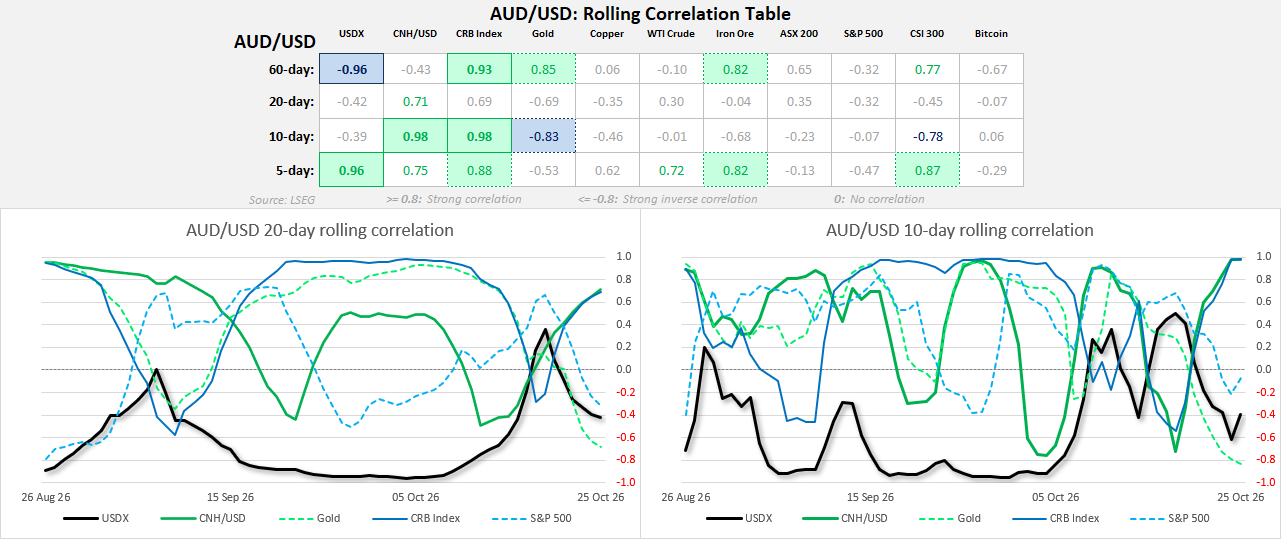
- US dollar relationship flips: AUD/USD's 5-day correlation with DXY has surged to +0.96, despite a strong inverse correlation of -0.96 over 60 days. This unusual divergence suggests the dollar may be a less reliable short-term guide for AUD/USD.
- Yuan remains influential: AUD/USD retains a strong positive correlation with CNH/USD over 10 days (+0.98) and 20 days (+0.71). Yuan strength could therefore provide further support for the Aussie.
- Commodities remain supportive: The CRB index has a strong positive correlation over 5 and 10 days (+0.88 and +0.98), while iron ore and crude oil have also turned positively correlated over the past week.
- Gold has diverged: The 10-day correlation sits at -0.83, despite a positive 60-day relationship of +0.85. Gold's recent performance is therefore offering little confirmation for AUD/USD bulls.
- Equity markets provide mixed signals: Correlations with the S&P 500 remain weak or negative across all periods, suggesting Wall Street is currently a less reliable indicator of AUD/USD direction than commodities or the yuan.
AUD/USD Futures Positioning | COT Report
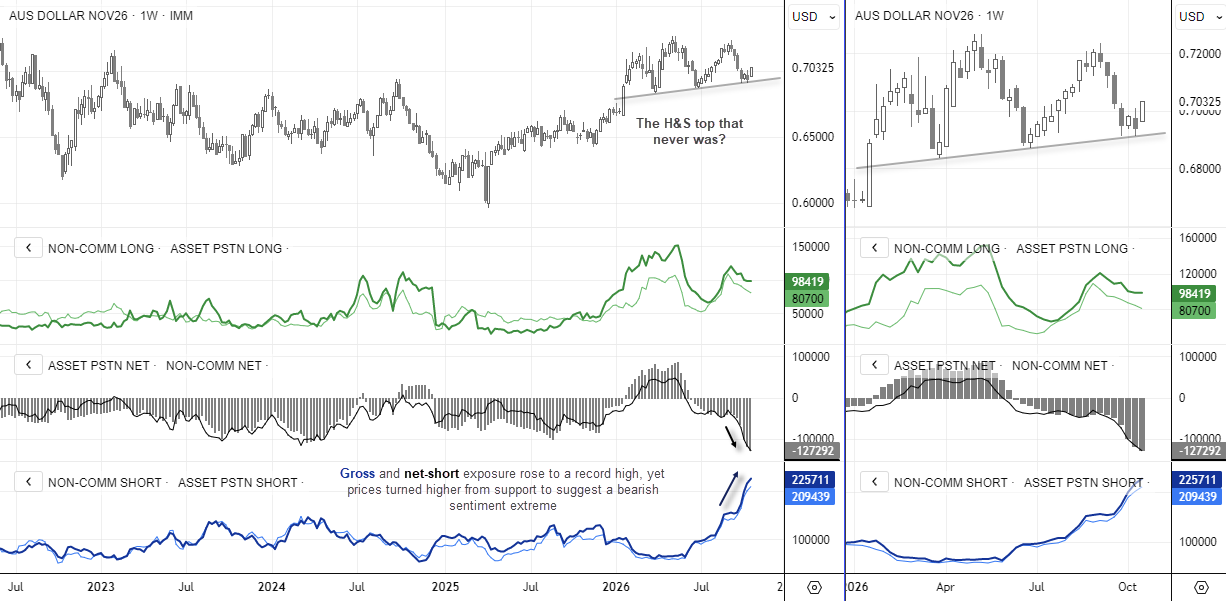
I don't have a lot to add this week, other than pointing out that asset managers and large speculators have pushed their gross-short exposure to record highs, while net-short positioning has also reached extreme levels.
Yet AUD/USD has bounced from the potential head-and-shoulders neckline, suggesting bearish sentiment may have become overstretched in the futures market.
Such crowded short positioning leaves AUD/USD vulnerable to a short-covering rally, particularly if Australian Q3 inflation remains firm and the Fed delivers a not-so-hawkish hold. That could provide bulls with the fuel needed to push higher.
Source: CFTC (COT) CME, LSEG
For traders wanting a deeper understanding of futures positioning, I’ve also published a guide on how to read and interpret weekly COT data in forex markets.
AUD/USD Options and Volatility Analysis (Risk Reversals, HVN Levels)
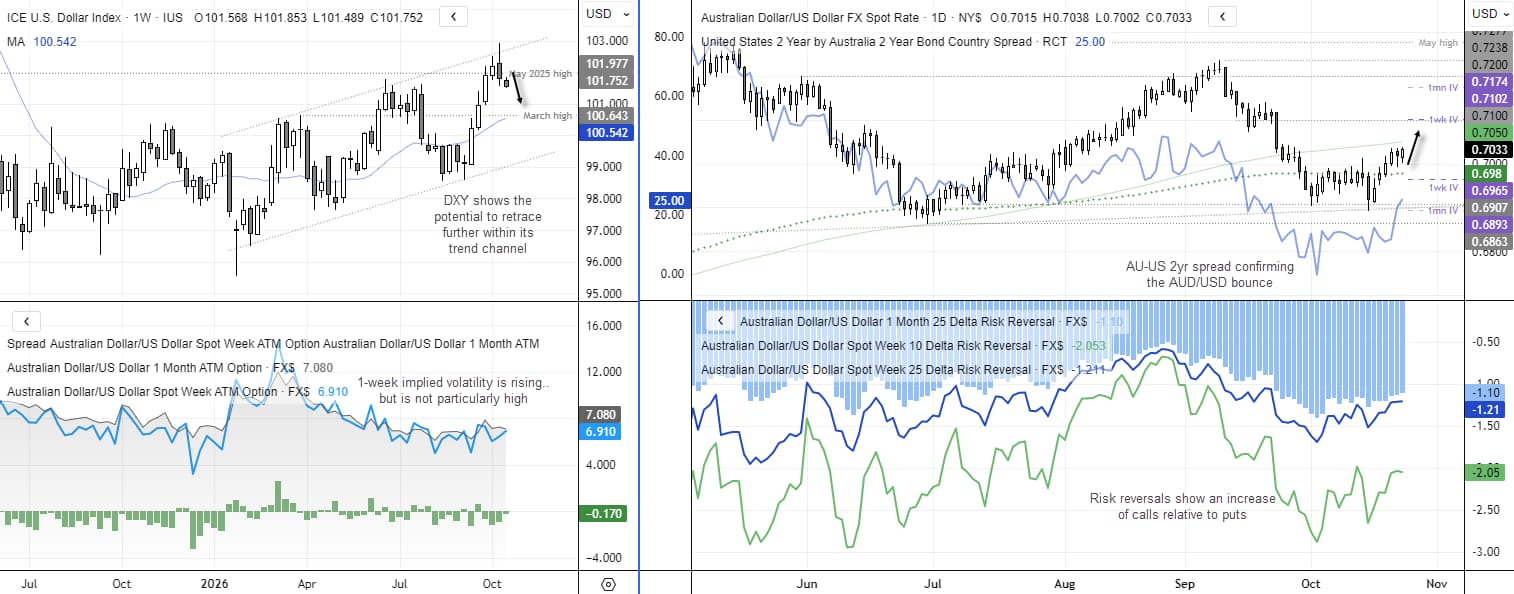
The Aussie dollar closed above 70c for the first week in four – though only just. Still, the bounce form the neckline shows bears have lost control for now, and momentum on the daily timeframe is clearly pointing higher. 1-week implied volatility is rising, though it remains below the 1-month – and suggests a 68% chance of AUD/SUD closing the week within a 135-pip range (68-pip move in either direction). That is not particularly wide considering we have several central bank meetings and a key inflation report lined up – so perhaps options traders ae under-pricing risk?
The AU-US 2yr spread is confirming the move higher on AUD/USD, and risk reversals are also showing an increase of put demand relative to calls. The US dollar index formed a small bearish candle after its key reversal week around the upper channel resistance, and shows the potential to extend its pullback – which could benefit AUD/USD.
Bulls could seek dips towards the 200-day EMA (0.6980) in anticipation of an eventual break above the 200-day SMA (0.7050).
Source: ICE, TradingView