
EUR/USD started the week posting gains of more than 0.4% in favor of the euro, marking a renewed bullish bias toward the close of 2025. For now, buying pressure has managed to hold, as central bank dynamics in the United States and Europe have supported a weaker outlook for the U.S. dollar, allowing the euro to continue regaining ground in the short term. As long as this environment remains in place, buying pressure is likely to become more relevant for EUR/USD over the coming trading sessions.

Central Bank Dynamics
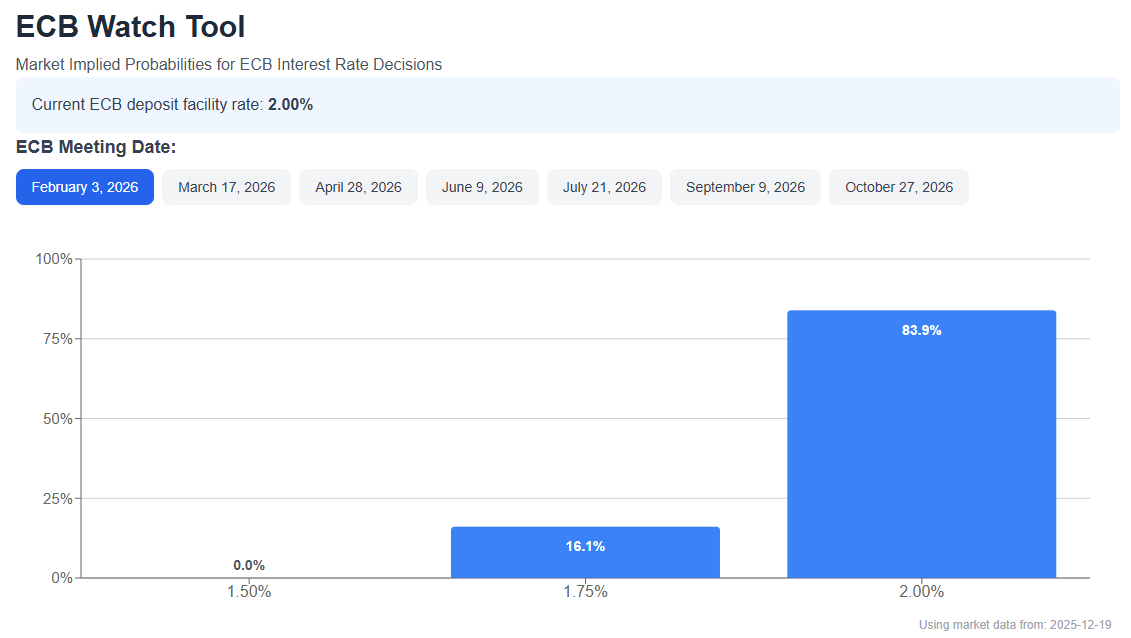
We are now in the final weeks of 2025, and the main central bank decisions have already been announced, beginning to shape expectations for 2026. First, the European Central Bank decided to keep interest rates in neutral territory in its final decision of the year and indicated that this stance could extend into 2026 under a policy of sustained neutral rates. In fact, in the days following the decision, the ECB Watch probability table shows that for the February 3, 2026 meeting there is an 83.9% probability that the current 2.00% deposit rate will remain unchanged, reinforcing the ECB’s neutral outlook as it continues to assess employment and inflation data.
Source: ECBWATCH
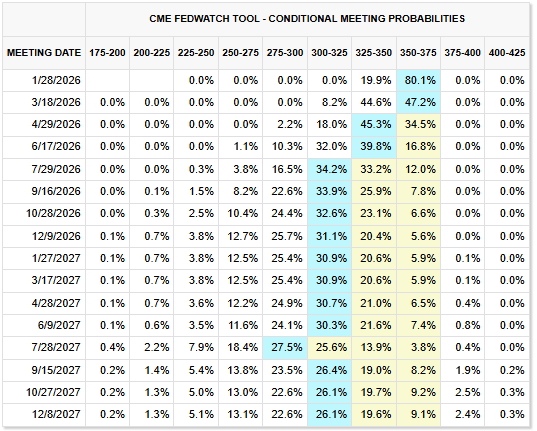
On the other hand, the U.S. central bank, the Federal Reserve, has followed a somewhat more uncertain path. To close 2025, the institution decided to cut its policy rate from 4.00% to 3.75%. However, recent inflation and employment data have delivered mixed signals, which for now do not point to a clear stance between maintaining neutral rates or considering additional cuts to support economic stability. Currently, CME Group probabilities assign an 80.1% chance that rates will remain unchanged at the January 28, 2026 meeting. However, for the March 18 meeting, probabilities remain closely split, with readings above 40% for both a rate cut and a hold, reinforcing the sense of indecision with which the Federal Reserve has ended the year.
Source: CMEGROUP
In this context, as long as Federal Reserve indecision persists, the outlook for stable interest rates in the European Union could continue to stand out relative to the United States. This dynamic appears to be restoring short-term appeal to euro-denominated investments, supporting foreign capital inflows and reinforcing demand for the euro. If this trend holds and markets begin to anticipate lower rates in the United States, the euro’s relative attractiveness could sustain persistent buying pressure in EUR/USD over the coming sessions.
Is the Dollar Still Weak?
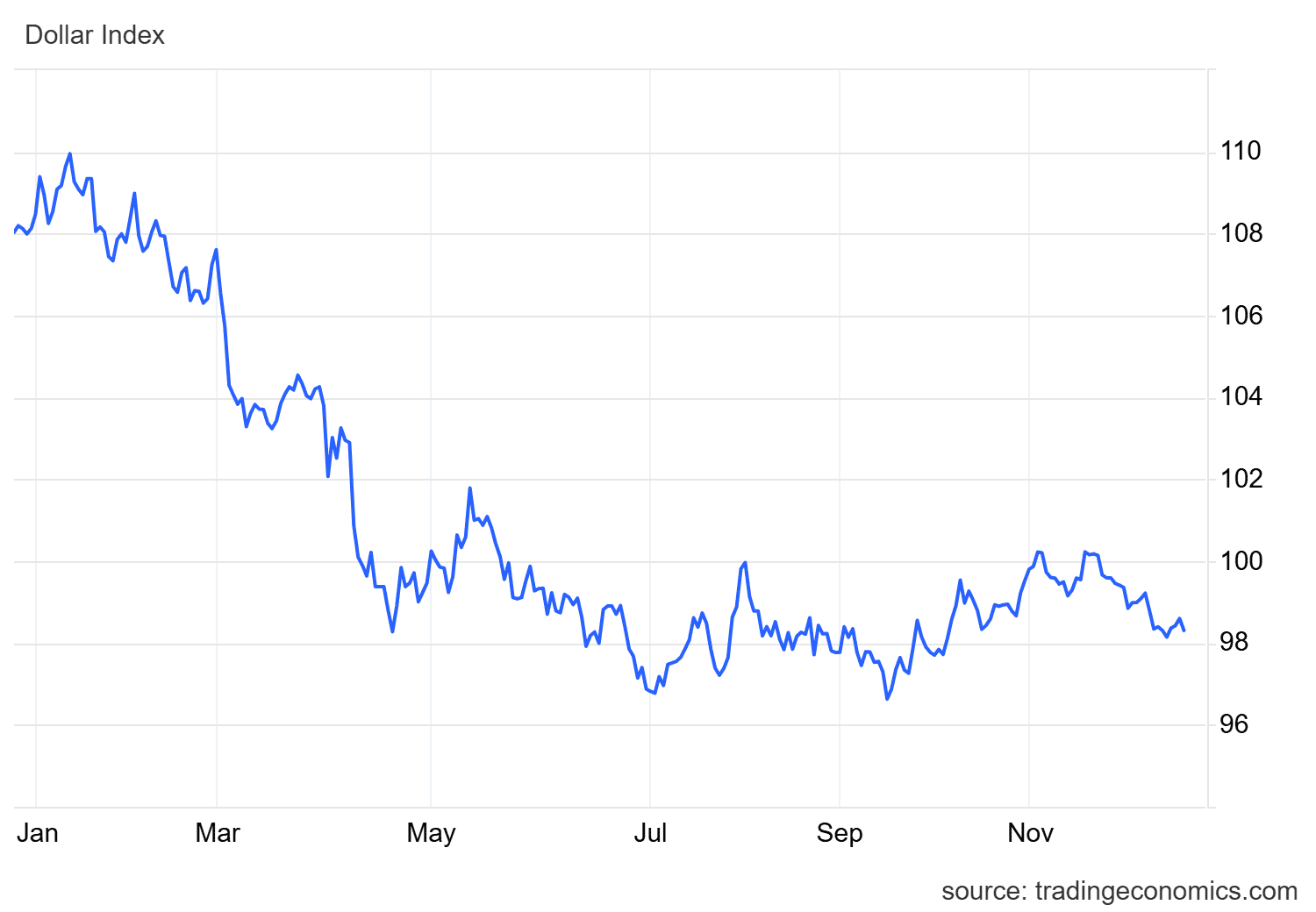
It is important to note that changes in probabilities regarding future Federal Reserve decisions have also begun to affect the dollar’s strength in recent sessions. The DXY index, which measures the dollar’s performance against other currencies, continues to display a downward slope, with bearish moves approaching the 98-point area, corresponding to the October lows. This behavior points to a short-term structural weakness in the U.S. dollar.
Source: TradingEconomics
It is important to note that changes in probabilities regarding future Federal Reserve decisions have also begun to affect the dollar’s strength in recent sessions. The DXY index, which measures the dollar’s performance against other currencies, continues to display a downward slope, with bearish moves approaching the 98-point area, corresponding to the October lows. This behavior points to a short-term structural weakness in the U.S. dollar.
EUR/USD Technical Outlook
Source: StoneX, Tradingview
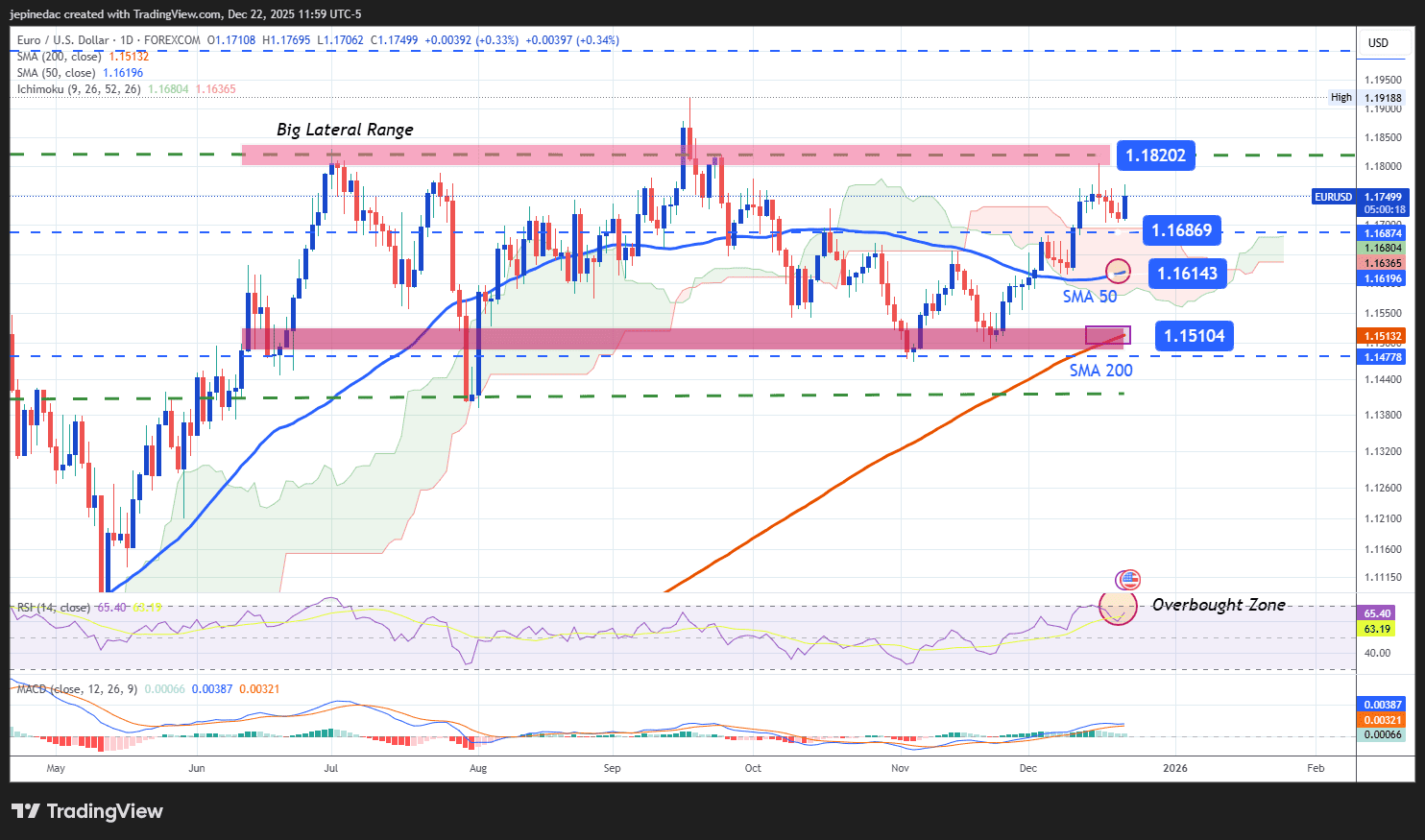
- A broad sideways range remains in place. Since mid-June, EUR/USD has traded within a wide consolidation range, capped at 1.18202 and supported near 1.15104. Recent price action has once again moved closer to the upper boundary of the range, which coincides with the highest levels of the year. If buying strength manages to hold, a range breakout could occur, opening the door to a more meaningful bullish bias in the coming sessions. However, as long as price continues to struggle near the highs, there is still room for short-term corrective pullbacks.
- RSI: The RSI remains in bullish territory above the neutral 50 level, suggesting that average buying momentum over the past 14 sessions has strengthened and that buying pressure continues to dominate. However, the indicator has progressively approached the overbought zone near 70, which could signal a potential imbalance and open the door to short-term corrections.
- MACD: Meanwhile, the MACD continues to show a histogram oscillating around the neutral zero line, reflecting a neutral stance in short-term moving average momentum. If this behavior persists, it could reinforce the idea of indecision in price action and favor the emergence of temporary bearish corrections.
Key Levels:
- 1.18202 – Key resistance: The upper boundary of the broader sideways range and the year’s highs. A sustained bullish breakout above this area could invalidate the range structure and activate a more extended bullish trend toward the close of 2025.
- 1.16869 – Nearby barrier: A level associated with recent neutrality, relevant as a potential cap on corrective pullbacks in the coming sessions.
- 1.16143 – Major support: A level aligned with the 50-period moving average. Sustained selling pressure toward this area could reactivate a bearish bias and reinforce the continuation of the broader sideways range in the short term.
Written by Julian Pineda, CFA, CMT – Market Analyst
Follow him on: @julianpineda25