



EUR/USD Forecast: The Euro Keeps Losing the Battle
EUR/USD has started to show consistent weakness, posting losses of more than 1.5% over the last two trading sessions. For now, selling pressure remains firmly in place, driven by a renewed strengthening of the U.S. dollar.
Share this:

EUR/USD has started to show consistent weakness, posting losses of more than 1.5% over the last two trading sessions. For now, selling pressure remains firmly in place, driven by a renewed strengthening of the U.S. dollar, which has pushed the euro lower in a sustained manner. As long as this environment persists, it is likely to remain a key source of downside pressure for EUR/USD in the sessions ahead.


The Federal Reserve takes center stage again
Several sessions have passed since the Federal Reserve’s latest policy decision on January 28, and current rate expectations continue to point toward a prolonged period of stability. Markets are pricing in approximately 89% probability that interest rates will remain at 3.75% at the March 18 meeting, while expectations for the April 29 decision still show a 76.1% probability that rates will stay unchanged. This suggests that, for now, there is no clear shift in monetary policy nor a visible path toward lower rates in the short term.
Part of this neutral outlook reflects the Fed’s repeated emphasis on persistent inflation, as policymakers have stressed that the 2% inflation target has not yet been achieved. This continues to act as a key constraint on the potential for rate cuts over the medium and long term in the United States.
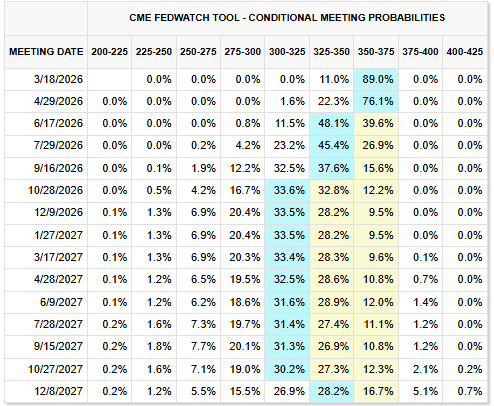
Source: CMEGROUP
In addition, another factor shaping market perception has been the nomination of Kevin Warsh by President Trump to lead the Federal Reserve. This potential appointment has been viewed as positive for the U.S. dollar, as Warsh is seen as a figure who reinforces monetary policy credibility and discipline, with less willingness to yield to political pressure for rate cuts. This has helped reaffirm confidence in the Fed’s independence, adding a greater sense of institutional stability.
Both factors have played a crucial role in the short-term recovery of the U.S. dollar. On one hand, expectations of rates remaining neutral for longer support attractive yields in the U.S. bond market, encouraging foreign capital inflows. On the other, the perception of greater stability at the Federal Reserve has helped restore confidence in the dollar, which had been under pressure for several weeks.
This dynamic is already clearly reflected in the DXY index, which measures the dollar’s strength against its major peers. The index has developed a consistent upward slope, now trading above the 97.5 level, confirming a meaningful improvement in demand for U.S. dollars in the short term.
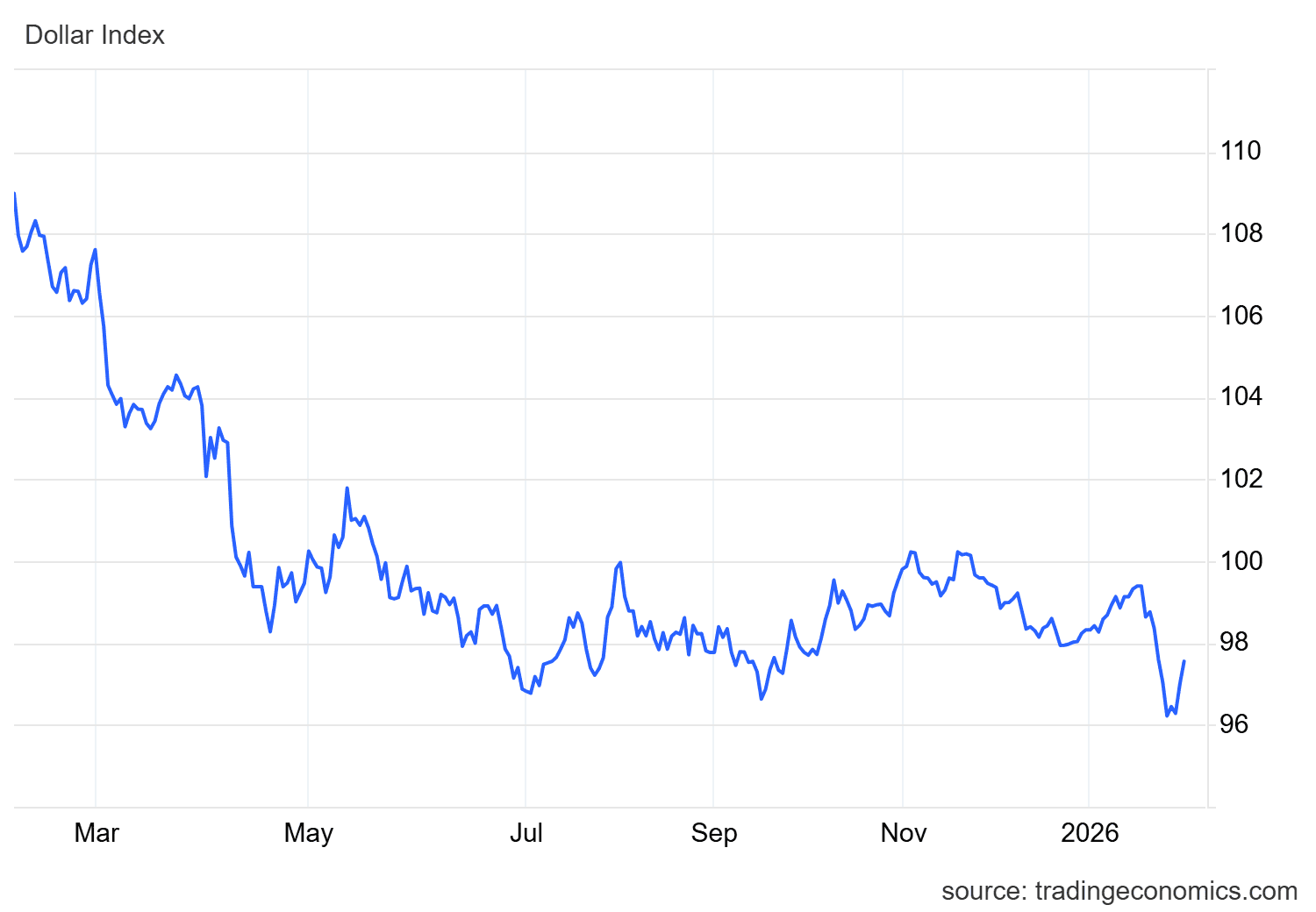
Source: TradingEconomics
Taking all of this into account, as long as this renewed sense of stability and the expectation of rates staying neutral for longer persist in the United States, the dollar is likely to remain supported. In this environment, the euro—one of the dollar’s main counterparts—could continue to lose ground, keeping downside pressure dominant on EUR/USD in the coming sessions.
EUR/USD Technical Outlook
Source: StoneX, Tradingview
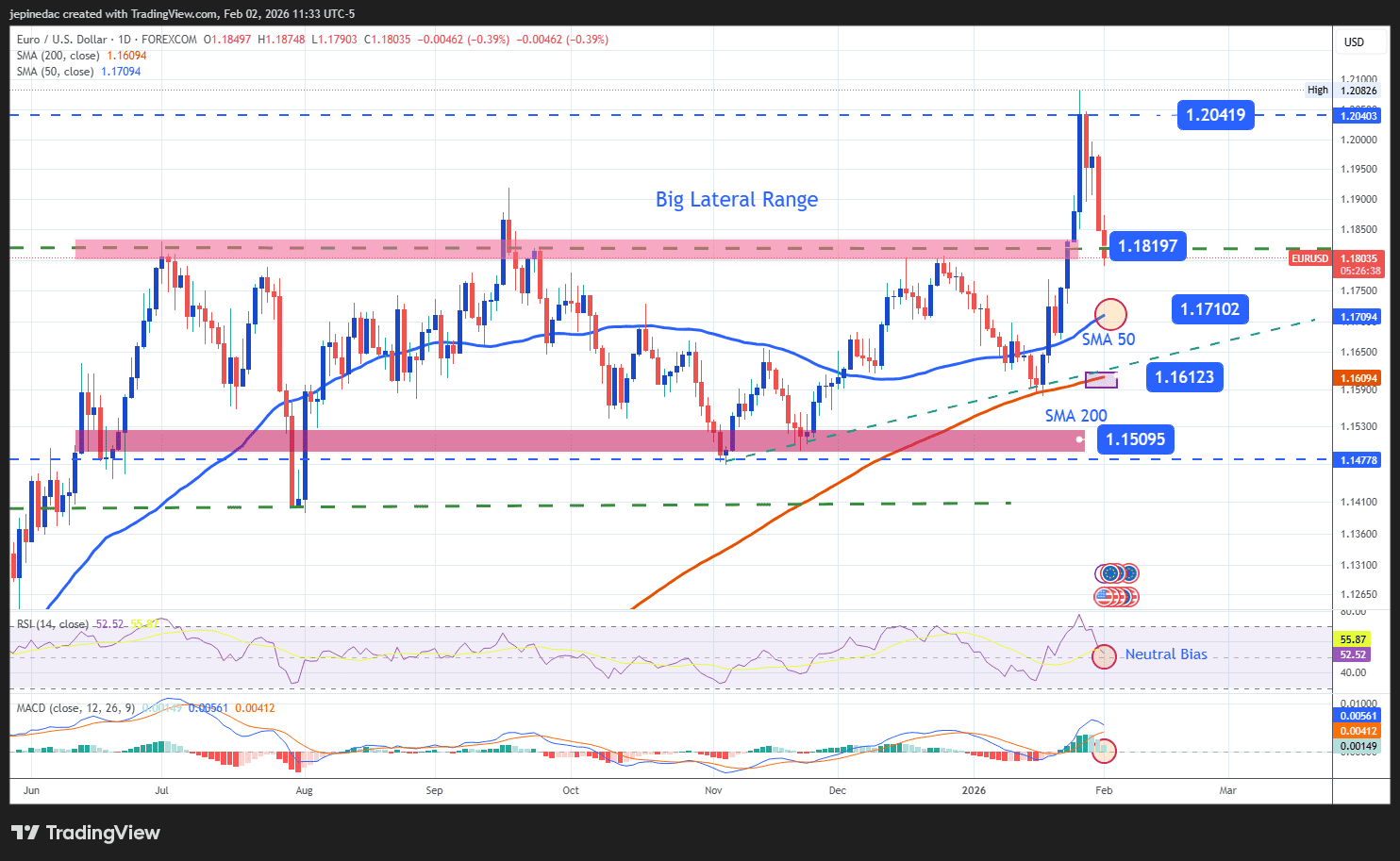
- The bullish trend fails to consolidate: Although since early November 2025 EUR/USD had been attempting to form a sequence of higher highs, suggesting the development of a potential bullish trend, recent selling pressure has begun to cast doubt on this structure. Price has moved back into the broader sideways range, bounded by resistance at 1.18197 and support at 1.15095, restoring the relevance of this technical pattern.If current selling pressure persists in the short term, the bullish structure could be invalidated, with the pair reverting to a neutral bias, similar to what has been observed over the past several months.
- RSI: The RSI remains oscillating near the neutral 50 level, reflecting a balance of forces over the last 14 sessions. As long as this behavior continues, it may reinforce an indecisive environment for EUR/USD price action.
- MACD: A similar picture is visible in the MACD, whose histogram is once again approaching the zero line, signaling the absence of a dominant trend in short-term moving averages. This reinforces the view of a market lacking clear direction in the near term.
Key levels:
- 1.20419 – Key resistance: This level aligns with the most recent high and represents the main upside barrier. A sustained move back toward this area could reactivate bullish momentum and open the door to a more clearly defined uptrend.
- 1.18197 – Nearby barrier: A neutral zone corresponding to the upper boundary of the broader sideways range. Sustained price action below this level would reinforce the consolidation scenario.
- 1.17102 – Key support: A level aligned with the 50-period simple moving average and the most important downside barrier to watch. A sustained break below this area could enable a more dominant bearish bias, potentially remaining relevant over the coming weeks.
Written by Julian Pineda, CFA, CMT – Market Analyst
Follow him on: @julianpineda25


The complete CFD trading experience
Award-winning platforms, competitive spreads, low commissions and dedicated support.
We live and breathe the markets and are dedicated to helping traders realise their ambitions as we continue to set the industry bar.
Economic calendar
Web Trader platform
Our sophisticated web-based platform is packed with features.
Related articles

NZD/USD pressure mounts as payrolls looms large
NZD/USD has fallen sharply as Fed rate expectations reset higher, but extreme downside stretch and major support raise the risk of a violent counter-trend rebound.

US Core PCE Preview: Stale or Significant for the Fed
Core PCE inflation takes center stage Wednesday, with traders watching for signs of renewed price pressure and clues on whether the Fed could hike again in October.

Australian Dollar Forecast: AUD/USD Four-Week Slide Nears Critical Uptrend Support 9 29 2026
Aussie momentum has deteriorated sharply into quarter-end, with inflation, Core PCE and NFP on tap as AUD/USD closes in on a pivotal technical threshold.

StoneX Europe Ltd may make third party material available on this website which may contain information included but not limited to the conditions of financial markets. The material is for information purposes only and does not contain, and should not be construed as containing, investment advice and/or investment recommendation and/or an investment research and/or an offer of or solicitation for any transactions in financial instruments; any decision to enter into a specific transaction shall be made by the client following an assessment by him/her of their situation.
StoneX Europe Ltd makes no representation or warranty and assumes no liability as to the accuracy or completeness of the information provided, nor any loss arising from any investment based on a recommendation, forecast or other information supplied. You should always seek independent advice as to your suitability to speculate in any related markets and your ability to assume the associated risks, if you are at all unsure. We are not under any obligation to update any such material. Any opinion made may be personal to the author and may not reflect the opinion of StoneX Europe Ltd.