


Google’s biggest acquisitions: what does Google own?
Google is the world’s largest search engine, but did you know it owns 256 other companies besides its original internet subsidiary? Let’s take a look at Google’s biggest acquisitions so far.
Share this:

How did Google become one of the largest companies in the world?
Google held its IPO on August 19, 2004, but at the time, the company was a relative unknown. The internet – let alone the concept of a search engine – was still in its relative infancy. At the time of its IPO, Google shares were worth $85 a piece.
Now, 19 years and 256 acquisitions later, Google is not only the world’s largest search engine but it’s synonymous with search engine itself. Nobody looks something up on the internet, they Google it. But the company is also far more than its internet empire. These acquisitions have taken Google into industries such as advertising, hardware and many more. To account for its growing areas of interest, in 2015, Google changed its name to Alphabet.
Under the new parent company, Google became a subsidiary, usually referred to as the search-and-services segment of earnings. This ‘core bets’ part of the business is comprised of Google, Android, YouTube and Google Cloud. The rest of Alphabet’s business is called ‘other bets’ and spans industries such as Fiber broadband (Access), artificial intelligence (DeepMind), startup investments (Google Ventures), smart homes (Nest) and ‘moon shot’ projects under the Google X wing, such as self-driving cars (Waymo), delivery drones (Wing) and robots (Boston Dynamics).
Despite a rough 2020 with Covid impacting businesses across the world, shares of GOOG trade for roughly ($106.70 as of April 10, 2023. Had you invested $1000 in Google’s IPO – buying 11 shares – your investment would now be worth over $47,000 thanks to a 2-4-1 stock split in 2014 and a second stock split of 20-1 in July 2022.
What companies does Google own?
Google owns approximately 256 companies for a total cost of about $20.89 billion. A lot of the businesses Google has acquired were all for their tech. What Google can’t do internally, it buys and incorporates into its own operations. The companies Google has acquired span industries such as social platforms, advertising, and cybersecurity.
Google's biggest acquisitions
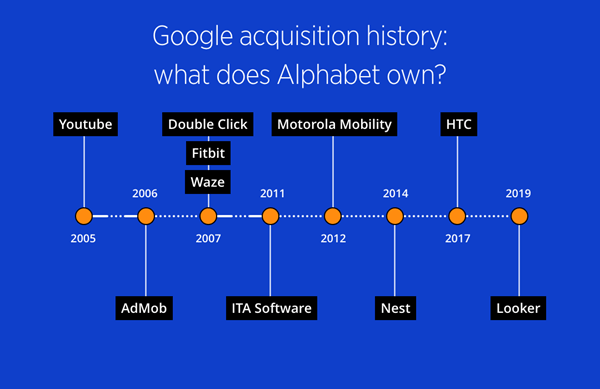
Google’s biggest acquisition to date is Motorola Mobility, which it bought for $12.5 billion but was later sold to Lenovo for just a quarter of the price ($2.9 billion). Of Google’s current holdings, the largest acquisition deal was Nest for $3.2 billion.
Here are Google’s ten biggest acquisitions.
- Motorola Mobility, 2012, Telecommunications, $12.5 billion
- Nest, 2014, Home automation, $3.2 billion
- DoubleClick, 2007, Online advertising, $3.1 billion
- Looker, 2019, Data analytics, $2.6 billion
- Fitbit, 2007, Consumer electronics, $2.1 billion
- YouTube, 2005, Online video platform, $1.65 billion
- Waze, 2007, GPS navigation software, $1.3 billion
- HTC, 2017, Telecommunications, $1.1 billion
- AdMob, 2006, Mobile advertising, $750 million
- ITA Software, 2011, Software and travel, $700 million
Google’s acquisition history
Google’s acquisition history has seen it buy a lot of big names and build on an already impressive empire. And it doesn’t look like there’s any sign of its M&As slowing down either. However, a lot of Google’s most recent acquisitions remain fairly private – most recently, Google has acquired data and analytics company BrightBytes and the air quality monitoring company BreezoMeter but both deal amounts remain undisclosed.
Latest market news



The complete CFD trading experience
Award-winning platforms, competitive spreads, low commissions and dedicated support.
We live and breathe the markets and are dedicated to helping traders realise their ambitions as we continue to set the industry bar.
Economic calendar
Web Trader platform
Our sophisticated web-based platform is packed with features.
Related articles

Gold Q4 2026 outlook: Resilience in the face of rallying dollar and yields
As we headed towards the latter stages of Q3 and into Q4, the Fed had just hiked rates in a hawkish FOMC meeting, while the likes of the ECB and BoJ had also tightened their respective policies. Oil prices remained elevated amid the prolonged US-Iran conflict. Meanwhile, bond yields were breaking out, and the dollar was higher across the board. Yet, remarkably, gold was still holding in the positive territory for the third quarter, even if it had weakened somewhat in September.


DeepSeek IPO: Everything You Need to Know About DeepSeek
DeepSeek IPO: Learn about its potential 2027 listing, valuation, revenue, profitability, ownership, competitors and what investors should watch.


Bloomberg IPO: Everything You Need to Know About Bloomberg
Explore everything investors need to know about a potential Bloomberg IPO, including valuation, ownership, profitability, competitors, leadership and possible timing.
StoneX Europe Ltd may make third party material available on this website which may contain information included but not limited to the conditions of financial markets. The material is for information purposes only and does not contain, and should not be construed as containing, investment advice and/or investment recommendation and/or an investment research and/or an offer of or solicitation for any transactions in financial instruments; any decision to enter into a specific transaction shall be made by the client following an assessment by him/her of their situation.
StoneX Europe Ltd makes no representation or warranty and assumes no liability as to the accuracy or completeness of the information provided, nor any loss arising from any investment based on a recommendation, forecast or other information supplied. You should always seek independent advice as to your suitability to speculate in any related markets and your ability to assume the associated risks, if you are at all unsure. We are not under any obligation to update any such material. Any opinion made may be personal to the author and may not reflect the opinion of StoneX Europe Ltd.