







NZD/USD: Trade Wars, Not Rate Cuts, Are Calling the Shots
The RBNZ has slashed rates aggressively, but markets still think there’s more to come. With the central bank’s neutral rate estimate sitting well below current levels, cuts look set to continue in 2025. But rate differentials aren’t driving NZD/USD moves. A deeper look reveals a clear culprit.
Share this:

- RBNZ sees neutral rates between 2.5-3.5%, hinting at more cuts ahead
- NZD/USD traders shrug off rate differentials, fixated on US trade policy
- Market pricing suggests at least four more RBNZ cuts by year-end
- Technical levels hold firm as NZD/USD rides tariff-driven volatility
Summary
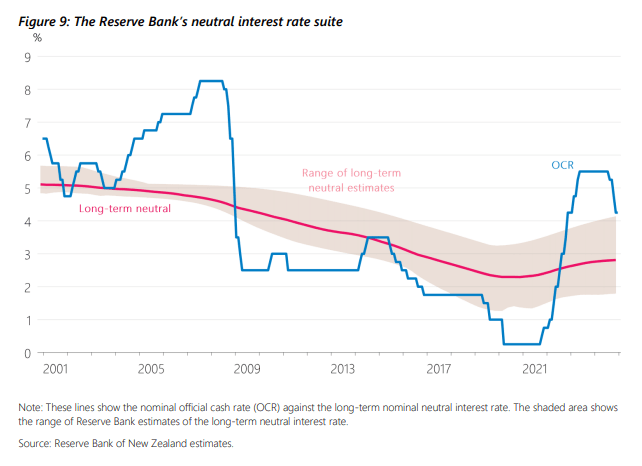
The Reserve Bank of New Zealand (RBNZ) says monetary policy remains in restrictive territory despite slashing interest rates by 125bps this cycle, implying there will be a need to continue reducing the overnight cash rate if inflation continues to subside. Its estimate for the range where interest rates keep unemployment and inflation stable are slightly lower than where markets expect the cash rate to bottom this cycle, suggesting the aggressive cuts seen over the past two meetings may extend well into 2025 should there be no evidence of a pickup in the economy.
While large scale rate cuts create downside risks for NZD/USD on a pure interest rate differential basis, right now, that’s a distant secondary consideration for traders. If you want clues on NZD/USD directional risks, evidence suggests you need to pay close attention to trade policy from the United States under the Trump Administration.
A primer on long-term nominal neutral interest rates
It’s a mouthful, but the concept is simple. It’s the level where interest rates keep inflation and unemployment are stable. Think of it as cruise control for an economy, where growth isn’t too fast or too slow.
It’s called “nominal” because it doesn’t account for inflation, and “neutral” because it’s not trying to restrain or stimulate activity. Central banks use it to guide expectations on interest rates. If rates are below the estimated level they’re trying to speed things up, and vice versus when above.
The emphasis needs to be on estimated as neutral is a dynamic level which constantly changes, influenced by things like population growth, productivity, and people’s willingness to save or spend.
RBNZ estimates neutral is below 4.25%
Paul Conway, Chief Economist at the RBNZ, estimates New Zealand’s neutral interest rate currently lies between 2.5% and 3.5%, below the 4.25% level where the overnight cash rate currently resides.
Source: RBNZ
“Easing domestic pricing intentions and the recent drop in inflation expectations help open the way for some further easing, as signalled in the November 2024 Monetary Policy Statement,” Conway said during a webinar hosted on Wednesday.
“Given uncertainty, we will need to ‘feel our way’ as the OCR gets closer to our estimate of neutral.
“We will continually cross-check our estimate of the neutral interest rate by comparing the proximity of the OCR to neutral against what we are seeing in the real economy.”
Markets see neutral around 3%
Source: Bloomberg
Overnight interest rate swaps indicate where markets expect the cash rate to settle in the future. By the next RBNZ meeting on February 19, markets anticipate it will drop to 3.762%, implying a nearly fully priced 50bp cut. By year-end, four 25bp cuts are expected, with a strong chance of a fifth, leaving the cash rate at 3%. This aligns with the midpoint of Conway’s range and the bank’s November guidance.
RBNZ rates a minor consideration for NZD/USD
Although the RBNZ is expected to cut rates faster than the Federal Reserve in 2025, this outlook is already factored in and has had minimal influence on NZD/USD moves recently.
Instead, the pair has shown a stronger inverse relationship with US equity market volatility futures, implied US bond market volatility, and the offshore-traded Chinese yuan (USD/CNH). This highlights the role of US trade policy speculation, which has caused sharp swings in NZD/USD.
Source: TradingView
Despite resembling a washing machine on spin cycle on an intraday basis, NZD/USD continues to respect technical levels. After breaking above downtrend resistance early last week, the pair found support at .5650 on three occasions in the past five sessions.
Momentum indicators like MACD and RSI (14) remain bullish, favouring a cautious near-term upside bias, with dips and topside breaks preferred over selling rallies.
Key resistance levels to watch include Friday’s high near .5725, the 50-day moving average, and horizontal resistance at .5754.
A sustained break below .5650 would invalidate the bullish bias, opening the door for bearish setups targeting a potential retest of early January swing lows.
-- Written by David Scutt
Follow David on Twitter @scutty
How to trade with City Index
You can trade with City Index by following these four easy steps:
- Open an account, or log in if you’re already a customer
• Open an account in the UK
• Open an account in Australia
• Open an account in Singapore
- Search for the market you want to trade in our award-winning platform
- Choose your position and size, and your stop and limit levels
- Place the trade
Related tags:
Latest market news




The complete CFD trading experience
Award-winning platforms, competitive spreads, low commissions and dedicated support.
We live and breathe the markets and are dedicated to helping traders realise their ambitions as we continue to set the industry bar.
Economic calendar
Web Trader platform
Our sophisticated web-based platform is packed with features.
Related articles
Canadian Dollar Forecast: USD/CAD Four-Week Rally Eyes Yearly Highs 9 30 2026
USD/CAD has advanced in 14 of the past 15 sessions, but stretched momentum raises the stakes as major resistance and NFP come into focus.

British Pound Technical Outlook: GBP/USD Rebound Challenges September Downtrend 9 30 2026
Sterling has rallied sharply from key support, with GBP/USD at an inflection point that could determine whether a larger recovery is underway.
The RBA Hiked Rates and the Australian Dollar Still Fell
AUD/USD fell after the RBA rate hike because the central bank's hawkish stance was already priced in while the U.S. dollar stayed firm.

StoneX Europe Ltd may make third party material available on this website which may contain information included but not limited to the conditions of financial markets. The material is for information purposes only and does not contain, and should not be construed as containing, investment advice and/or investment recommendation and/or an investment research and/or an offer of or solicitation for any transactions in financial instruments; any decision to enter into a specific transaction shall be made by the client following an assessment by him/her of their situation.
StoneX Europe Ltd makes no representation or warranty and assumes no liability as to the accuracy or completeness of the information provided, nor any loss arising from any investment based on a recommendation, forecast or other information supplied. You should always seek independent advice as to your suitability to speculate in any related markets and your ability to assume the associated risks, if you are at all unsure. We are not under any obligation to update any such material. Any opinion made may be personal to the author and may not reflect the opinion of StoneX Europe Ltd.