



USD/JPY outlook: BOJ holds steady as intervention risk builds
The BOJ appears content to normalise policy gradually, but leaving rates unchanged has handed the initiative back to USD/JPY bulls. The problem is every push higher also increases the likelihood Japanese authorities step back into the market.
Share this:

- BOJ keeps rates unchanged in July, as expected
- Single dissent points towards slower policy normalisation
- USD/JPY rebounds extends beyond 160 following rate decision
- Near-term intervention threat clouds bullish USD/JPY outlook
Intervention first, tightening later?
The Bank of Japan left interest rates unchanged at 1% in July, as widely expected by markets. There had been some speculation the BOJ may deliver a surprise rate increase following likely coordinated intervention between Japan's Ministry of Finance, the US Treasury and South Korean officials on Thursday, but that failed to materialise.
Notably, there was only one dissenter, Takata, who voted in favour of a 25 basis point increase, arguing upside risks to prices had increased sufficiently to warrant a more pre-emptive policy response.
That's important because previous BOJ tightening episodes have generally been preceded by meetings where multiple dissenters emerged. The fact there was only one on this occasion suggests, at face value, that September may be off the table for a hike, with October or December looking more likely for the next move, broadly in line with current market pricing.
Growth optimism offsets softer inflation
Beyond the policy decision, the updated Outlook Report continued to point towards further policy normalisation, even if the timing of the next move remains opaque.
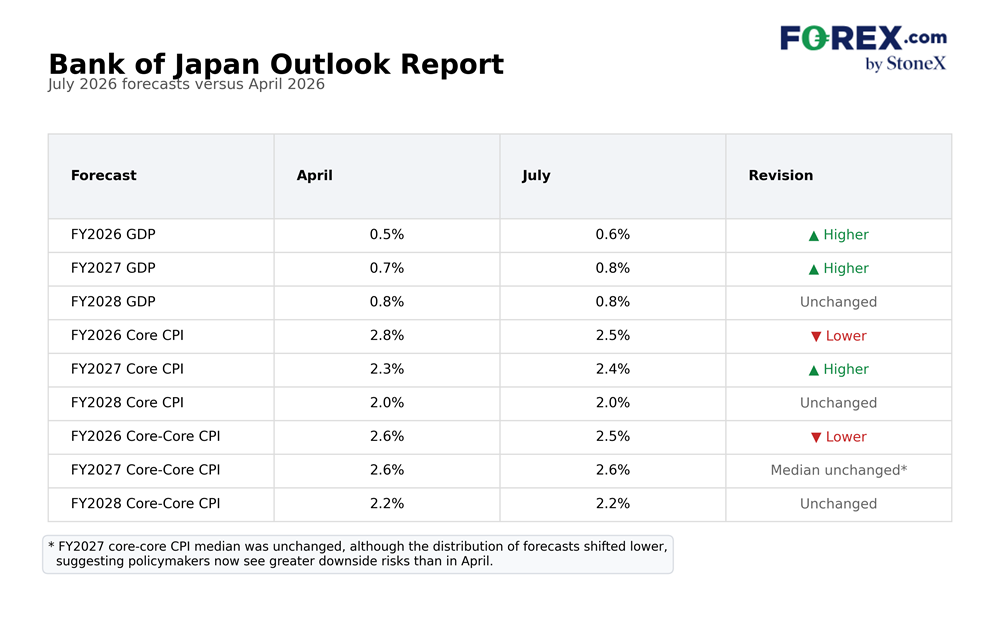
While the Bank lowered its near-term inflation forecasts, it remained optimistic on the outlook for economic activity, expanding its commentary on AI, semiconductor-related investment and business spending as important drivers of growth.
Source: BOJ, FOREX.com
On inflation, the BOJ said wage and price-setting behaviour among firms is continuing to shift, helping underpin its expectation that underlying CPI inflation will gradually move towards its 2% target over time. However, it acknowledged uncertainty remains elevated, particularly around global trade policy, overseas economic activity and developments in financial markets.
Overall, there was little in the forecasts to suggest the direction of travel for policy has changed. While the timing of the next rate increase remains data dependent, the BOJ still appears biased towards further gradual tightening.
Yen weakness quickly returns
The initial market reaction suggests traders have interpreted the outcome as dovish, with the yen resuming its slide after Thursday's spectacular rally. With USD/JPY already back above 160, it raises fresh questions about exactly what Japanese authorities were trying to achieve through what appeared to be coordinated intervention.
At face value, it may have been conducted to provide room for the BOJ to deliver a more dovish outcome without immediately inviting another wave of yen selling. Had intervention not taken place, leaving policy unchanged may have risked a far stronger market reaction and another push towards fresh multi-decade highs in USD/JPY.
While you wouldn’t know from the market reaction, the risk of further intervention remains elevated. If Japanese authorities revert to the playbook seen earlier this year, intervention may come in waves over several days rather than as a single event. That's an acute risk for anyone chasing USD/JPY higher.
Attention now shifts to Governor Ueda's press conference at 3:30pm Tokyo time. If history is any guide, he has a habit of sounding more dovish than the policy statement, keeping the risk of renewed USD/JPY upside firmly in play.
160.73 becomes the focal point
Source: TradingView
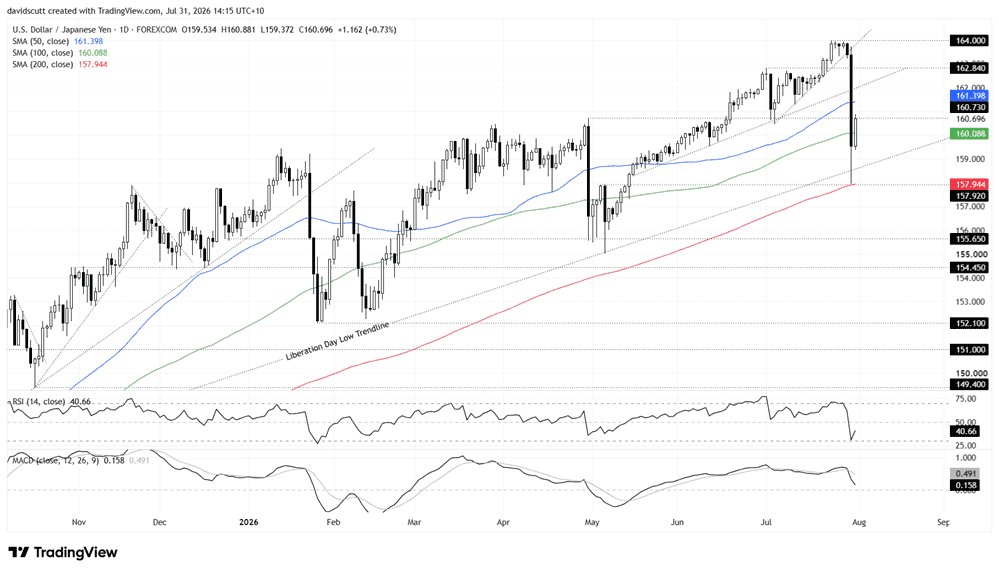
The first thing that stands out on the daily chart is just how respectful USD/JPY remains to known technical levels, despite what appears to have been intervention from Japanese authorities. The violent unwind stalled almost perfectly at the confluence of the 200-day simple moving average and 157.92, a former breakout level from earlier this year, before buyers stepped back in.
That rebound has since taken USD/JPY back to 160.73, the former record high set earlier this year. While the pair briefly traded above that level, it has so far struggled to establish a foothold, leaving it as an obvious pivot for traders.
For those anticipating further bouts of likely intervention, 160.73 looms as a level to build setups around, allowing traders to consider initiating shorts beneath the level with a stop above, targeting a move back towards where the bearish unwind on Thursday stalled just beneath 158. However, just because earlier intervention episodes came in waves doesn't mean that pattern will necessarily be repeated this time.
Conversely, if USD/JPY can reclaim 160.73 and hold above it, it would suggest intervention-related selling may have run its course for now, allowing traders to consider initiating long positions above the level with a stop beneath, targeting a move towards the former uptrend from early May, found today just beneath 162. Above that, 162.84 and then 164 become the next upside levels to watch.
Even though the longer-term trend remains undeniably bullish, favouring buying dips, the ongoing threat of further intervention means chasing USD/JPY higher near term looks unappealing.


The complete CFD trading experience
Award-winning platforms, competitive spreads, low commissions and dedicated support.
We live and breathe the markets and are dedicated to helping traders realise their ambitions as we continue to set the industry bar.
Economic calendar
Web Trader platform
Our sophisticated web-based platform is packed with features.
Related articles
EUR/USD, GBP/USD Outlook: RSI Hits 2020 Oversold Levels
EUR/USD, GBP/USD Outlook: The EUR/USD daily RSI has fallen to oversold levels last seen in 2020, raising the risk of a reversal across correlated currency pairs, including the US dollar and GBP/USD.

Dow Jones forecast: Stock markets under pressure from multiple sources
When looking at the major tech-heavy US indices like the S&P 500 or the Nasdaq 100, you wouldn’t think that the stock market is particularly weak. Yet, beneath the surface, the market is far from healthy right now. Investors are evidently just piling into the big tech and AI names, and as a result, market breadth is deteriorating. Other indices like the small cap Russell 2000 and the Dow Jones are starting to reflect that weakness.


Nikkei breakout accelerates as yen weakness returns
Nikkei has started October with a powerful breakout, helped by renewed yen weakness and strong upside momentum
StoneX Europe Ltd may make third party material available on this website which may contain information included but not limited to the conditions of financial markets. The material is for information purposes only and does not contain, and should not be construed as containing, investment advice and/or investment recommendation and/or an investment research and/or an offer of or solicitation for any transactions in financial instruments; any decision to enter into a specific transaction shall be made by the client following an assessment by him/her of their situation.
StoneX Europe Ltd makes no representation or warranty and assumes no liability as to the accuracy or completeness of the information provided, nor any loss arising from any investment based on a recommendation, forecast or other information supplied. You should always seek independent advice as to your suitability to speculate in any related markets and your ability to assume the associated risks, if you are at all unsure. We are not under any obligation to update any such material. Any opinion made may be personal to the author and may not reflect the opinion of StoneX Europe Ltd.