




USDJPY bears smelling blood
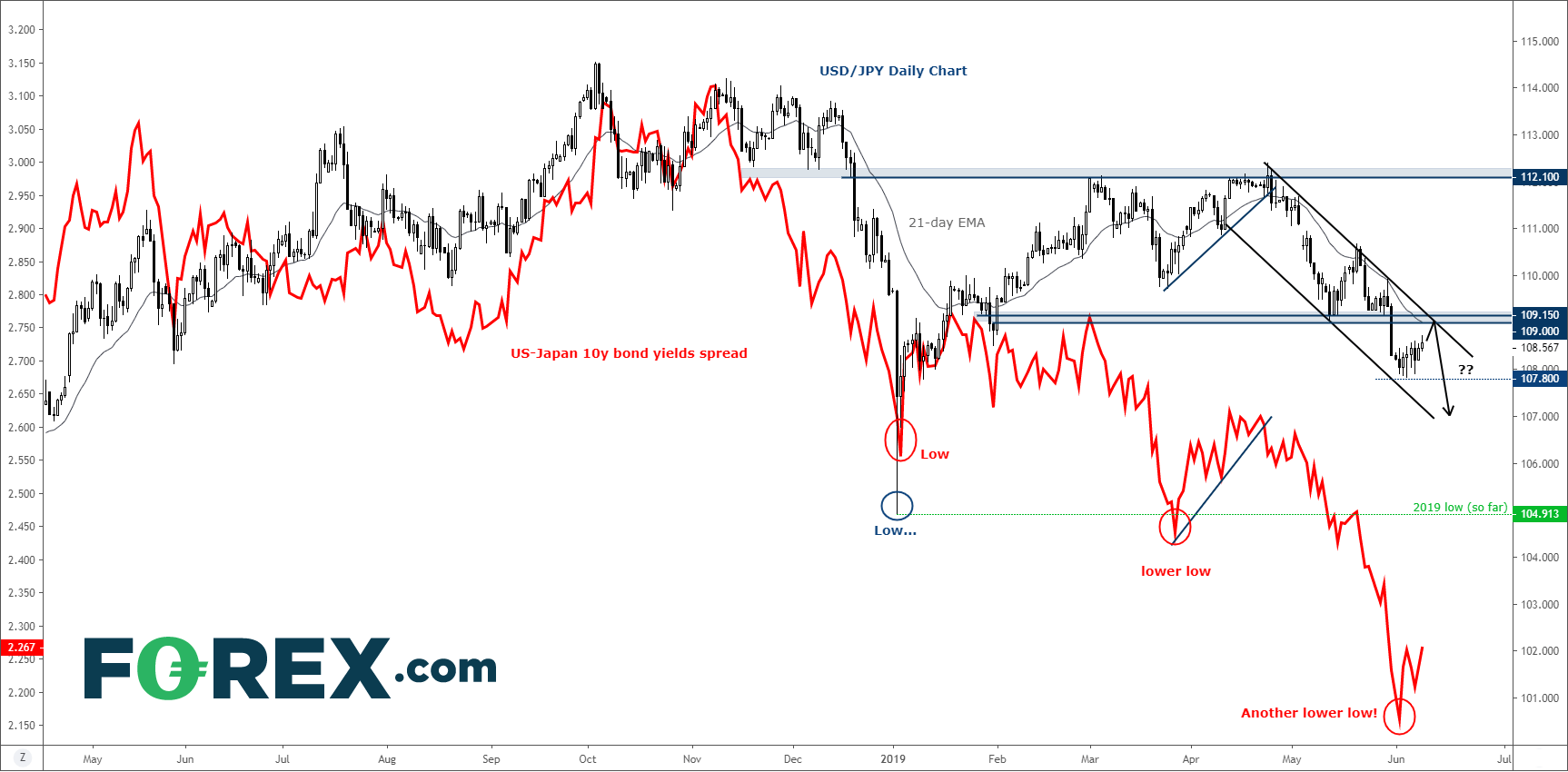
The Fed’s U-turn on interest rates has gathered significant momentum over the past few weeks but the dollar has not made a similar move. Yet. But if the slumping US-Japan 10-year yield spread is anything to go by, then the fact this has made a new lower low suggests the USD/JPY could be on the verge of dropping below the January’s flash crash low over the coming weeks.
Share this:

The US dollar has started the new week on the front foot after being hammered in the last couple of weeks on rising probabilities of a rate cut by the Federal Reserve. As my colleague Matt Weller noted earlier, traders are now pricing in an over 80% chance of a rate cut by the end of July. Despite this, the USD/JPY fell only slightly last week and was up at the start of this week. The safe haven yen is undoubtedly undermined by the ongoing “risk-on” rally – owing to news that the US and Mexico have reached an agreement over migration, allowing the latter to avoid the 5% tariffs threatened by Trump.
However, once the impact of the Mexico news is absorbed, we reckon the UJ will probably decline further and catch down with the falling US-Japan bond yield spreads – especially if Wednesday’s release of US CPI fails to positively surprise the downbeat expectations. The Fed’s U-turn on interest rates has gathered significant momentum over the past few weeks but the dollar has not made a similar move. Yet. But if the slumping US-Japan 10-year yield spread is anything to go by, then the fact this has made a new lower low suggests the USD/JPY could be on the verge of dropping below the January’s flash crash low over the coming weeks.
A potential resistance area to watch is around 109.00-109.15 on the USD/JPY, which was previously support. This area also ties in with the down trend of the bearish channel and the 21-day exponential moving average. Of course, rates need not get there before turning; essentially what we are looking for is a failure to hold above last week’s high at 108.60ish. The first downside target is the liquidity below last week’s low at 107.80, with the ultimate bearish objective being the low beneath the January low at 104.90. However, a clean break above the aforementioned 109.00-109.15 resistance area would probably invalidate this bearish outlook, until rates find stronger resistance at higher levels.
Source: TradingView and City Index
The US dollar has started the new week on the front foot after being hammered in the last couple of weeks on rising probabilities of a rate cut by the Federal Reserve. As my colleague Matt Weller noted earlier, traders are now pricing in an over 80% chance of a rate cut by the end of July. Despite this, the USD/JPY fell only slightly last week and was up at the start of this week. The safe haven yen is undoubtedly undermined by the ongoing “risk-on” rally – owing to news that the US and Mexico have reached an agreement over migration, allowing the latter to avoid the 5% tariffs threatened by Trump.
However, once the impact of the Mexico news is absorbed, we reckon the UJ will probably decline further and catch down with the falling US-Japan bond yield spreads – especially if Wednesday’s release of US CPI fails to positively surprise the downbeat expectations. The Fed’s U-turn on interest rates has gathered significant momentum over the past few weeks but the dollar has not made a similar move. Yet. But if the slumping US-Japan 10-year yield spread is anything to go by, then the fact this has made a new lower low suggests the USD/JPY could be on the verge of dropping below the January’s flash crash low over the coming weeks.
A potential resistance area to watch is around 109.00-109.15 on the USD/JPY, which was previously support. This area also ties in with the down trend of the bearish channel and the 21-day exponential moving average. Of course, rates need not get there before turning; essentially what we are looking for is a failure to hold above last week’s high at 108.60ish. The first downside target is the liquidity below last week’s low at 107.80, with the ultimate bearish objective being the low beneath the January low at 104.90. However, a clean break above the aforementioned 109.00-109.15 resistance area would probably invalidate this bearish outlook, until rates find stronger resistance at higher levels.
Source: TradingView and FOREX.com
Related tags:

The complete CFD trading experience
Award-winning platforms, competitive spreads, low commissions and dedicated support.
We live and breathe the markets and are dedicated to helping traders realise their ambitions as we continue to set the industry bar.
Economic calendar
Web Trader platform
Our sophisticated web-based platform is packed with features.
Related articles

USD/MXN Forecast: Peso Loses Momentum Ahead of Banxico Decision
Over recent trading sessions, the Mexican peso has started to show signs of losing strength against the U.S. dollar. This can be seen in the performance of USD/MXN, which has gained more than 1.7% over the last three sessions, highlighting the dollar's renewed strength against the peso.


Euro Short-term Outlook: EUR/USD Selloff Nears Critical Yearly Support 9 23 2026
Euro has fallen seven of the past nine sessions, with stretched momentum raising the stakes as EUR/USD closes in on a major inflection zone.


GBP/USD forecast: US dollar surges as bonds implode
The US dollar continued to press higher deep into the European session, supported by the slump in the bond markets as yields broke out across the curve. Following the recent hawkish Fed rate hike, yield spreads between the US and the rest of the world has continually increased, and that motion continued today, helped in part by some forecast-beating US macro data and hawkish Fed commentary.

StoneX Europe Ltd may make third party material available on this website which may contain information included but not limited to the conditions of financial markets. The material is for information purposes only and does not contain, and should not be construed as containing, investment advice and/or investment recommendation and/or an investment research and/or an offer of or solicitation for any transactions in financial instruments; any decision to enter into a specific transaction shall be made by the client following an assessment by him/her of their situation.
StoneX Europe Ltd makes no representation or warranty and assumes no liability as to the accuracy or completeness of the information provided, nor any loss arising from any investment based on a recommendation, forecast or other information supplied. You should always seek independent advice as to your suitability to speculate in any related markets and your ability to assume the associated risks, if you are at all unsure. We are not under any obligation to update any such material. Any opinion made may be personal to the author and may not reflect the opinion of StoneX Europe Ltd.