



Meta Q2 preview: Where next for Meta stock?
Investors fear Facebook and its other apps have already reached their peak before its metaverse ambitions have even started to get off the ground.
Share this:

When will Meta release Q2 earnings?
Meta, the owner of Facebook, Instagram and WhatsApp, is scheduled to release second quarter earnings after US markets close on Wednesday July 27. The company will hold a conference call with investors at 1400 PT, or 1700 ET.
Meta Q2 earnings consensus
Wall Street forecasts revenue will fall 0.2% from last year to $29.01 billion, bang in the middle of Meta’s $28 billion to $30 billion guidance range, and expect diluted EPS to drop over 29% to $2.56.
Meta Q2 earnings preview
Meta shares have experienced one of the steepest declines within the S&P 500 in 2022 after its share price fell off a cliff back in February when it revealed user numbers experienced its first sequential dip ever. The fact user numbers returned to growth in the last quarter has done little to address an array of issues among shareholders, with the stock having lost even further ground since its last update.
Rightly so, considering markets are expecting Meta to report yet another sequential drop in Facebook daily active users to 1.956 billion at the end of the second quarter. Although that will be 2.4% higher than last year, it marks another sequential fall from the 1.960 billion it had at the end of the first quarter.
Not only has user growth stalled, but ad prices have come under pressure. The decision by Apple last year to introduce IDFA changes has been a major knock to Meta as well as other social media platforms as it has made it much harder to target adverts at users. That has forced social media firms to rejig their algorithms, but it has ultimately made their services less efficient in the meantime, which has prompted advertisers to spend their marketing dollars on alternative services. The fact Meta has implemented the Reels video feature from Instagram to Facebook is also likely to hit pricing, considering shorter-form videos yield less than longer ones, while increased competition from the likes of TikTok is also playing its part. All-in-all, revenue per user is expected to drop 2.2% in the second quarter, as improvements in Asia and the Rest of the World fail to counter the pressure being seen in North America and Europe.
The result is expected to be tepid topline growth in the second quarter, while earnings are expected to suffer as costs continue to surge this year and squeeze margins. It is worth noting that tough comparatives will play their part considering earnings doubled the year before and revenue surged some 55% as advertisers flocked to its platforms during the pandemic.
Meta has said total expenses will be in the range of $87 billion to $92 billion in 2022, which has been cut from its original budget of up to $95 billion. That will mark a steep increase from the $71 billion reported in 2021. The company’s ability to maintain a tight grip on costs will be pivotal in deciding how profits fare this year considering its social media apps are suffering from a slowdown and losses from its metaverse operations are growing. Notably, current consensus figures show markets currently believe Meta will hit the very-bottom of its current cost target range, providing scope for this to tweaked once again.
The tough environment has severely knocked confidence in Meta this year, when it also muddled its investment case after sharpening the company’s prospects on the metaverse. This dramatic change in focus means Meta is spending big on its metaverse ambitions – with its Reality Labs unit losing over $13 billion since the start of 2021 and forecast to lose another $3.2 billion in the second quarter – at a time when its core business driven by social media and advertising is under pressure. Its cost-intensive metaverse plans are swallowing up the profits made by advertising on its social media platforms and clouding the outlook. The transition from social media platform to a fully functioning (and more importantly, sustainable and profitable) metaverse operator is no small feat. The fear is that the current Meta – driven by Facebook, Instagram and WhatsApp – is reaching its peak before the new catalysts set to come from the metaverse have even been sparked.
Facebook, Instagram and WhatsApp are forecast to report a combined operating profit of $11.7 billion in the second quarter, marking a 21% fall compared to last year. The drag from Reality Labs means overall operating profit will drop at a steeper rate of 31% to $8.54 billion.
The outlook for the rest of the year will be closely watched. Meta has only been providing firm targets regarding costs and capital expenditures (which is currently budgeted at $29 billion to $34 billion), so more attention will be paid to commentary on the environment and any comments on the softness in advertising. We have already seen foreign exchange headwinds weigh on topline growth this year and the recent strength of the US dollar could crimp expectations this week, following a number of other US giants that have been forced to temper their outlook due to their sprawling overseas operations.
Facebook is expected to see DAUs return to growth in the third quarter to 1.974 billion and analysts currently forecast revenue will rise 5.6% from last year as comparatives become easier, which should also result in a milder decline in EPS of 8.2%.
Where next for Meta stock?
Meta shares have slumped 46% since the start of 2022, with the stock now trading just 12.5% above its pandemic-induced lows seen back in March 2020.
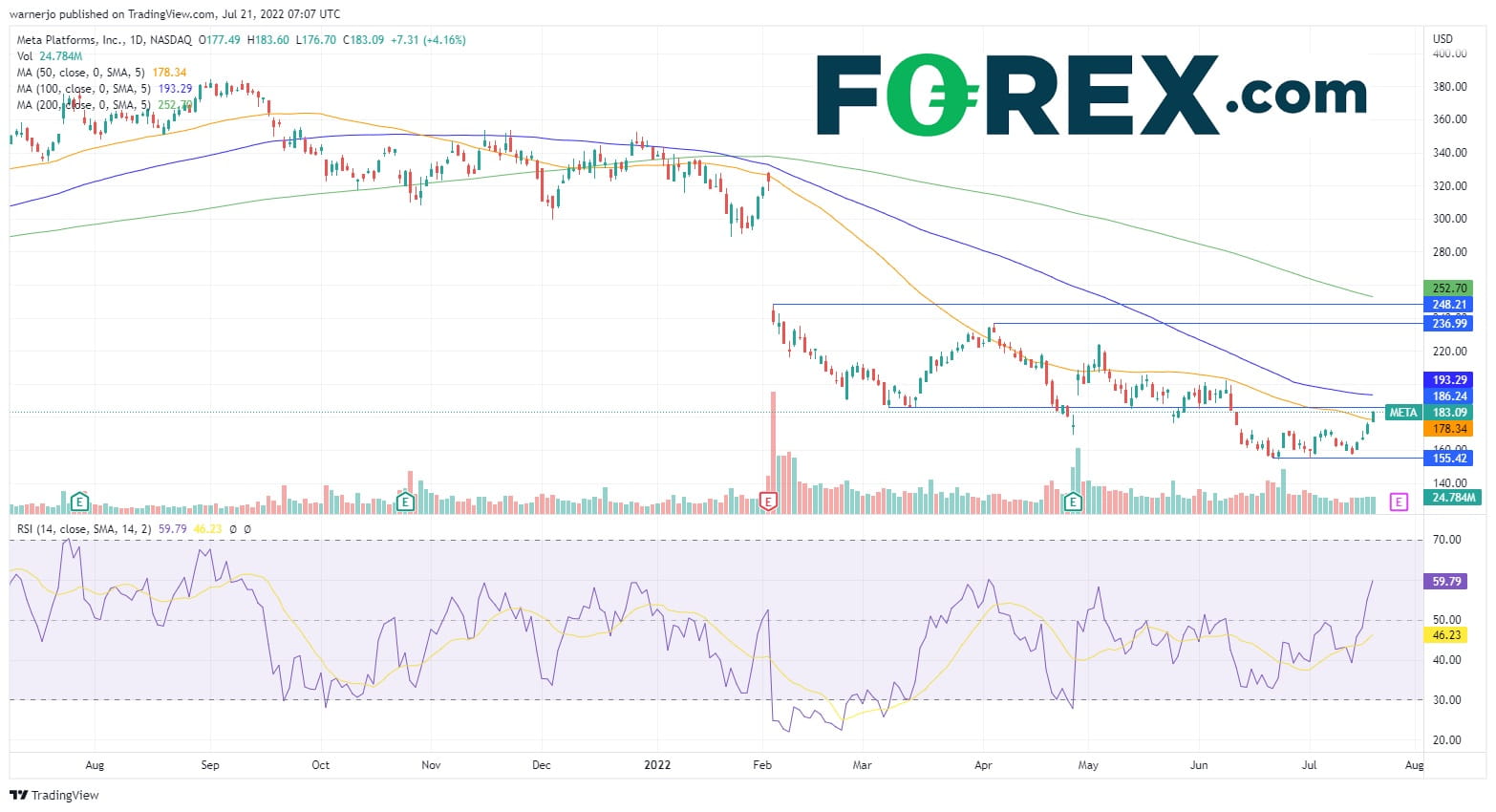
The stock has found higher ground for four consecutive sessions to signal it could be on the rebound after sinking to a 26-month low of $155 last month. Notably, this has coincided with a 10% lift in the average-volume-at-time over the past five days compared to the 10-day average to suggest the stock is gaining traction. However, volumes remain below both the 30-day and 100-day averages. The recent rise in volumes is reinforced by the RSI, which is pushing further into bullish territory.
Shares recaptured the 50-day moving average at $178 yesterday, although investors will want to see a sustained move above here considering it has struggled to stay above this level for too long over since the start of 2022. The next upside targets are now the $186 level of support that has surfaced several times this year, and then the 100-day moving average at $193. We could see the stock target $237 and then $248 from there. Notably, the 61 brokers that cover Meta are largely bullish on the stock’s prospects over the next 12 months with an average target price of $278.72, implying there is over 52% potential upside from current levels.
Any renewed pressure could see Meta shares slump back to $155. Meta will hit new post-pandemic lows if this fails to hold. The 50-day moving average can be treated as an initial floor now that has been recaptured.

How to trade Meta stock
You can trade Meta shares with City Index in just four easy steps:
- Open a City Index account, or log-in if you’re already a customer.
- Search for ‘Meta’ in our award-winning platform
- Choose your position and size, and your stop and limit levels
- Place the trade
Or you can try out your trading strategy risk-free by signing up for our Demo Trading Account.
You can trade Meta shares with Forex.com in just four steps:
- Open a Forex.com account, or log-in if you’re already a customer.
- Search for ‘Meta’ in our award-winning platform
- Choose your position and size, and your stop and limit levels
- Place the trade
Or you can try out your trading strategy risk-free by signing up for our Demo Account.


The complete CFD trading experience
Award-winning platforms, competitive spreads, low commissions and dedicated support.
We live and breathe the markets and are dedicated to helping traders realise their ambitions as we continue to set the industry bar.
Economic calendar
Web Trader platform
Our sophisticated web-based platform is packed with features.
Related articles

NZD/USD pressure mounts as payrolls looms large
NZD/USD has fallen sharply as Fed rate expectations reset higher, but extreme downside stretch and major support raise the risk of a violent counter-trend rebound.

US Core PCE Preview: Stale or Significant for the Fed
Core PCE inflation takes center stage Wednesday, with traders watching for signs of renewed price pressure and clues on whether the Fed could hike again in October.

Australian Dollar Forecast: AUD/USD Four-Week Slide Nears Critical Uptrend Support 9 29 2026
Aussie momentum has deteriorated sharply into quarter-end, with inflation, Core PCE and NFP on tap as AUD/USD closes in on a pivotal technical threshold.

StoneX Europe Ltd may make third party material available on this website which may contain information included but not limited to the conditions of financial markets. The material is for information purposes only and does not contain, and should not be construed as containing, investment advice and/or investment recommendation and/or an investment research and/or an offer of or solicitation for any transactions in financial instruments; any decision to enter into a specific transaction shall be made by the client following an assessment by him/her of their situation.
StoneX Europe Ltd makes no representation or warranty and assumes no liability as to the accuracy or completeness of the information provided, nor any loss arising from any investment based on a recommendation, forecast or other information supplied. You should always seek independent advice as to your suitability to speculate in any related markets and your ability to assume the associated risks, if you are at all unsure. We are not under any obligation to update any such material. Any opinion made may be personal to the author and may not reflect the opinion of StoneX Europe Ltd.