



AUD/USD, NZD/USD Forecast: CPI, RBNZ create volatility events but crude remains king
With swaps markets aggressively pricing further RBNZ tightening and traders still unconvinced the RBA will hike again in June, today’s event risk may prove critical for near-term Aussie and Kiwi direction.
Share this:

- Aussie, Kiwi face major event risk today
- Hawkish RBNZ pricing faces huge test
- Hot Aussie CPI required to rekindle June hike odds
- Crude and dollar show rolls on in FX
CPI, Central Banks and Crude
Wednesday's Australian inflation report and the Reserve Bank of New Zealand (RBNZ) policy decision have the potential to generate sharp short-term volatility across AUD/USD and NZD/USD, especially given how sensitive markets remain to anything that may alter the rates outlook on either side of the Tasman.
While both events are important for near-term price action, traders should also be mindful of the broader macro backdrop currently driving FX markets, especially given the elevated volatility seen across energy markets and the spillover impact that’s continuing to have on broader US dollar performance.
Trimmed Mean Holds the Key
Source: TradingView (AEST shown)
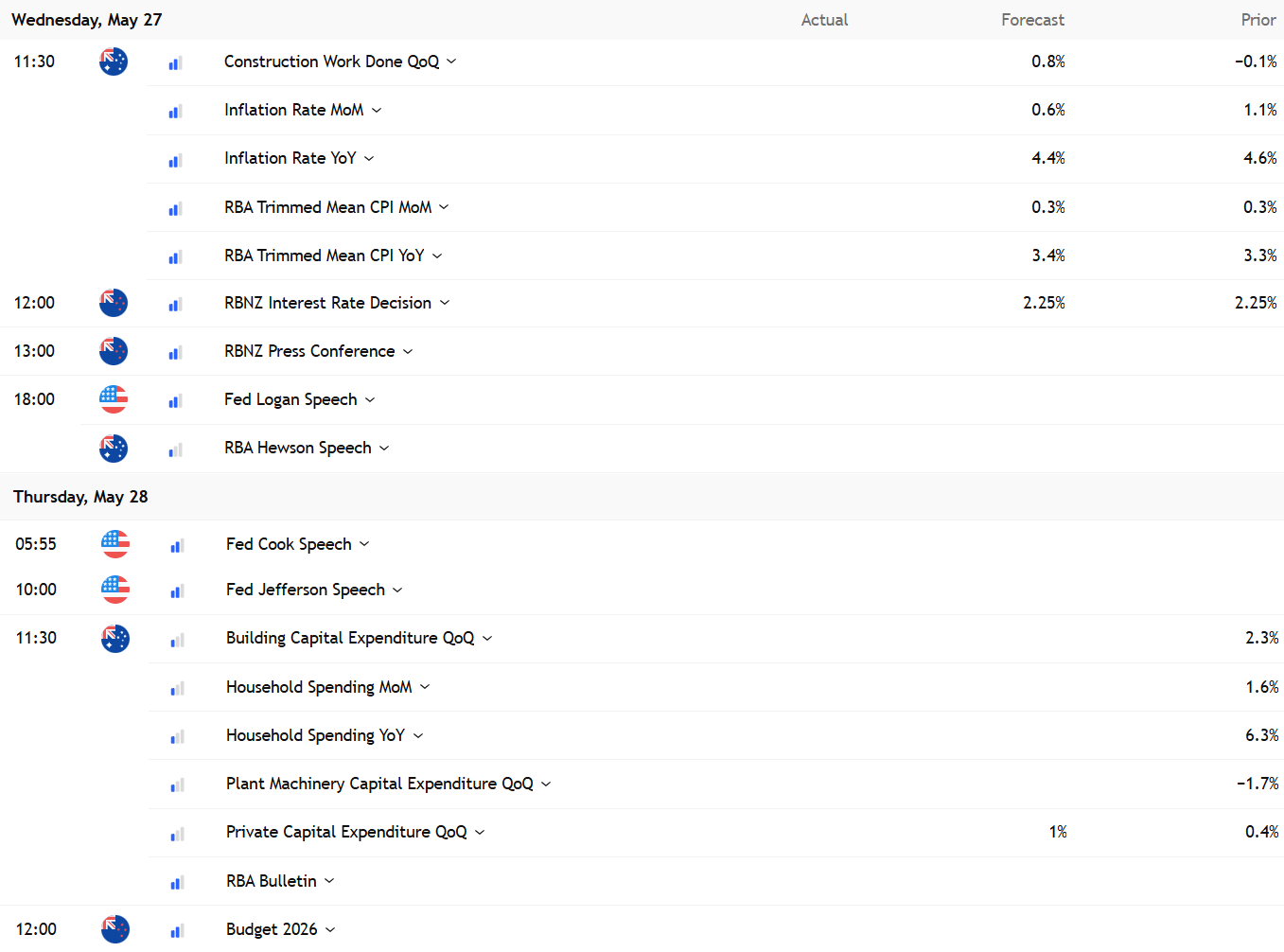
With Australian CPI arriving ahead of the RBNZ policy decision, traders face a concentrated burst of event risk across the Asian session.
For Australia, headline inflation is expected to slow sharply to 0.6% in April, largely reflecting the government’s decision to halve fuel excises in response to the surge in crude oil prices following the Iran war, an effect that was not captured in the March report. However, the bigger focus for markets and the Reserve Bank of Australia (RBA) will be trimmed mean inflation which is expected to hold at 0.3% for the month, lifting the annual pace to 3.4%, nearly a full percentage point above the midpoint of the RBA’s 2-3% target band.
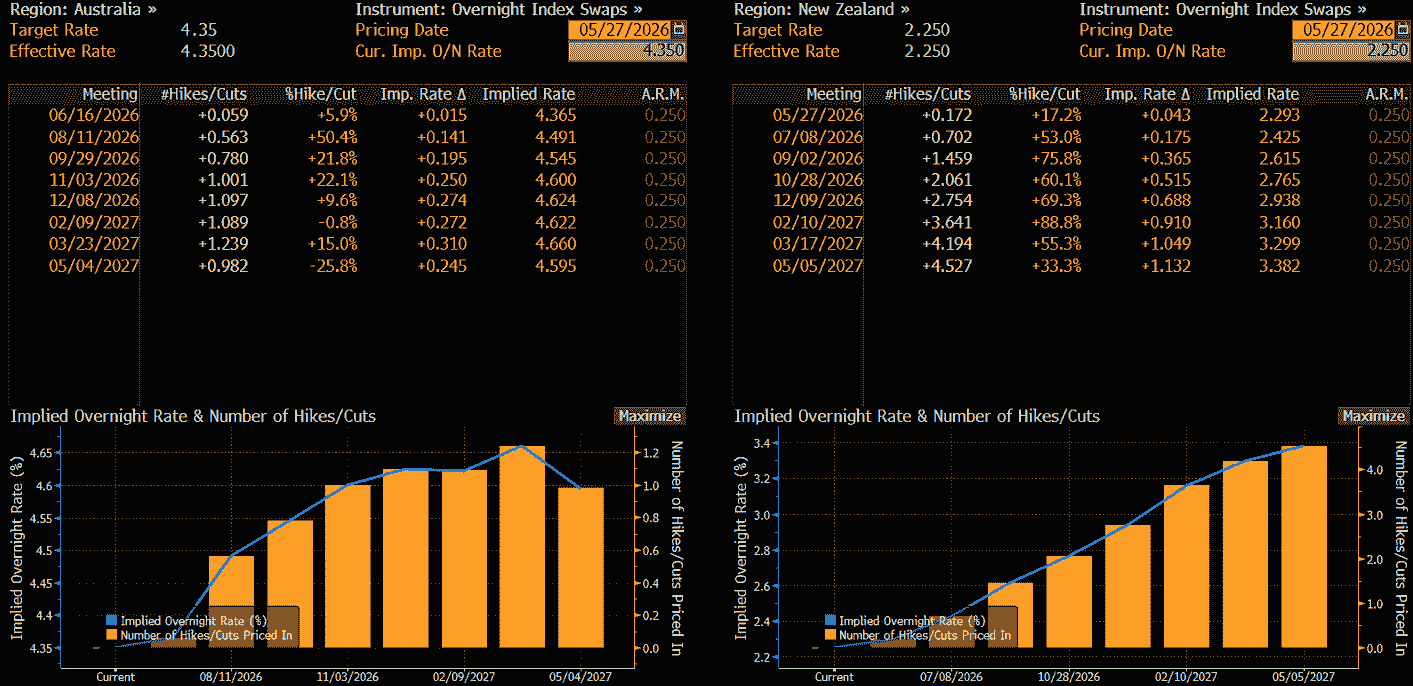
Despite that, after three consecutive rate increases alongside softer activity data and guidance earlier this month hinting a pause in June, swaps traders assign only a 6% probability to another hike when the RBA meets on June 16. That suggests it may take a super-hot trimmed mean print to force markets into meaningfully repricing near-term tightening risk, especially with a full hike not priced until November and August currently viewed as little more than a coin toss.
Beyond the inflation report itself, traders should also keep an eye on comments from independent RBA board member Carolyn Hewson later in the session. Usually, markets only hear from the governor or deputy governor when it comes to policy matters, but with the speech marking the beginning of the bank’s push for greater transparency, markets will pay close attention, especially coming immediately after the inflation release. Nobody knows whether Hewson will discuss policy directly or effectively be sent out carrying a message from the board.
Source: Bloomberg
Will the RBNZ Torch the Economy Again?
Across the Tasman, the Reserve Bank of New Zealand (RBNZ) meeting may prove even more interesting given just how aggressive market pricing has become. Swaps currently imply four rate hikes by March next year, taking the cash rate back into what would theoretically be moderately restrictive territory.
Part of that likely reflects the fact the RBNZ, unlike the RBA, operates with a singular inflation mandate. But one look at the underlying New Zealand economy suggests capacity constraints are the least of policymakers’ problems right now, especially in the labour market where slack appears excessive relative to periods when wage pressures emerged in the recent past.
That leaves markets focused on one key question: will the committee look through the energy-driven inflation spike, or choose to effectively torch the private sector again by hiking rates aggressively? Under former leadership, I’d have honestly leaned towards the latter. But with a new governor now in charge, it’s not difficult to imagine the statement, vote split and Breman’s press conference failing to live up to what is already extremely hawkish pricing.
While little chance of a move is seen at today’s meeting, with swaps assigning only a 17% probability of a hike, July looms as the more important meeting with traders currently pricing around a 70% chance of tightening. Fail to strongly validate that today and the Kiwi is unlikely to fly.
Energy Volatility Still Dominates FX
Source: TradingView
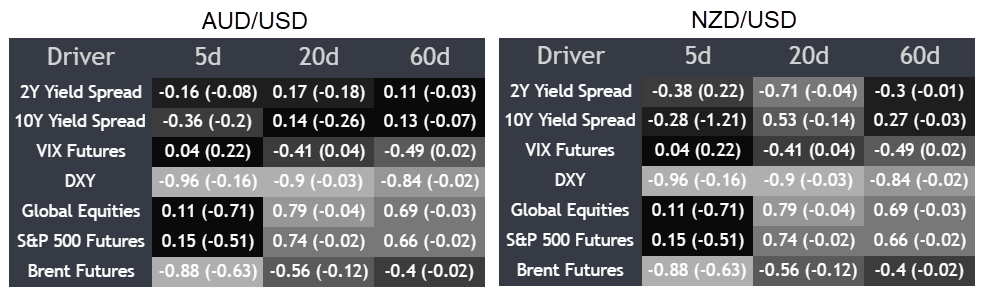
While both local events matter for near-term price action, the broader message from the correlation matrix above is that crude oil and US dollar remain king for broader FX performance. Across both AUD/USD and NZD/USD, the strongest relationships continue to sit with the US dollar index and energy markets, with the five-day correlation between DXY and both pairs sitting at -0.96 while Brent crude correlations sit at -0.88.
That’s important because drivers such as rate spreads have shown far weaker and inconsistent relationships recently, suggesting even major surprises may struggle to generate sustained movement after their release.
Beyond the local event risk, traders should also keep an eye on speeches from Federal Reserve governors Lisa Cook and Philip Jefferson later in the session following Christopher Waller’s hawkish pivot last Friday. Should they reinforce Waller’s message, it would point towards the likelihood of a firmer US dollar backdrop into the North American session.
Aussie Coils Beneath Resistance
Source: TradingView
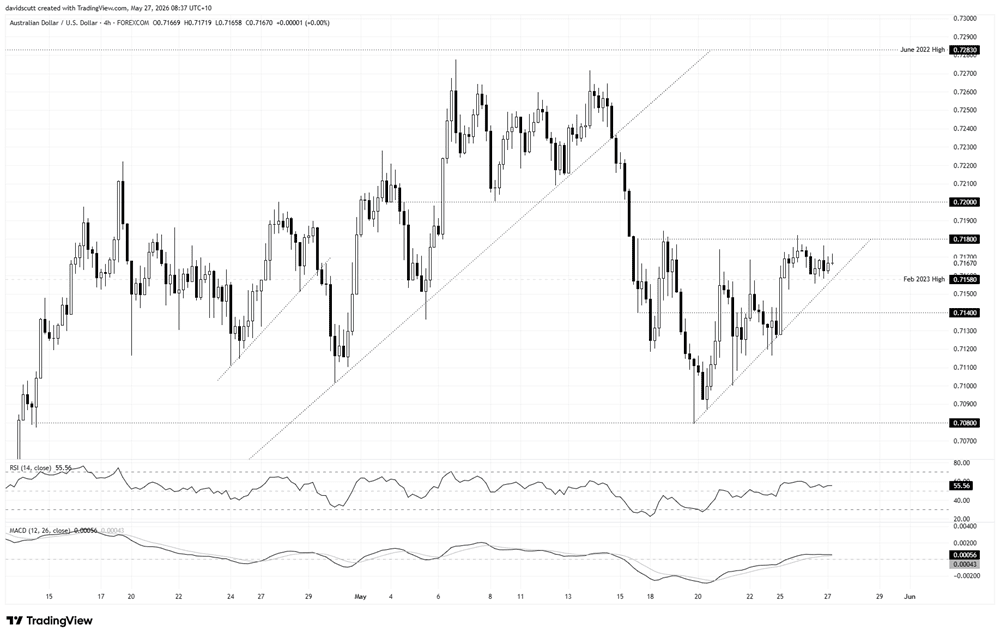
AUD/USD finds itself coiling within an ascending triangle structure on the H4 timeframe, pointing to the risk of an eventual bullish breakout. However, as you’ll see with the Kiwi section below, just because the pair is coiling within a bullish structure does not mean the price action will oblige.
.7180 marks the immediate topside level to watch with a bullish break above it adding to the risk of a possible retest of the multi-year highs above .7270 set earlier this month. .7200 is another level of note located in between, having acted as both support and resistance in the recent past.
Should the pair break lower by slicing through uptrend support, .7140, .7120, .7100 and .7080 either sparked swing lows or have acted as support and resistance recently, making them relevant downside levels should the Aussie roll over.
While the oscillators are delivering a mildly bullish signal, favouring long setups over shorts, I’m not putting much weight on the price action over the past few sessions which has seen both RSI (14) and MACD flatten out.
Kiwi Bulls Need the RBNZ to Deliver
Source: TradingView
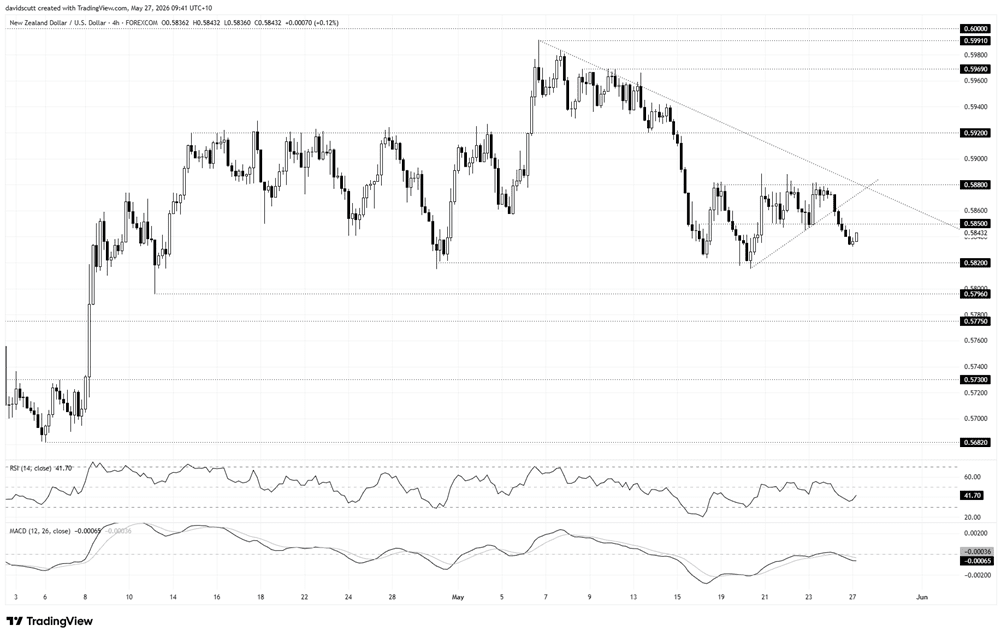
Just as the Aussie is now, the Kiwi was previously coiling within an ascending triangle structure before abruptly breaking down, slicing through horizontal support at .5850 before entering a period of consolidation heading into the RBNZ meeting.
While there’s early evidence of a three-candle morning star pattern forming on the H4 timeframe, with RSI (14) and MACD both still delivering mildly bearish signals, I’m not prepared to act on it before completion.
Beneath where the pair currently trades, levels to watch include support at .5820 along with .5796, the swing low set on April 13. A move beneath the latter would bring .5775, .5750 and .5730 into play for shorts.
Above .5850, the intersection of horizontal and downtrend resistance near .5880 looms as a tough test for bulls should we see a near-term squeeze. If the pair were to break and close above that level, it may be enough to encourage additional longs to join the move seeking a retest of resistance at .5920.

Open an account in minutes
Experience award-winning platforms with fast and secure execution.
Economic calendar
Web Trader platform
Our sophisticated web-based platform is packed with features.
Related articles

Bond yields and crude call the shots for ASX 200
The ASX 200 has rallied on 93% of occasions this year when Australian three-year bond yields have fallen at least five basis points. With crude prices also plunging, the latest breakout has history on its side.

Gold coils for potential breakout as US CPI looms
Gold's ascending triangle is putting $4,140 firmly in focus ahead of US CPI. With traditional macro relationships offering few clues, the price action may prove more useful for traders.

USD/CAD Outlook: Loonie left behind as US CPI looms
USD/CAD's sharp rebound has coincided with widening US–Canada interest rate differentials. With US CPI approaching and bullish momentum building, another breakout may be on the cards.
The information on this web site is not targeted at the general public of any particular country. It is not intended for distribution to residents in any country where such distribution or use would contravene any local law or regulatory requirement. The information and opinions in this report are for general information use only and are not intended as an offer or solicitation with respect to the purchase or sale of any currency or CFD contract. All opinions and information contained in this report are subject to change without notice. This report has been prepared without regard to the specific investment objectives, financial situation and needs of any particular recipient. Any references to historical price movements or levels is informational based on our analysis and we do not represent or warranty that any such movements or levels are likely to reoccur in the future. While the information contained herein was obtained from sources believed to be reliable, author does not guarantee its accuracy or completeness, nor does author assume any liability for any direct, indirect or consequential loss that may result from the reliance by any person upon any such information or opinions.
Futures, Options on Futures, Foreign Exchange and other leveraged products involves significant risk of loss and is not suitable for all investors. Losses can exceed your deposits. Increasing leverage increases risk. Spot Gold and Silver contracts are not subject to regulation under the U.S. Commodity Exchange Act. Contracts for Difference (CFDs) are not available for US residents. Before deciding to trade forex, commodity futures, or digital assets, you should carefully consider your financial objectives, level of experience and risk appetite. Any opinions, news, research, analyses, prices or other information contained herein is intended as general information about the subject matter covered and is provided with the understanding that we do not provide any investment, legal, or tax advice. You should consult with appropriate counsel or other advisors on all investment, legal, or tax matters. References to FOREX.com or GAIN Capital refer to StoneX Group Inc. and its subsidiaries. Please read Characteristics and Risks of Standardized Options.