


Crypto Outlook: Is Uncertainty Still Holding Back the Market?
As the final month of 2026 approaches, a growing sense of indecision has become increasingly evident across the cryptocurrency market. Although the sector attempted to sustain bullish momentum during the week, the recovery has not been strong enough to signal a more consistent return of buying confidence.
Share this:

As the final month of 2026 approaches, a growing sense of indecision has become increasingly evident across the cryptocurrency market. Although the sector attempted to sustain bullish momentum during the week, the recovery has not been strong enough to signal a more consistent return of buying confidence. For now, several factors continue to limit demand, including recent tariff-related announcements and uncertainty surrounding the prospect of higher interest rates in the United States.
This combination of factors has allowed alternative markets perceived as more stable to continue attracting capital away from cryptocurrencies, potentially slowing the recovery in demand across the sector. As long as these risks remain in place, a phase of indecision and neutrality could continue to be an important feature of the crypto market in the short term.

Factors Still Limiting Demand
The week brought important developments on the international trade front. Over recent days, reports emerged that the United States is considering new tariffs on imports from 14 major economies, including tariffs of up to 20% on goods from China and up to 15% on imports from economies such as the European Union and Japan. This has reintroduced a risk that had largely faded from market attention in recent months: the possibility of renewed global trade tensions.
This development has not been particularly favorable for risk assets, as concerns about slower global economic growth typically encourage a more cautious stance among investors. As a result, liquidity available for speculative assets may decline while uncertainty surrounding markets such as cryptocurrencies continues to increase.
However, the most important catalyst remains the outlook for the Federal Reserve. Expectations for a more restrictive monetary policy remained in place throughout the week, and this scenario could even gain additional support from tariff-related developments, as higher import costs could eventually generate additional inflationary pressures within the U.S. economy.
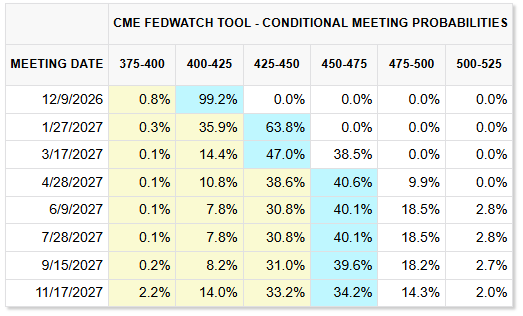
Currently, CME probabilities continue to reflect more than a 99% chance of a rate increase during the December 9 meeting, while the probability of an additional hike in January 2027 remains above 63%. This suggests that markets are not only dealing with trade-related uncertainty but also with expectations of an increasingly restrictive interest-rate environment.
Source: CME
The combination of these two dynamics remains challenging for cryptocurrencies. Both rising trade tensions and a more aggressive central bank can reduce liquidity available for risk assets. In addition, periods of uncertainty often favor more defensive assets, particularly the U.S. dollar.
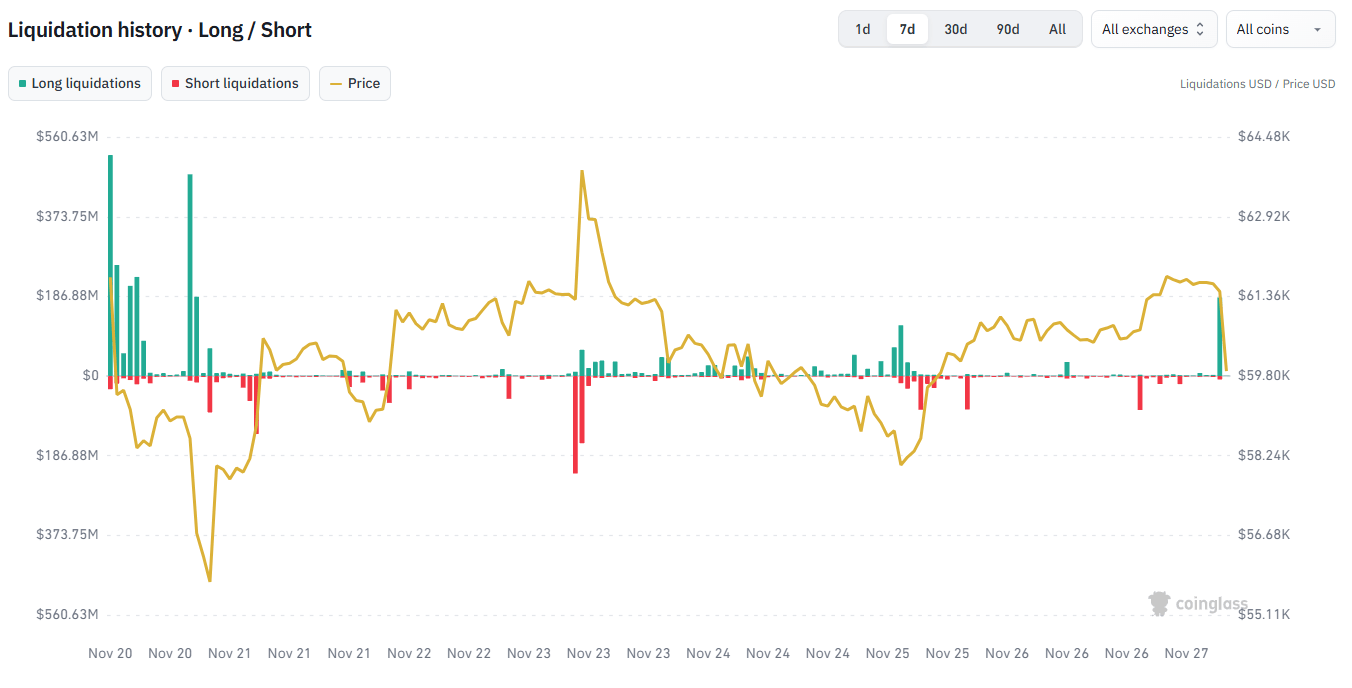
This situation is already beginning to appear in market activity. Looking at liquidation data from the last seven days, long positions continue to account for most liquidations. Toward the end of the week alone, nearly $200 million in long liquidations were recorded across major exchanges. This reflects that demand remains far from stable and continues to struggle to establish a more consistent recovery.
Source: Coinglass
With this in mind, the recovery attempts seen during the week continue to face important obstacles. As long as concerns surrounding a potential trade conflict and higher interest rates remain relevant, demand may continue struggling to recover in a sustained way, reinforcing a dynamic of indecision or even renewed weakness across the cryptocurrency market in the coming weeks.
Bitcoin Versus Other Markets
The current dynamic is not limited to higher-rate expectations or trade-related concerns. Bitcoin's weakness has also been accompanied by the performance of alternative markets such as the U.S. dollar, which typically benefits from both higher interest rates and its role as a liquidity safe haven during periods of uncertainty.
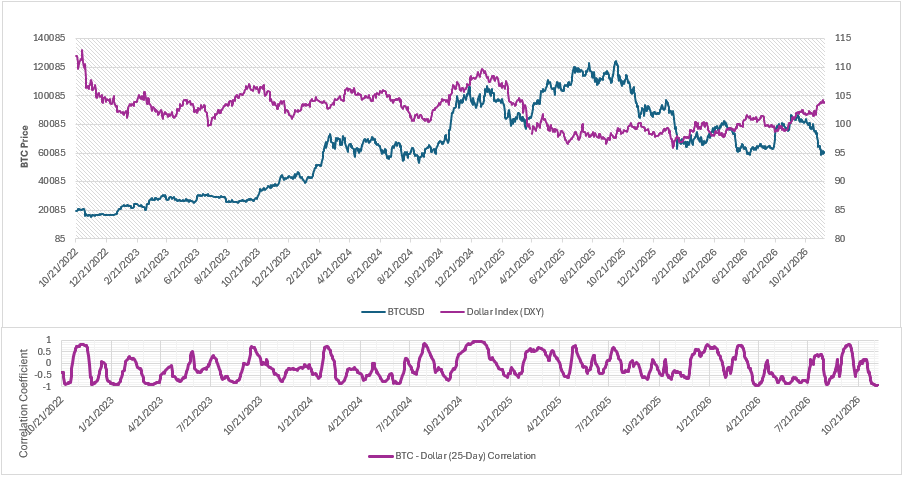
This relationship has become increasingly evident when comparing Bitcoin to the DXY Index. The correlation coefficient between the two assets currently remains close to -1 over the last 25 trading sessions, highlighting a particularly strong inverse relationship in the short term. Correlations can, of course, change over time.
Source: Data – TVC, StoneX, TradingView
This relationship is especially important because while DXY continues trading near recent highs, supported by continued dollar strength, Bitcoin remains unable to sustain a meaningful recovery. This suggests that assets perceived as more stable continue attracting capital that might otherwise flow toward higher-risk alternatives.
Even Bitcoin, as the leading cryptocurrency and benchmark for the broader market, is currently not being viewed as an alternative source of stability. As a result, confidence across the crypto ecosystem continues to slow as defensive assets gain a larger share of market attention.
For this reason, as long as this inverse relationship remains strong and the dollar continues to maintain its strength, the cryptocurrency market may continue facing challenges in rebuilding a more consistent demand backdrop during the short term.
Confidence Remains Near Extreme Lows
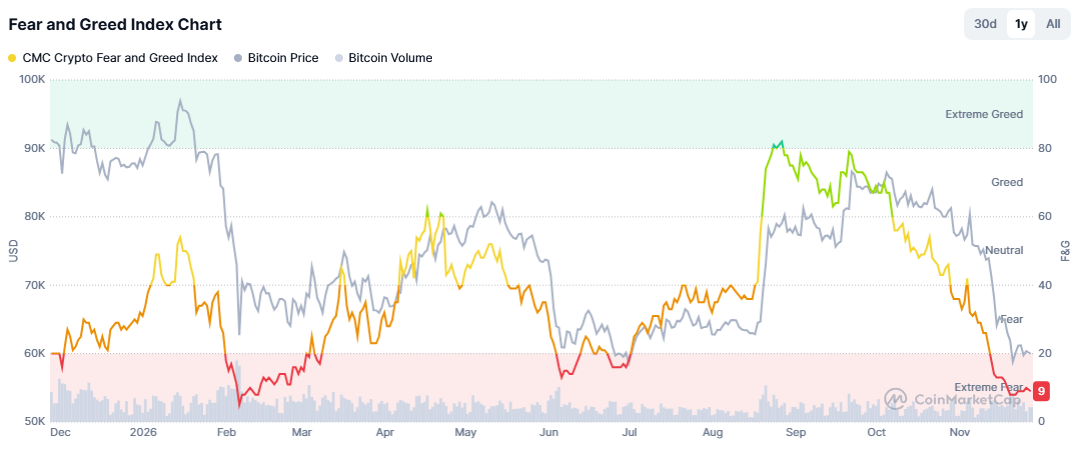
Recent movements in the Fear & Greed Index continue to reflect underlying weakness across the market. The indicator currently stands near 9 points, placing it firmly back in Extreme Fear territory and highlighting that confidence within the cryptocurrency market remains limited despite the recovery attempts seen during the week.
This situation is particularly important because it suggests that the optimism that had started to emerge several weeks ago continues to fade. In other words, while the market has attempted to recover, the move has not been sufficient to generate a meaningful improvement in overall sentiment.
Source: Coinmarketcap
The evolution of this indicator remains important because it serves as a gauge of risk appetite across the cryptocurrency market. If confidence continues to struggle, it could limit the market's ability to sustain more consistent demand and reinforce the perception that capital continues rotating toward alternatives viewed as more stable outside of risk assets.
Under this scenario, the loss of momentum in market confidence could continue supporting a phase of weakness and indecision that has become increasingly visible across the cryptocurrency market and may remain relevant throughout the coming trading sessions.
Written by Julian Pineda, CFA, CMT – Market Analyst
Follow him on: @julianpineda25




Open an account in minutes
Experience award-winning platforms with fast and secure execution.
Economic calendar
Web Trader platform
Our sophisticated web-based platform is packed with features.
Related articles
Crypto Outlook: Is Uncertainty Still Holding Back the Market?
As the final month of 2026 approaches, a growing sense of indecision has become increasingly evident across the cryptocurrency market. Although the sector attempted to sustain bullish momentum during the week, the recovery has not been strong enough to signal a more consistent return of buying confidence.

USD/JPY Weekly Outlook: Fed Hikes, AI Volatility and a Sleeping Yen
USD/JPY is tracking the direction of US rates without responding with its usual magnitude. Can Jensen Huang and the payrolls lottery wake the pair from its slumber?


Bitcoin forecast: BTC/USD steadies as risk appetite returns for now
Bitcoin has steadied around 60,000 after a November slide driven by ETF outflows, weaker liquidity and regulatory doubts. Fawad Razaqzada explains why 65,000 is now the line in the sand.

The information on this web site is not targeted at the general public of any particular country. It is not intended for distribution to residents in any country where such distribution or use would contravene any local law or regulatory requirement. The information and opinions in this report are for general information use only and are not intended as an offer or solicitation with respect to the purchase or sale of any currency or CFD contract. All opinions and information contained in this report are subject to change without notice. This report has been prepared without regard to the specific investment objectives, financial situation and needs of any particular recipient. Any references to historical price movements or levels is informational based on our analysis and we do not represent or warranty that any such movements or levels are likely to reoccur in the future. While the information contained herein was obtained from sources believed to be reliable, author does not guarantee its accuracy or completeness, nor does author assume any liability for any direct, indirect or consequential loss that may result from the reliance by any person upon any such information or opinions.
Futures, Options on Futures, Foreign Exchange and other leveraged products involves significant risk of loss and is not suitable for all investors. Losses can exceed your deposits. Increasing leverage increases risk. Spot Gold and Silver contracts are not subject to regulation under the U.S. Commodity Exchange Act. Contracts for Difference (CFDs) are not available for US residents. Before deciding to trade forex, commodity futures, or digital assets, you should carefully consider your financial objectives, level of experience and risk appetite. Any opinions, news, research, analyses, prices or other information contained herein is intended as general information about the subject matter covered and is provided with the understanding that we do not provide any investment, legal, or tax advice. You should consult with appropriate counsel or other advisors on all investment, legal, or tax matters. References to FOREX.com or GAIN Capital refer to StoneX Group Inc. and its subsidiaries. Please read Characteristics and Risks of Standardized Options.