
- EUR/USD outlook remains mildly bullish amid US shutdown and weak data flow
- Softer energy prices help euro, though weak eurozone data limits upside
- Week ahead quieter for macro releases
The EUR/USD outlook continues to lean cautiously bullish as traders navigate a quieter week in global markets. With the US government shutdown delaying key data releases, investors have shifted focus to private-sector indicators and commentary from Federal Reserve officials. Meanwhile, the euro is finding modest support from easing energy costs, which reduce import burdens for the region, even as sluggish growth data from Germany, France, and Italy weigh on sentiment.
US dollar undermined by delayed data
The US dollar’s brief rebound lost steam last week, reflecting growing conviction that the Fed will cut rates further. Markets now expect two additional cuts before the end of 2025, and possibly another 50 basis points worth of easing in 2026.
Friday’s release of ISM services PMI and speeches from Fed officials couldn’t inject much volatility.
With the government shutdown halting the release of critical labor market and inflation data, investors lack the evidence needed to justify a stronger dollar. On Friday, US Senators failed for a fourth time to pass spending proposals to reopen the government. This means that the shutdown is extending into the week ahead, and possibly longer.
Euro benefits from energy weakness
The euro has quietly strengthened thanks to falling oil and gas prices, which lower import costs and help offset Europe’s otherwise sluggish economic backdrop. The weakness in energy prices has provided a cushion for the single currency even as regional PMIs from major economies like Germany and France continue to signal contraction.
The European Central Bank remains cautious but comfortable with the current policy. There is growing speculation that the cutting cycle is effectively over, with no additional cuts anticipated in 2025 unless inflation or economic data undershoots sharply.
Keep an eye on the upcoming eurozone data, with Sentix Investor Confidence due for release on Monday. Here’s the rest of this week’s data releases:
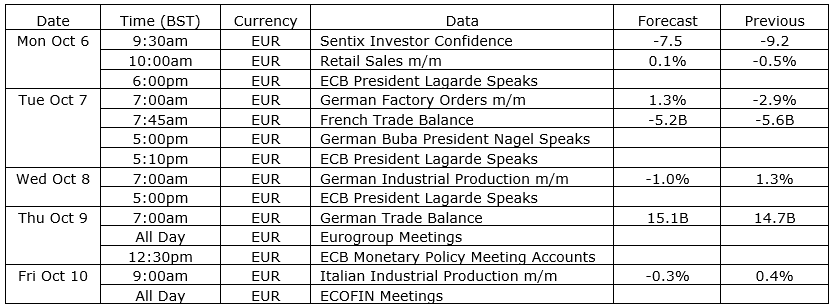
What else to watch this week
The global risk sentiment remains positive which has been lifted by a surge in AI-driven tech stocks. This has supported risk-sensitive assets and currencies. This risk-on tone has indirectly helped the euro by keeping investor appetite away from safe-haven flows into the dollar.
Elsewhere, developments in other major economies could influence broader FX flows. The Reserve Bank of New Zealand (RBNZ) is expected to cut rates by 25 basis points to 2.75% this week, marking its tenth consecutive reduction since August 2024.
Meanwhile, Canada’s employment report on Friday could show continued weakness after two months of heavy job losses, keeping pressure on the loonie and indirectly supporting USD.
Should the US government reopen soon, a backlog of economic data – such as non-farm payroll – could be released all at once, potentially sparking renewed volatility across major currency pairs including EUR/USD.
Technical EUR/USD outlook: Consolidation with mild bullish bias
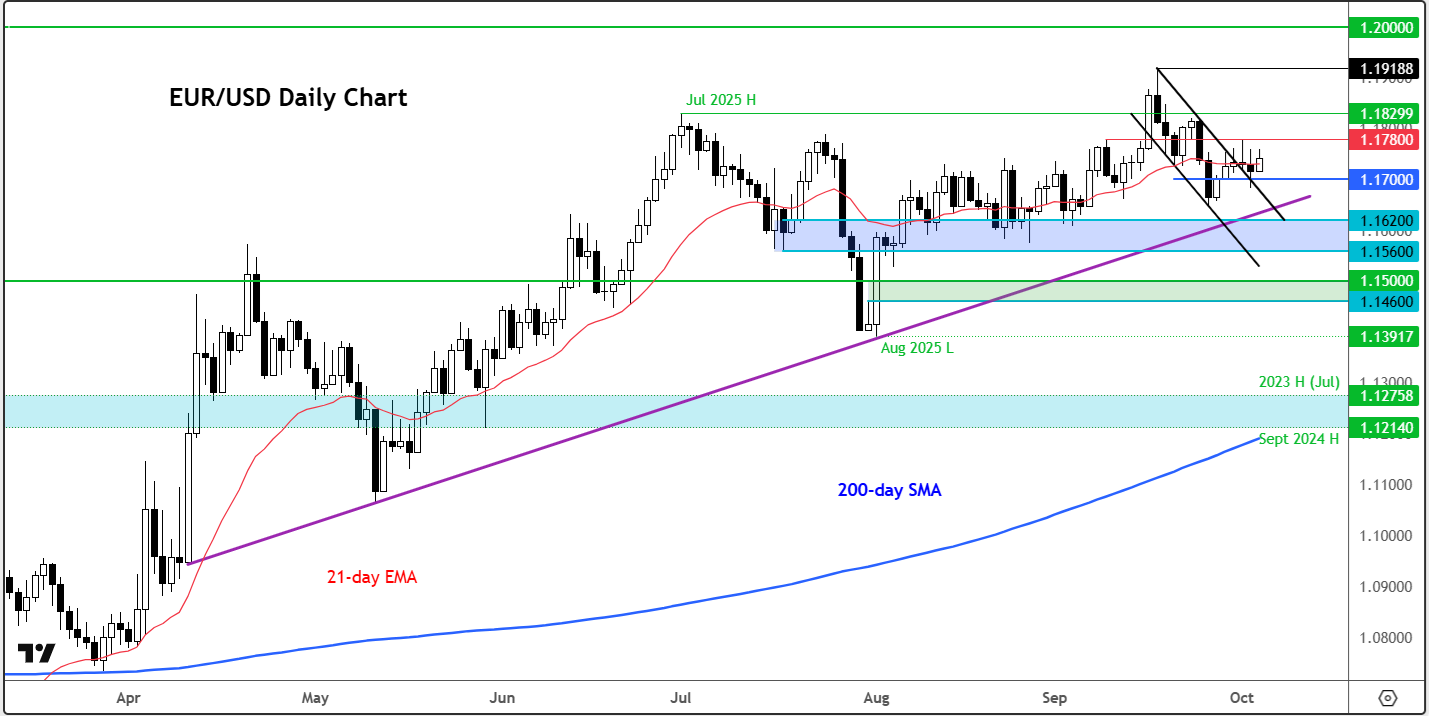
From a technical standpoint, the EUR/USD chart remains range-bound but biased to the upside. The pair is consolidating between 1.1700 and 1.1800, with potentially strong support at 1.1670 and 1.1600. Resistance lies at 1.1850, followed by 1.1900, while the key psychological barrier remains at 1.2000. The pair broke above a short-term bearish channel, which is a positive sign.

-- Written by Fawad Razaqzada, Market Analyst
Follow Fawad on Twitter @Trader_F_R