Sterling has had a poor start to the week. The GBP/USD, which slid more than 1% last week, extended its decline so far into Monday’s session. Meanwhile, the EUR/GBP extended its rally to its highest point since April, despite the single currency struggling against the US dollar following weekend news of higher US tariffs on EU exports. The cable’s losses come after market sentiment soured on the pound following a string of weak UK economic data, which heightened expectations for further rate cuts by the Bank of England this year—starting with a likely reduction in August. At the same time, investor sentiment shifted in favour of the US dollar last week amid speculation that the US may introduce higher tariffs on major trading partners after the extended deadline of August 1. On Friday, Donald Trump signalled a potential 35% tariff on select Canadian imports and then at the weekend floated the possibility of imposing similar or even higher duties—up to 30%—on Mexican and European Union goods if new agreements aren't reached before the deadline. As both the UK and US prepare to release key inflation data this week, the GBP/USD forecast will be tested once again, making it our currency pair of the week.
Dollar could extend gains amid inflation fears and Trump’s fiscal plans
The US dollar found renewed support last week, driven in part by stronger-than-expected economic data and, more notably, growing concerns about inflation. President Trump's threats of higher tariffs and his expansive fiscal policies have raised the prospect of stickier inflation. Although markets still anticipate a potential Federal Reserve rate cut in September, persistent inflationary pressures could cause the Fed to hold steady or slow the pace of monetary easing beyond that. As long as investor confidence in US monetary policy remains intact, the dollar may continue to benefit from this shift in outlook.
Week ahead: UK and US CPI reports could shape GBP/USD forecast
- US CPI – Tuesday, July 15
While the inflationary effects of Trump’s tariffs and proposed fiscal measures have yet to be reflected clearly in economic data, signs of persistent inflation could begin to surface. Should inflation prove more resilient than expected, it may delay or limit the Fed’s ability to cut rates.
- UK CPI – Wednesday, July 16
Fresh data on Friday revealed the UK economy contracted for a second consecutive month amid a deepening manufacturing downturn. The question now is whether ongoing economic weakness and recent pound strength might help tame imported inflation. A soft CPI reading would likely lead markets to price in additional rate cuts later in the year.
- US Retail Sales – Thursday, July 17
Despite ongoing trade tensions, recent indicators suggest the US economy remains relatively resilient. Consumer activity will be in focus following a 0.3% m/m decline in core retail sales in May—a figure expected to rebound in June.
Technical GBP/USD forecast: key levels to watch
Source: TradingView.com
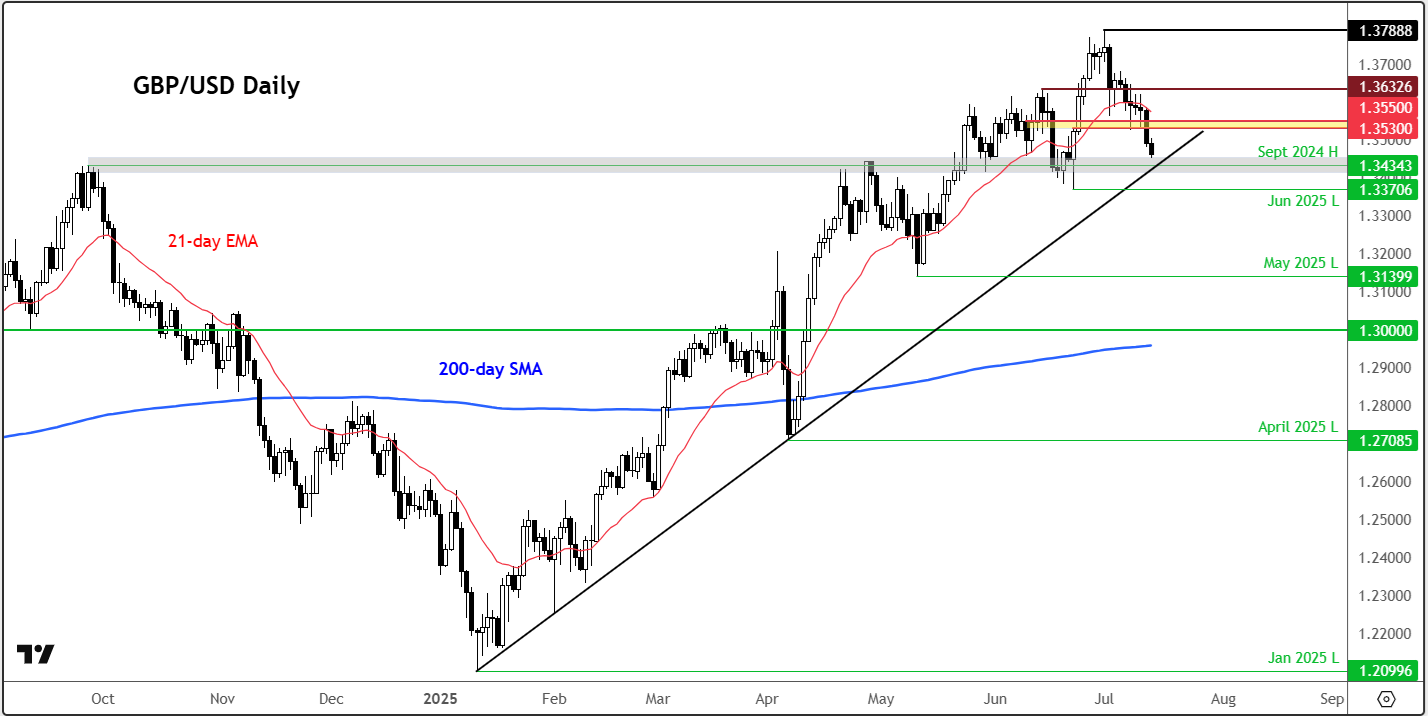
From a technical perspective, the GBP/USD forecast deteriorated after breaching several important short-term support levels, notably around 1.3630 and the 1.3530–1.3550 zone. These levels now act as near-term resistance. On the downside, the next critical level is the September high of 1.3434, followed by the psychological 1.3400 level. This area aligns with a rising trend line, marking a pivotal technical zone for the pair. If we break below here, then watch out for further technical selling below it, targeting liquidity below the June low of 1.3370 initially, ahead of low 1.30s next.
Written by Fawad Razaqzada, Market Analyst