

As the trading week comes to an end, gold price movements continue to show a steady bullish bias, allowing for a gain of more than 2.5% over the past five sessions. Buying pressure has held thanks to weakness in substitute assets—such as 10-year U.S. Treasury bonds—and because overall market confidence has not fully recovered, which has supported a stable short-term rebound in the metal. If these factors persist, buying pressure may continue to dominate in the coming sessions.

Bonds begin to weaken
The ongoing shifts in interest rate expectations ahead of the December 11 Federal Reserve meeting—the last policy decision of 2025—have strengthened the likelihood of an additional 0.25% rate cut. According to CME Group, this scenario now carries an 84.7% probability, aligning with the more accommodative stance the Fed has attempted to maintain toward year-end.
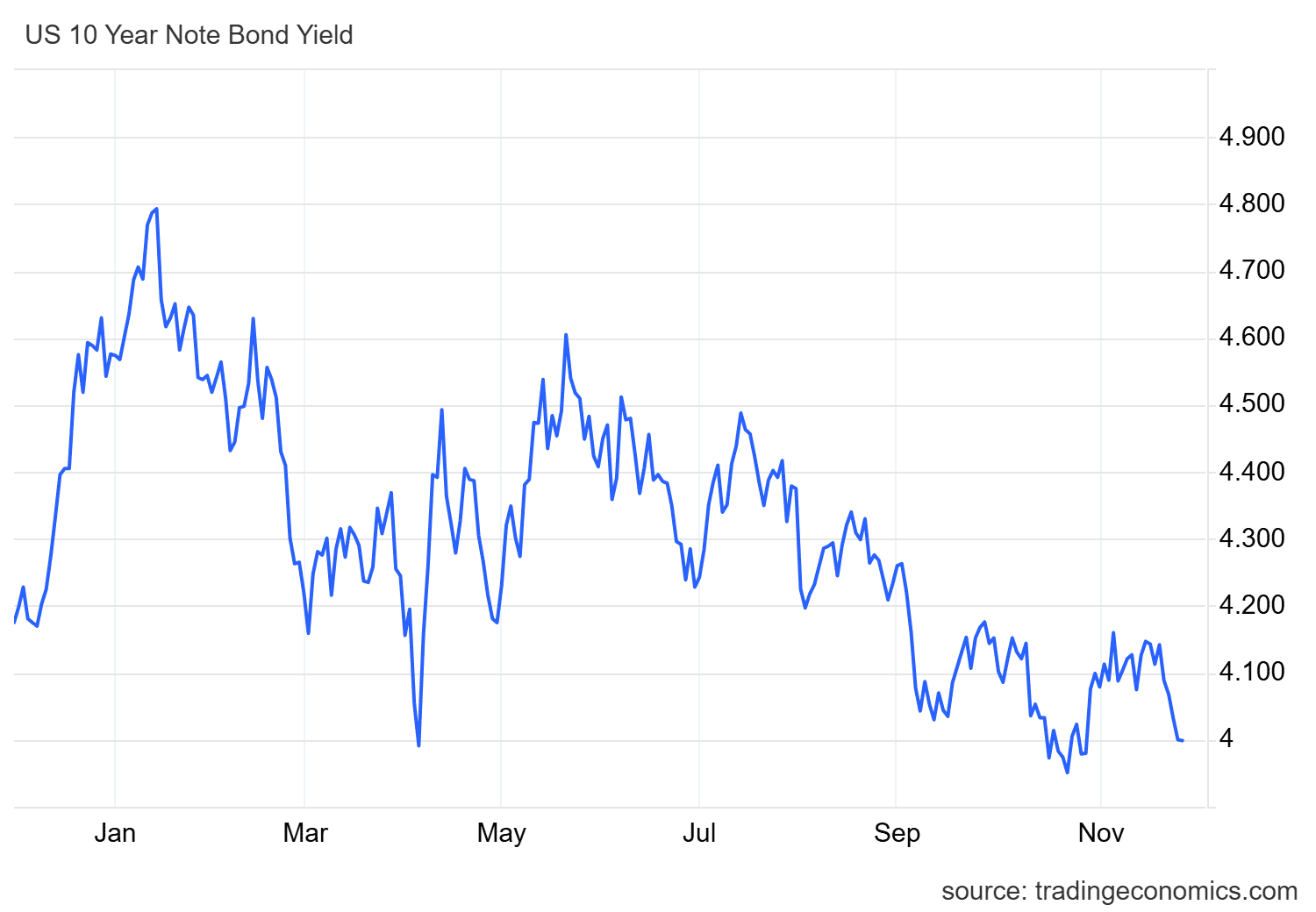
However, these expectations have created a negative environment for 10-year Treasury yields, one of the most important assets compared to gold. Just a few days ago, yields were near 4.2%, but they have since fallen below 4.00%, their short-term stability zone. Lower yields have reduced demand for Treasuries, and part of the market appears to be shifting toward gold as a safe-haven asset, supporting its recent recovery.
Source: TradingEconomics
In this context, the declining appeal of bonds continues to reinforce gold’s role as a safe haven. If lower rates are confirmed in the United States, the additional weakening of yields could support stronger gold demand, becoming a key factor in maintaining consistent buying pressure in the short term.
Is confidence still playing a role?
Although gold has shown strong swings during the second half of 2025, it remains widely considered a key global safe-haven asset. It tends to benefit when market confidence declines and risk appetite weakens.
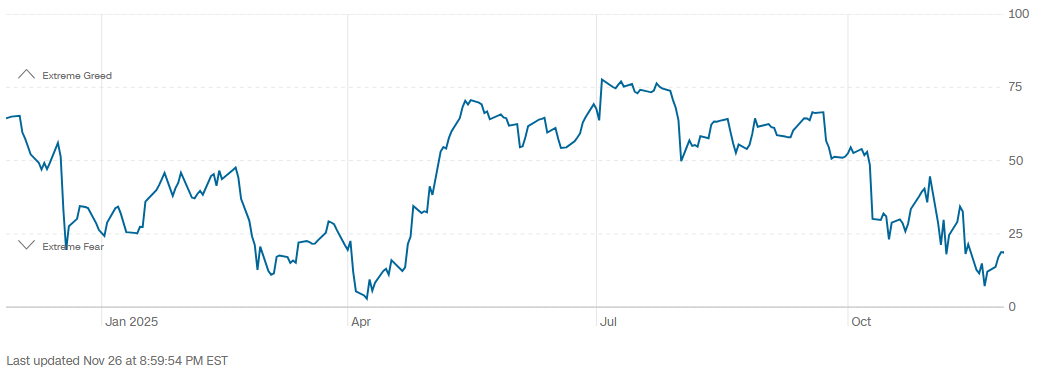
Currently, market confidence has not fully recovered. While the Fear and Greed Index has shown some stabilization, it still hovers around 19 points, within the “extreme fear” zone. This indicates that part of the market continues to perceive heightened risk, which supports demand for safe-haven assets.
Source: CNN
As long as confidence remains in negative territory—and does not move, even temporarily, out of the “extreme fear” zone—safe havens are likely to remain relevant in the short term. In this environment, gold may play a crucial role, and if confidence does not improve, there is a possibility that gold demand will remain strong, reinforcing a bullish bias in XAU/USD over the coming sessions.
Technical Outlook for Gold
Source: StoneX, Tradingview
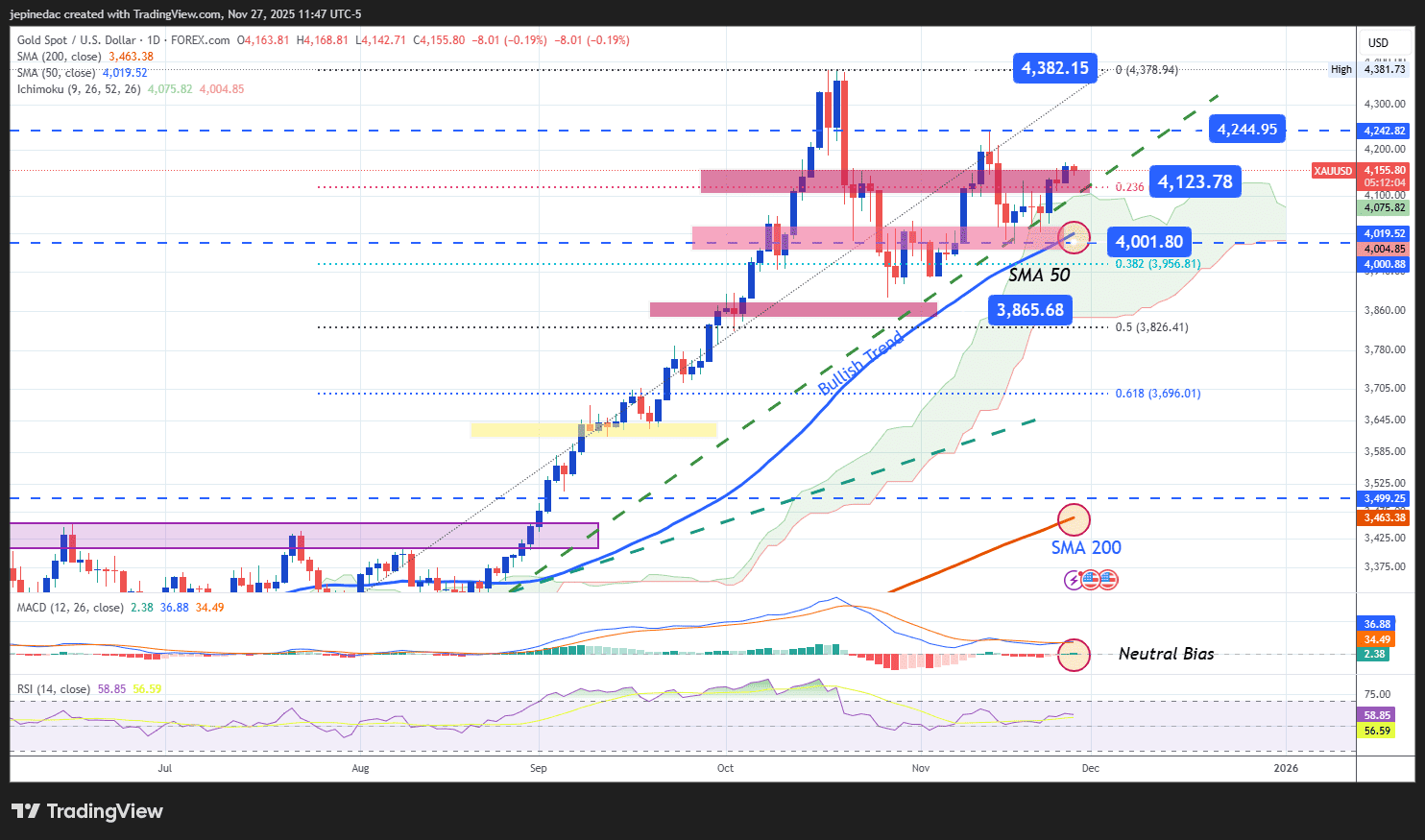
- Uptrend holds: For more than three months, gold has maintained a consistent upward trendline. Despite recent downward corrections, this structure remains intact and shows no signs of breaking. It continues to be the dominant technical formation guiding most price movements. However, recent gains have not been entirely stable, and prolonged neutrality could open the door to a short-term sideways range if buying pressure does not strengthen.
- RSI: The RSI line maintains an upward slope and remains above the neutral 50 level, suggesting bullish momentum over the past 14 sessions. If this continues, it could strengthen a more meaningful bullish bias in the short term.
- MACD: The MACD histogram remains near the zero line, signaling a lack of dominant momentum in short-term moving averages. If this neutrality persists, it may favor a sideways phase without clear bullish or bearish dominance.
Key levels to watch:
- 4,244 USD – Critical resistance: This level corresponds to recent gold highs. A breakout above it could reinforce a stronger bullish impulse, supporting the uptrend and potentially enabling a new attempt toward all-time highs.
- 4,124 USD – Nearby barrier: A zone of short-term neutrality where price has repeatedly pulled back. Failure to break out of this level could lead to a sideways range in the near term.
- 4,000 USD – Critical support: This psychological level aligns with the 38.2% Fibonacci retracement and the 50-period simple moving average. Falling below it would jeopardize the current uptrend and could trigger a more aggressive bearish bias.
Written by Julian Pineda, CFA, CMT – Market Analyst
Follow him at: @julianpineda25