



Nasdaq Analysis: The index starts the week with a bullish bias, approaching the 25,000 level
The trading week has started with a positive bias in Nasdaq price movements in the short term. The equity index recorded a gain of more than 1.4% at the start of the week, amid a slight recovery in market confidence.
Share this:

The trading week has started with a positive bias in Nasdaq price movements in the short term. The equity index recorded a gain of more than 1.4% at the start of the week, amid a slight recovery in market confidence. This occurs in a context where efforts are being made to coordinate a partial reopening of the Strait of Hormuz, while investors also remain attentive to expectations surrounding the U.S. Federal Reserve’s policy decision later this week.
For now, these developments have allowed short-term confidence in the equity markets to show a moderate recovery, which could continue during the coming trading sessions and partially support Nasdaq price movements in the short term.


A temporary sense of calm
Although risk sentiment in financial markets remains a relevant factor due to the ongoing geopolitical conflict in the Middle East, recent updates have allowed market sentiment to show a temporary sense of calm.
The main concern was an extreme scenario in which the Strait of Hormuz could become completely unavailable for shipping in the coming weeks. However, over the weekend it was reported that Iran stated the strait would be closed only to enemy countries, while other non-involved parties could continue navigating through the area. In addition, it was reported that the United States is attempting to organize a naval coalition to secure maritime traffic in the region.
This scenario has led the market to consider that part of the global trade flows could resume sooner than previously expected, something that has already been reflected in the behavior of WTI crude oil, which began the week moving away from the $100 reference level.
Since a major military escalation has not taken place and the worst-case scenario in the Strait of Hormuz has not materialized, confidence in risk markets has begun to recover slightly. At the moment, a positive risk appetite can be observed, particularly in the equity market and among the main components of the Nasdaq 100.
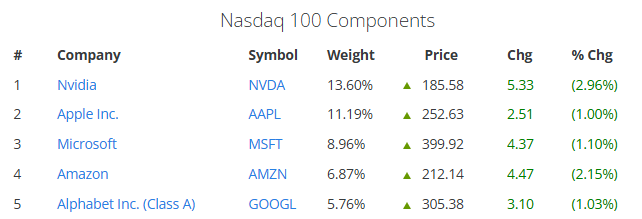
Recent movements show the top five components of the index posting gains: Nvidia rises more than 2.96%, Apple climbs around 1.00%, Microsoft advances 1.10%, Amazon gains about 2.15%, and Alphabet increases roughly 1.03%. This suggests that the positive market bias is reflected in the main components of the index, indicating that confidence has managed to stabilize slightly in the equity market in the short term.
Source: Slickcharts
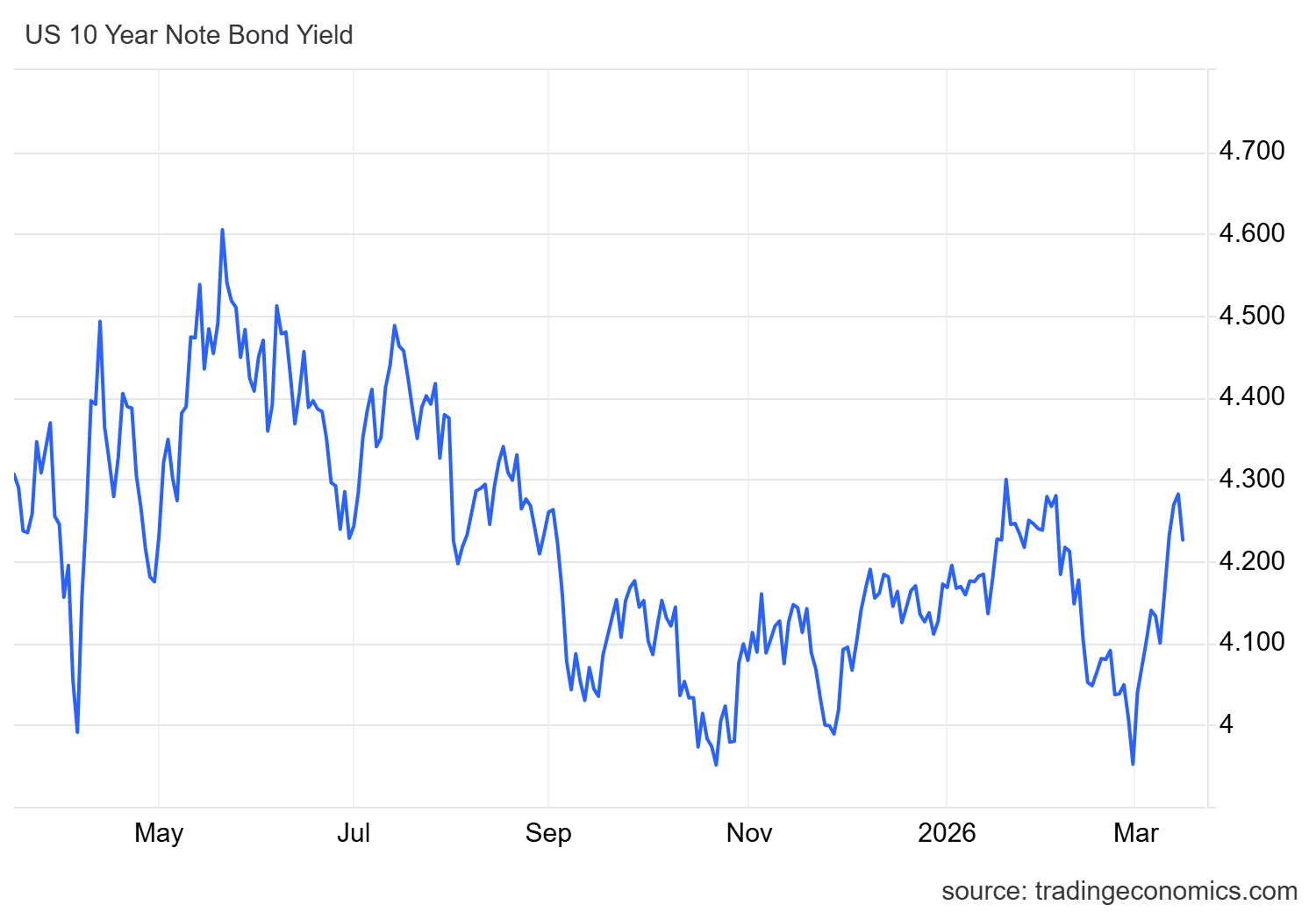
In the same context, it is also important to note that alternative safe-haven assets, such as U.S. 10-year Treasury bonds, have begun to lose attractiveness. The yield has declined from levels close to 4.3% and now trades around 4.2%, reflecting some weakness in the bond market.
The reduction in the attractiveness of these safe-haven assets, combined with the temporary sense of calm, may be allowing interest in risk assets such as the Nasdaq to stabilize more consistently in the short term.
Source: TradingEconomics
In this scenario, if the sense of calm persists and the attractiveness of alternative markets such as bonds continues to decline, this could help demand for equity indices such as the Nasdaq 100 recover in the short term, potentially generating more stable buying pressure in the coming trading sessions.
However, it is important to note that the index has previously shown significant sensitivity to escalations in the conflict, meaning current confidence could deteriorate quickly if new developments increase market risk again.
The market awaits the central bank
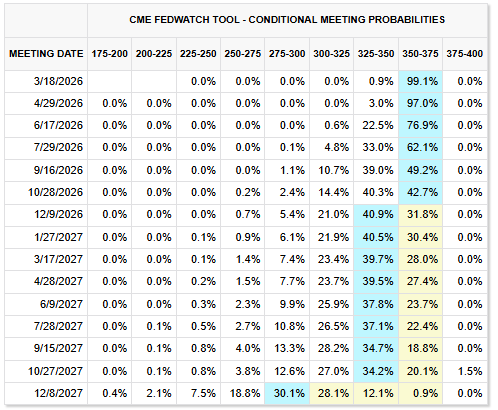
Despite the recent rebound in confidence seen in the Nasdaq index, the Federal Reserve’s policy decision on Wednesday still remains a key event this week. At the moment, the probability outlook shows more than 90% chance that the next two policy decisions will result in no changes to interest rates.
In fact, a potential rate cut is not expected until December 2026, where current probabilities indicate around a 40.9% chance that the policy rate could fall below the current 3.75% level.
Source: CMEGROUP
In this context, markets may remain focused on what could happen with monetary policy in the coming months. If the current scenario of neutral interest rates for an extended period continues, it could eventually affect the performance of the equity market in the coming weeks.
An environment where rate cuts are not anticipated keeps financing costs elevated, which could begin to weigh on the earnings outlook of major companies heading into 2026. For this reason, if this week confirms a neutral rate outlook for a large part of 2026, the recent recovery in Nasdaq confidence could weaken again, potentially leading to renewed episodes of price weakness in the coming sessions.
Nasdaq 100 Technical Outlook
Source: StoneX, Tradingview
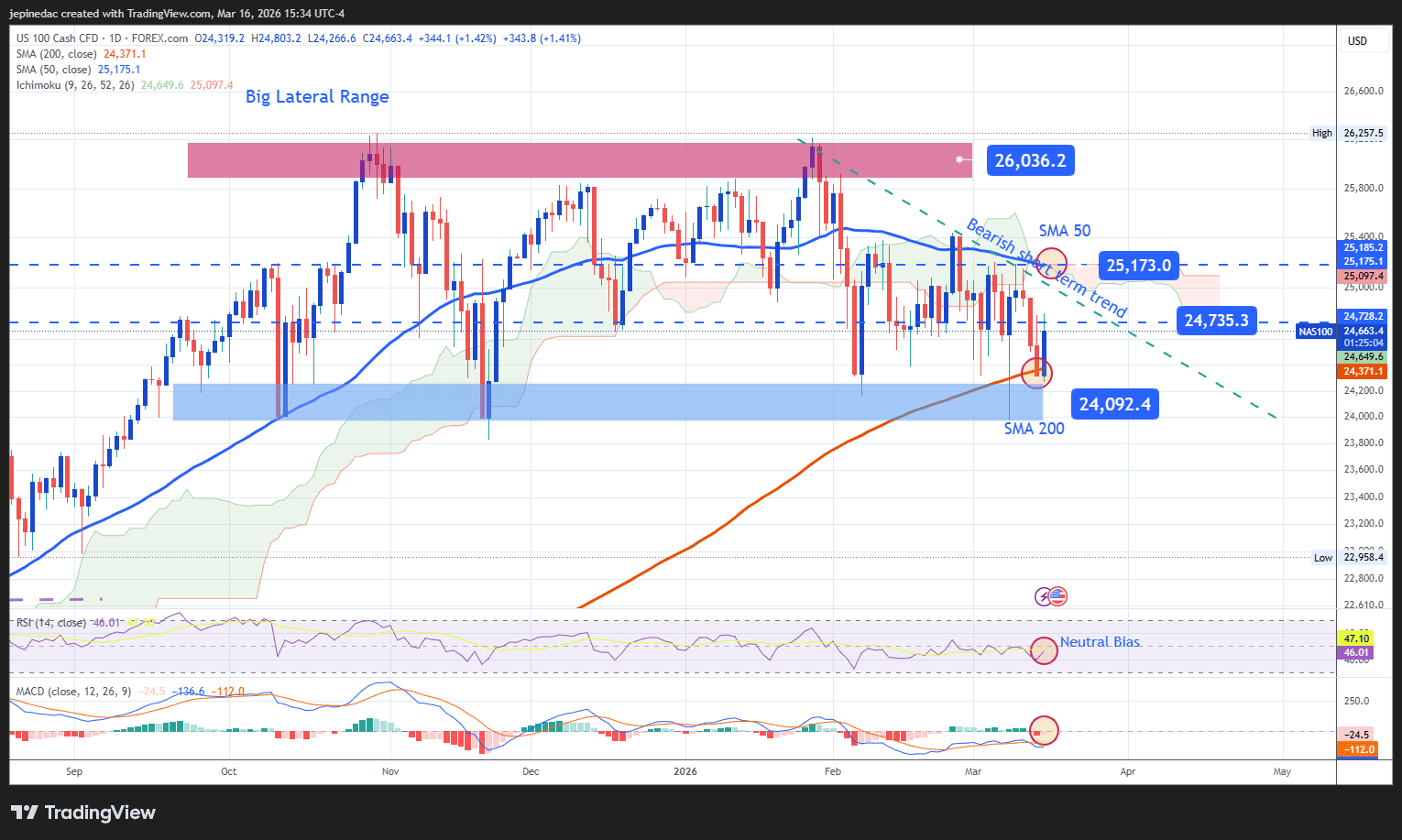
- The recovery is still not enough: Although the index has attempted to consolidate a meaningful rebound at the start of the week, average price movements remain within a broad long-term sideways range, which also coincides with the possible formation of a short-term downward trendline. If the price recovery fails to remain consistent in the coming sessions, the market could move into a phase of indecision or renewed weakness. This suggests that, for now, further development of bullish momentum is still needed before a more structured bullish pattern can be identified on the Nasdaq daily chart.
- RSI: The RSI indicator continues to oscillate around the neutral 50 level, suggesting that buying and selling momentum remains relatively balanced. As long as the indicator continues to move around this level, a neutral market sentiment could remain present in the coming sessions.
- MACD: A similar scenario can be observed in the MACD indicator, whose histogram continues to oscillate close to the zero line, suggesting that no dominant force currently exists in the short-term moving average dynamics. This could reinforce the idea of a neutral phase in recent price movements.
Key levels:
- 25,173 points – Key resistance: Level located near the barrier formed by the potential downward trendline and the 50-period simple moving average. Price movements above this level could invalidate the current bearish structure and open the door for a dominant bullish bias in the coming sessions.
- 24,735 points – Near-term barrier: A relevant neutrality zone observed during recent weeks. If price movements fail to move decisively away from this level, the market could enter a phase of indecision, extending the broad sideways range seen in the index in recent months.
- 24,092 points – Key support: Level corresponding to the lower boundary of the sideways range, which also aligns with the 200-period simple moving average. Price movements below this level could activate a relevant bearish bias, reinforcing the potential downward trendline in the coming weeks.
Written by Julian Pineda, CFA, CMT – Market Analyst
Follow him on: @julianpineda25




Open an account in minutes
Experience award-winning platforms with fast and secure execution.
Economic calendar
Web Trader platform
Our sophisticated web-based platform is packed with features.
Related articles

Nasdaq 100 Forecast: Nvidia CEO Huang is Out – What’s Next for NDX?
While the issue is as idiosyncratic as it gets, Nvidia’s turmoil may nonetheless have broader market implications for the Nasdaq 100 and AI trade as a whole.

Nasdaq 100 forecast: Nvidia troubles put AI recovery into question
The recovery for major indices this week has helped repair much of the technical damage inflicted by last week’s sell-off, but the latest developments with Nvidia suggest investors are not quite ready to put the underlying risks behind them. The Nasdaq 100 led other US index futures lower overnight, with falls of around 0.8%.

ASX 200 Outlook: Sector Rotation Builds as Rally Nears Record High
The ASX 200 nears record highs as sector rotation gathers pace. Could the RBA be nearing peak rates, and will resistance at 9200 trigger a pullback?

The information on this web site is not targeted at the general public of any particular country. It is not intended for distribution to residents in any country where such distribution or use would contravene any local law or regulatory requirement. The information and opinions in this report are for general information use only and are not intended as an offer or solicitation with respect to the purchase or sale of any currency or CFD contract. All opinions and information contained in this report are subject to change without notice. This report has been prepared without regard to the specific investment objectives, financial situation and needs of any particular recipient. Any references to historical price movements or levels is informational based on our analysis and we do not represent or warranty that any such movements or levels are likely to reoccur in the future. While the information contained herein was obtained from sources believed to be reliable, author does not guarantee its accuracy or completeness, nor does author assume any liability for any direct, indirect or consequential loss that may result from the reliance by any person upon any such information or opinions.
Futures, Options on Futures, Foreign Exchange and other leveraged products involves significant risk of loss and is not suitable for all investors. Losses can exceed your deposits. Increasing leverage increases risk. Spot Gold and Silver contracts are not subject to regulation under the U.S. Commodity Exchange Act. Contracts for Difference (CFDs) are not available for US residents. Before deciding to trade forex, commodity futures, or digital assets, you should carefully consider your financial objectives, level of experience and risk appetite. Any opinions, news, research, analyses, prices or other information contained herein is intended as general information about the subject matter covered and is provided with the understanding that we do not provide any investment, legal, or tax advice. You should consult with appropriate counsel or other advisors on all investment, legal, or tax matters. References to FOREX.com or GAIN Capital refer to StoneX Group Inc. and its subsidiaries. Please read Characteristics and Risks of Standardized Options.