





NZD/USD Outlook: New Zealand Dollar Weakens Ahead of RBNZ Decision
The NZD/USD pair has fallen more than 1% over the past four trading sessions, favoring the U.S. dollar over the New Zealand dollar. For now, the bearish bias remains intact as the market awaits the Reserve Bank of New Zealand’s (RBNZ) interest rate decision.
Share this:

The NZD/USD pair has fallen more than 1% over the past four trading sessions, favoring the U.S. dollar over the New Zealand dollar. For now, the bearish bias remains intact as the market awaits the Reserve Bank of New Zealand’s (RBNZ) interest rate decision, amid continued uncertainty surrounding the Federal Reserve’s next moves. If New Zealand confirms a rate cut, selling pressure on the pair could intensify in the short term.
RBNZ Decision Day Arrives
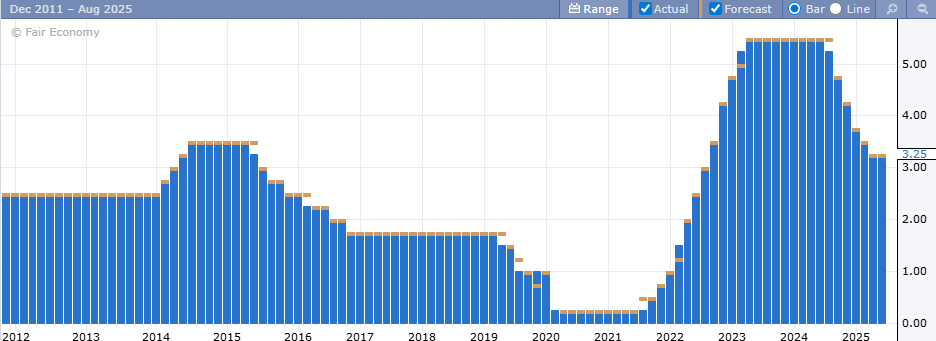
Today, the RBNZ is expected to announce its next monetary policy decision, and current consensus points to a 25-basis point cut, bringing the rate from 3.25% down to 3.00%. Markets believe the central bank views inflation as under control, with the most recent annual figure at 2.7%, comfortably below the 3% upper limit of its inflation target. Signs of labor market weakness have also emerged, reinforcing the case for starting a new rate-cutting cycle, likely holding the rate at 3.00% in the short term.
Source: ForexFactory
In this environment, pressure on the New Zealand dollar has started to build. A lower interest rate reduces the country’s investment appeal, particularly for fixed-income instruments, and could lead to capital outflows toward economies with higher yields, weakening demand for the NZD. If the RBNZ confirms a dovish tone and signals further cuts ahead, downward pressure on NZD/USD is likely to persist in the coming sessions.
What About the U.S.?
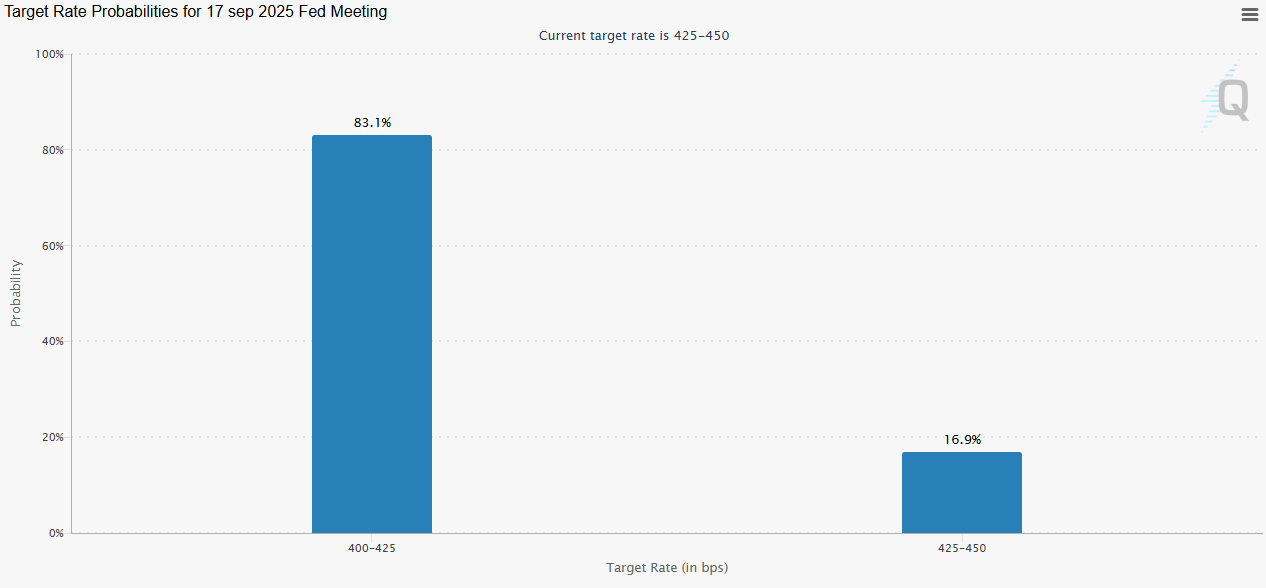
The situation at the Federal Reserve is becoming increasingly similar. Market participants are raising the probability that the Fed will also begin a rate-cutting cycle. According to data from CME Group, there is currently an 83.1% chance of a rate cut from 4.5% to 4.25% at the next September 17 meeting, which would align with the stance expected from the RBNZ.
Source: CMEGroup
However, the market remains more focused on the current interest rate differential, as the U.S. rate (4.5%) is still significantly higher than that of New Zealand (potentially 3.0%). Additionally, the Jackson Hole Symposium takes place this week, and key remarks from the Fed are expected. These could clarify whether the Fed is truly ready to begin cutting rates soon, or if it prefers a more cautious approach.
For now, this rate differential and the uncertainty around U.S. monetary policy continue to favor the U.S. dollar, which also offers more attractive returns on its dollar-denominated securities. This dynamic has increased demand for the greenback and may continue to put downward pressure on NZD/USD, especially if the Fed maintains a less dovish stance than the RBNZ.
NZD/USD Technical Outlook
Source: StoneX, Tradingview
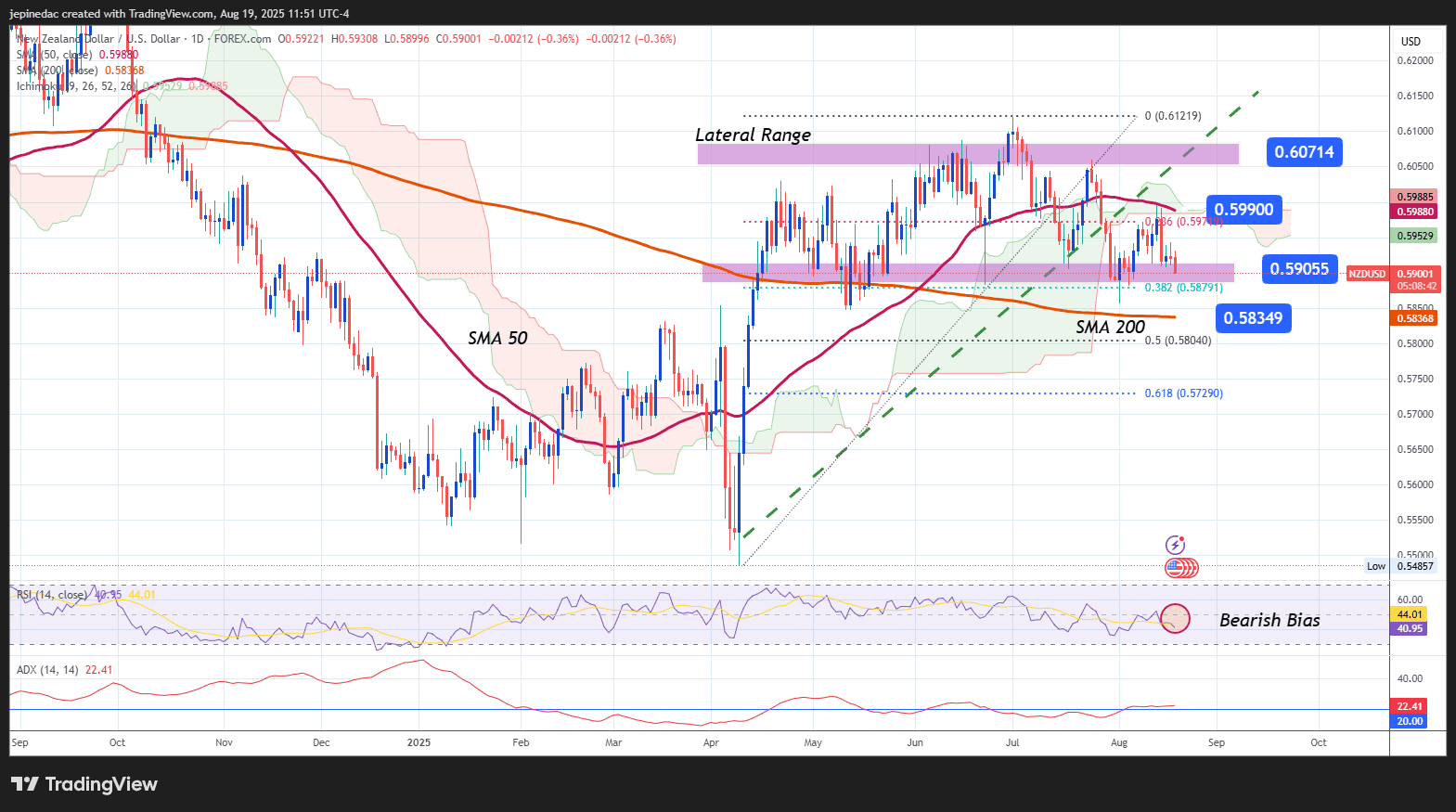
- Consolidated Sideways Channel: Since late April, the NZD/USD pair has traded within a well-defined lateral channel, with resistance around 0.60714 and support at 0.59055. So far, bearish swings have not been strong enough to break below the channel’s base, keeping this structure as the main technical reference for the coming sessions. However, if selling pressure continues to build, a breakdown of the channel could signal the start of a new bearish trend.
- RSI: The Relative Strength Index has begun fluctuating consistently below the 50 level, indicating that bearish momentum is gaining ground. If this persists, the downward bias could strengthen in the short term.
- ADX: The ADX line remains above the neutral level of 20, suggesting active volatility, though without a clearly dominant direction yet. As the RBNZ decision approaches, volatility may increase, and the indicator could reflect stronger directional movement if a channel break is confirmed.
Key Levels:
- 0.59900 – Key Resistance: Located at the midpoint of the channel, this level also aligns with the Ichimoku cloud and the 50-period moving average. Price action near this zone could keep the pair within its current range.
- 0.59055 – Immediate Support: This marks the bottom of the channel and coincides with the 38.2% Fibonacci retracement. A bearish breakout here could trigger a stronger selling bias in the short term.
- 0.58349 – Major Support: Aligned with the 200-period simple moving average, this is the most critical technical barrier in the event of a breakdown. If price moves below this level, it could confirm a structural shift, opening the door to a sustained downtrend.
Written by Julian Pineda, CFA – Market Analyst
Follow him on: @julianpineda25
Related tags:

Open an account in minutes
Experience award-winning platforms with fast and secure execution.
Economic calendar
Web Trader platform
Our sophisticated web-based platform is packed with features.
Related articles

USD/JPY, USD/CAD Outlook: Fed hawks put dollar bulls on alert
Hotter US inflation and hawkish Fed commentary have triggered a sharp repricing of interest rate expectations. USD/JPY and USD/CAD are in focus as the dollar's sensitivity to Fed policy strengthens.


Gold Feels the Weight of USD, Yields on Hawkish Fed and CPI
Gold remains under pressure as hot US CPI, rising Treasury yields and hawkish Fed commentary support the US dollar. Bears eye another break below $4,000

Bitcoin Analysis: BTC Weakness Deepens as Price Approaches $70K
These continue to be challenging sessions for Bitcoin in the short term. The cryptocurrency keeps losing ground consistently and has declined nearly 2.7% over the last three trading sessions, highlighting a phase of weakness that is becoming increasingly relevant within the market.
The information on this web site is not targeted at the general public of any particular country. It is not intended for distribution to residents in any country where such distribution or use would contravene any local law or regulatory requirement. The information and opinions in this report are for general information use only and are not intended as an offer or solicitation with respect to the purchase or sale of any currency or CFD contract. All opinions and information contained in this report are subject to change without notice. This report has been prepared without regard to the specific investment objectives, financial situation and needs of any particular recipient. Any references to historical price movements or levels is informational based on our analysis and we do not represent or warranty that any such movements or levels are likely to reoccur in the future. While the information contained herein was obtained from sources believed to be reliable, author does not guarantee its accuracy or completeness, nor does author assume any liability for any direct, indirect or consequential loss that may result from the reliance by any person upon any such information or opinions.
Futures, Options on Futures, Foreign Exchange and other leveraged products involves significant risk of loss and is not suitable for all investors. Losses can exceed your deposits. Increasing leverage increases risk. Spot Gold and Silver contracts are not subject to regulation under the U.S. Commodity Exchange Act. Contracts for Difference (CFDs) are not available for US residents. Before deciding to trade forex, commodity futures, or digital assets, you should carefully consider your financial objectives, level of experience and risk appetite. Any opinions, news, research, analyses, prices or other information contained herein is intended as general information about the subject matter covered and is provided with the understanding that we do not provide any investment, legal, or tax advice. You should consult with appropriate counsel or other advisors on all investment, legal, or tax matters. References to FOREX.com or GAIN Capital refer to StoneX Group Inc. and its subsidiaries. Please read Characteristics and Risks of Standardized Options.