

US futures
Dow futures -0.56%, S&P 500 futures -1.35% & Nasdaq futures -2.2%
European futures
FTSE -0.2%, DAX 0.86%
- US stocks fall with tech leading declines amid AI spending fears
- Meta free cash flow turns negative for the first time since 2012
- Tesla and Lam Research fall post-earnings
- Oil prices jump on Middle East supply worries
U.S. stocks fall as Meta spending concerns and rising oil prices weigh
U.S. stocks are falling sharply on Thursday, led by the tech sector, as Meta Platforms' negative free cash flow unnerved markets, while oil prices continued rising, adding to inflationary concerns.
While Meta beat Wall Street's expectations, reporting record revenue, negative free cash flow for the first time since 2012 comes amid an 80% year-on-year increase in AI infrastructure spending.
The rotation out of tech and into Treasuries has pulled yields significantly lower, with the 10-year Treasury yield dropping 11 basis points to 5.02%. The decline in yields comes even as oil prices extend gains, suggesting investors are becoming more concerned about the outlook for tech earnings and AI spending.
Oil prices have risen, with Brent touching $113 a barrel, amid reports of detailed plans for renewed strikes against Iran after the U.S. midterm elections.
This week has been quiet for U.S. economic data. U.S. jobless claims unexpectedly fell, while continuing claims rose.
The data does little to change expectations surrounding next week's FOMC meeting, where the Federal Reserve is expected to leave rates unchanged. However, the Fed is widely expected to hike rates before the end of the year.
Corporate movers
Tesla is falling 3% after mixed third-quarter earnings. The company earned 48 cents per share on an adjusted basis and posted revenue of $28.05 billion, slightly short of the $28.13 billion forecast. The share price has given up earlier gains.
Lam Research, the AI equipment maker, has fallen as much as 10% owing to supply chain constraints, which impacted its revenue guidance.
Meta is falling 6% on the open despite a strong quarter, with revenue coming in at $64.6 billion against $63.34 billion estimated, up 26% year-on-year. Q4 guidance of $73 billion–$76 billion was also above the $73.64 billion expected. Capital spending remains substantial, with the 2026 forecast at $135 billion–$145 billion. The top end is unchanged, while the range has narrowed.
However, free cash flow turned negative, with a deficit of $12.12 billion against positive cash flow a year earlier. This highlights the pressure that heavy AI investment is putting on cash generation. Advertising revenue grew 26%, and engagement is at all-time highs, but investors are increasingly focused on how much this growth is costing.
Spotify is trading 5% higher after Q4 revenue guidance exceeded expectations. Spotify also reported that active users rose 11% year-on-year to 788 million.
Energy stocks are rising as oil prices surge on renewed geopolitical fears. ConocoPhillips is up 1%, while Kinder Morgan has climbed 2%.
S&P 500 forecast – technical analysis
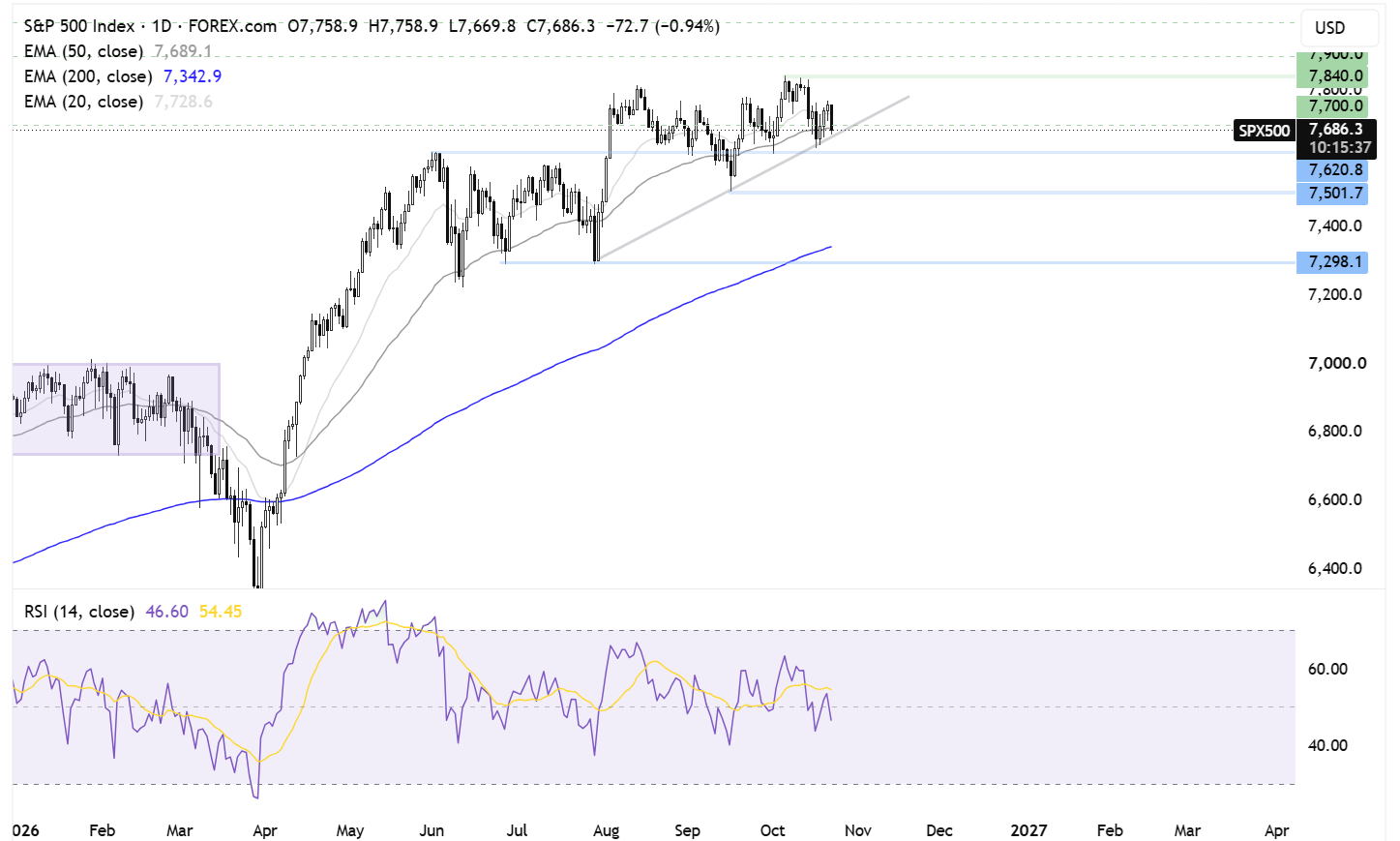
The S&P 500 has pulled back from its record high of 7,830, trading at 7,680 at the time of writing. The price is testing support at the 50 EMA while remaining above the rising trend line and 200 EMA, keeping the constructive outlook intact for now.
Should support at the 50 EMA hold, buyers will look to extend gains above 7,700 towards 7,830 and fresh record highs. A break above this level would support the current bullish picture.
Should sellers push the price below the 50 EMA, the next test will be the rising trend line support, ahead of 7,620, the October low. Below here, attention turns to 7,500, the September low. From here, attention turns to 7,340, the 200 EMA, ahead of 7,300, the July nadir.
FX markets - USD rises, EUR/USD falls
The USD is rising from its three-week low on safe-haven demand and amid higher oil prices. Risk-off sentiment is helping the U.S. dollar recover from recent lows, following a period in which falling Treasury yields pulled the currency lower.
EUR/USD is falling against a stronger USD, and amid ongoing political and fiscal concerns in France. The French 10-year borrowing cost rose above 5% for the first time in 24 years yesterday, amid concerns over how politically difficult it will be to bring the debt burden down ahead of next year's election. Geopolitical concerns could also limit the upside, with President Zelensky warning that Trump is pushing for Ukraine to cede territory.
GBP/USD is falling amid a risk-off mood as oil prices surge and the U.S. dollar finds support, although the pair remains on track to rise around 0.3% so far this week. Sterling has been supported by stronger-than-expected UK jobs data and hotter-than-expected inflation data. However, caution could also be setting in ahead of next week's budget, particularly after the latest government borrowing data showed that the government borrowed more than expected in September.
Oil rises as Middle East tensions lift supply concerns
Oil is surging on Thursday, with Brent pushing to $113 a barrel after a deadly attack in Saudi Arabia fuelled concerns over an escalation of the conflict in the Middle East and further disruption to oil supplies.
Reports that oil exports from the Middle East have exceeded pre-war levels are being overshadowed by ongoing attacks on vessels in the Strait of Hormuz and attacks on Saudi oil infrastructure from Yemen.
The U.S. has ordered the withdrawal of diplomatic families from the kingdom, highlighting concerns over further escalation.
Furthermore, there are few signs of de-escalation in the region, leaving little reason for the geopolitical risk premium in oil prices to unwind.