
- USD/CAD flashes bullish reversal signal ahead of Fed, BoC
- BoC hike expectations contrast with weakening Canadian economic data
- US Treasury yields track AI-related market sentiment
- Hedge funds remain heavily short CAD despite hawkish BoC pricing
It's going to be a big week for USD/CAD traders, with not only the Federal Reserve and Bank of Canada delivering interest rate decisions on Wednesday, but also major US tech earnings midweek, along with renewed uncertainty surrounding trade negotiations between the two nations.
When it comes to central banks, markets heavily favour the Bank of Canada delivering the first hike of its tightening cycle, while the Fed is expected to leave rates unchanged despite persistently elevated US inflationary pressures.
Ahead of this blockbuster week, USD/CAD delivered a bullish reversal signal on the daily chart on Friday, suggesting the recent downtrend may have run its course, placing greater emphasis on Monday's price action for confirmation.
BoC and Fed face very different inflation signals
Markets are heavily favouring a 25-basis-point rate hike from the Bank of Canada on Wednesday following hawkish comments from Governor Tiff Macklem that saw the implied probability surge from around 36% to more than 80% last week.
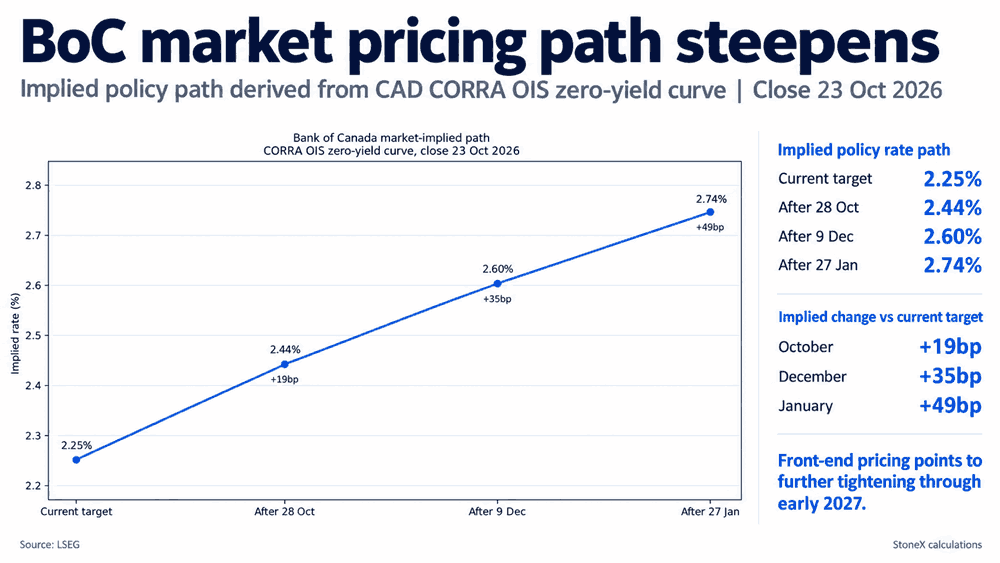
Source: LSEG
But the economic data hardly screams out for tighter monetary policy. Canadian employment fell by 68,000 in September, while the BoC's preferred trimmed-mean and median inflation measures averaged just 1.85%, below the central bank's 2% target.
Macklem's argument is that persistently elevated energy prices may spill over into broader inflationary pressures, particularly as businesses pass higher costs on to consumers. That's a legitimate risk, and one we've seen materialise elsewhere, but it's not what the latest Canadian inflation figures are showing.
That raises questions about whether the BoC needs to tighten this week. It also suggests there may be an underappreciated risk of the central bank leaving rates unchanged while delivering a hawkish message about the outlook.
Source: TradingView
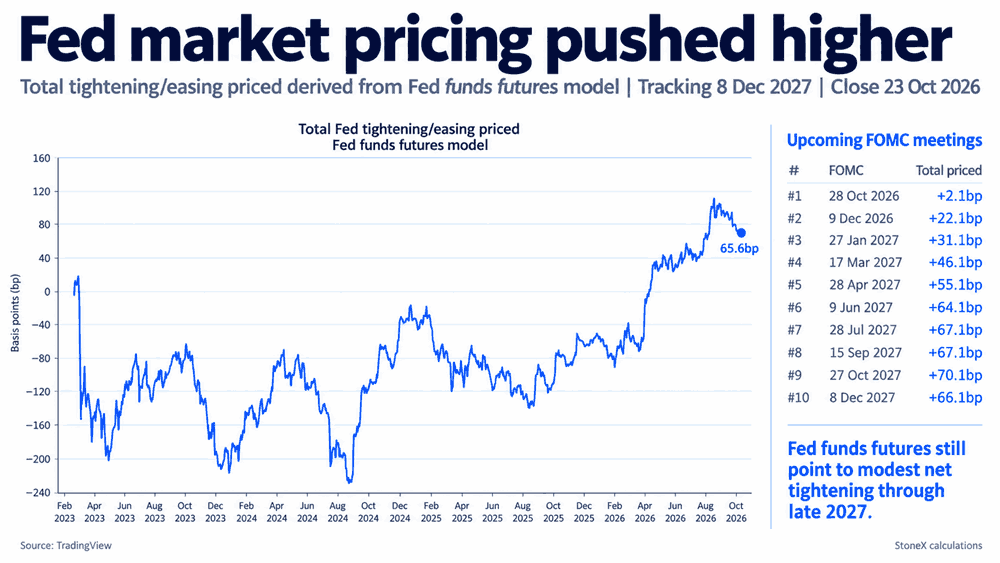
Realistically, you could argue that it should be the Fed considering a rate hike this week, rather than the Bank of Canada. US inflation remains persistently elevated, with the latest CPI data for September coming in much hotter than expected, while the labour market remains tight.
Yet despite that hawkish backdrop, several senior Fed officials went out of their way to signal to markets that the October meeting was likely to be a placeholder. As a result, markets are positioned for a hawkish hold, with expectations centred on the Fed gradually raising rates at every second meeting, with the next hike heavily favoured for December.
AI sentiment drives US yields, but not USD/CAD
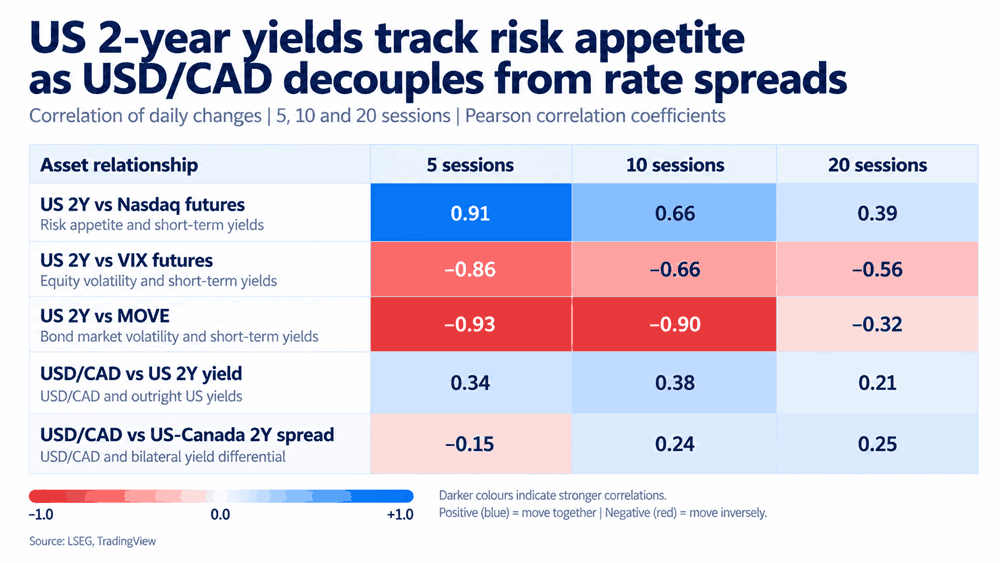
While both central bank meetings create the potential for knee-jerk market reactions, a look at the relationship between USD/CAD and US-Canada interest rate differentials suggests the latter haven't been an overwhelmingly strong driver of the pair over short and medium-term windows.
Source: LSEG
AI-related sentiment has clearly been influencing US Treasury yields and broader risk appetite, with yields increasingly moving in line with Nasdaq futures and inversely to volatility measures. However, that relationship hasn't flowed through directly to USD/CAD, much as it hasn't for the broader US dollar complex, as discussed in separate analysis published late last week.
It seems traders are using fluctuations in AI-linked markets as a proxy for the longer-term US nominal growth outlook.
CAD shorts extreme despite hawkish BoC pricing
Despite markets heavily favouring multiple Bank of Canada rate hikes in the months ahead, hedge funds remain overwhelmingly short the Canadian dollar. CFTC futures and options data released last Friday, covering positions as of Tuesday, October 20, showed net speculative shorts rising to 92,789 contracts, the 11th most bearish reading in a series dating back to 2007.
While this is only a snapshot of leveraged fund positioning rather than the broader market, it suggests expectations for tighter Canadian monetary policy have yet to translate into a meaningful reduction in bearish CAD bets among this group of traders.
Adding another layer of uncertainty for traders to navigate this week are US-Canada trade negotiations, with White House economic adviser Kevin Hassett suggesting on Sunday that the two countries were close to reaching an agreement. His comments followed Friday's decision to remove 50% tariffs on selected Canadian products, even as new tariffs were imposed on others.
On the surface, that's a positive development that would normally be expected to benefit the loonie rather than the US dollar. However, in early Asian trade on Monday, that hasn't been the case so far.
USD/CAD bullish reversal signal requires confirmation
Source: TradingView
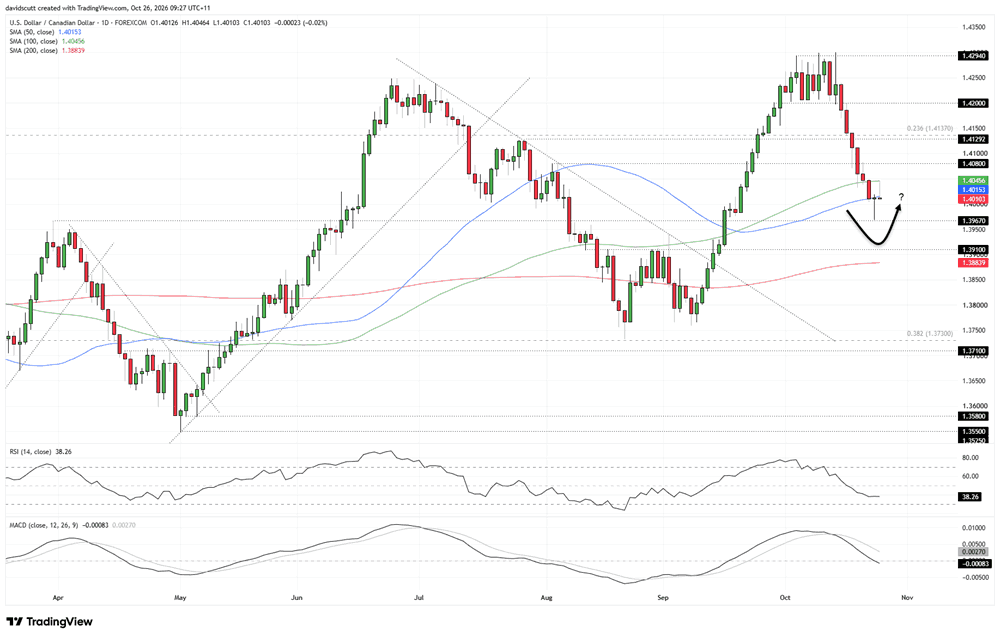
USD/CAD delivered a bullish pin bar on Friday after finding buyers around 1.3967, the swing high set on March 31 this year. The subsequent reclaim of 1.4000 suggests upside reversal risk may be starting to build following the sharp decline from the October highs, although the broader momentum picture remains bearish.
I wouldn't put too much weight on price action in early Asian trade, although the broader market backdrop points to the potential for Friday's rebound in risk appetite to extend. Nasdaq futures are trading higher, with similar gains likely in the Nikkei and KOSPI, both of which have been influential in the AI sentiment trade. Given how the broader US dollar behaved last week, that's another factor worth monitoring.
For USD/CAD, the immediate level to watch overhead is the 100-day moving average, which the price tested early on Monday before being comprehensively rejected. A recovery above that level that sticks would shift attention to 1.4080, which has acted as both support and resistance recently, alongside the 23.6% Fibonacci retracement of the move from the May 2021 low to the February 2025 high.
Beyond that, 1.4200 and 1.4294 are the next levels to watch, with the latter marking an area where the pair stalled on multiple occasions earlier this month.
Underneath, 1.3967 remains the key level, having acted as resistance on March 31 before providing support on Friday. A break beneath it would bring 1.3910 and then the 200-day moving average into focus.
While Friday's bullish pin bar warns of a potential reversal, the oscillators continue to favour short setups over longs. RSI (14) remains below 40 and, although starting to curl higher, has yet to stage a meaningful rebound. MACD has also delivered a bearish crossover and moved into negative territory, confirming that downside momentum remains dominant.
With price action and momentum sending conflicting signals, greater weight should be placed on how USD/CAD trades through the remainder of Monday, particularly around the 100-day moving average and 1.3967, for confirmation of whether Friday's bullish reversal signal has any staying power.