


USD/CHF Outlook: Swiss Franc Surges as AI Trade Capitulates and SNB Bets Shift
USD/CHF weakens as the Swiss franc surges amid AI trade capitulation and shifting SNB rate bets, with further downside possible as December approaches.
Share this:

USD/CHF has weakened sharply in recent sessions as the Swiss franc attracts safe-haven demand, with EUR/CHF and AUD/CHF also moving lower. CHF/JPY has risen to a nine-day high, while the franc has strengthened notably against the Australian dollar and British pound.
The move has coincided with a sharp pullback in AI-linked equities, higher market volatility and growing concern over the debt-funded expansion of AI infrastructure. Swiss imported inflation has also accelerated, while markets have nudged OIS pricing above the SNB’s flat policy-rate path.
The evidence points to a combination of deteriorating risk appetite, shifting SNB expectations and renewed concern in credit markets. This USD/CHF outlook examines those forces before assessing whether the pair offers a tactical short trade as December approaches.
View related analysis:
AI Trade Capitulation and SNB Bets Shape the USD/CHF Outlook
Safe-Haven Demand Supports the Swiss Franc
The catalyst for the Swiss franc’s strength this week appears to be a renewed deterioration in risk appetite. Investors are questioning whether the debt-funded expansion of AI infrastructure will generate sufficient returns, while fresh US tariff proposals have added another source of uncertainty.
The Nasdaq has fallen sharply from its October peak and volatility has risen significantly through November. Earlier this week, the VIX was on track for its worst monthly increase since the pandemic. While the VIX has pulled back, sentiment remains battered and bruised for now.
This environment has favoured traditional safe havens such as the Swiss franc and Japanese yen. However, CHF/JPY has risen to a nine-day high after its strongest two-day rally, suggesting the franc has become the preferred haven during this bout of risk aversion.
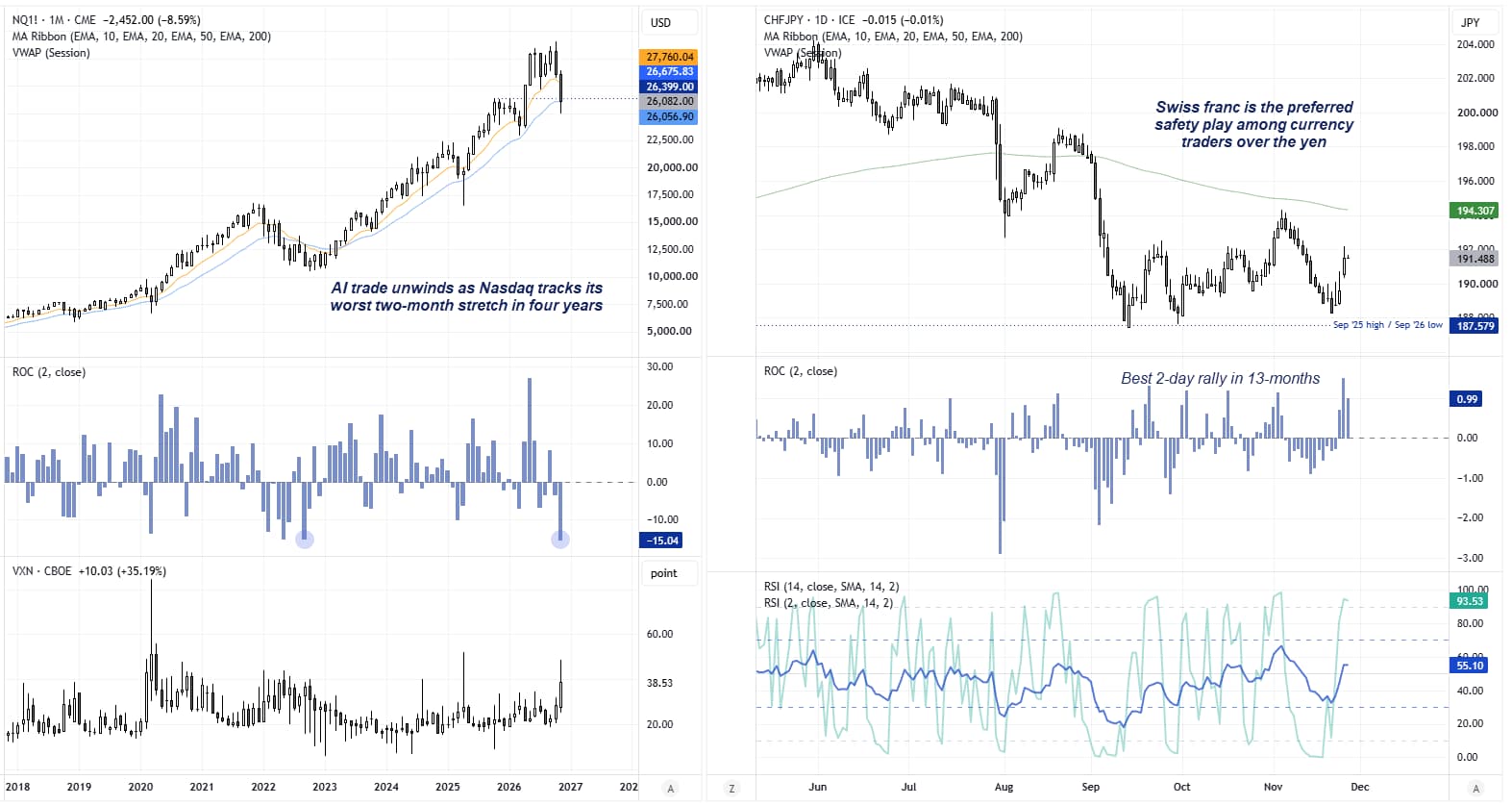
Source: CME, ICE, TradingView
The franc has also strengthened against higher-beta currencies, particularly the Australian dollar. That broad-based performance is consistent with investors reducing exposure to risk-sensitive positions rather than simply adjusting US dollar exposure.
The fact that the franc has strengthened despite Switzerland being included in the latest US tariff proposals further suggests that safe-haven demand has been more important than any improvement in the Swiss domestic outlook.

Imported Inflation Adds to SNB Concerns
While risk aversion explains the timing of the franc’s move, a modest repricing of Swiss monetary policy expectations helps explain why its resurgence has been so strong and broad-based across FX majors. Sure, hike expectations are far from imminent, but it is the change of trajectory that ahs caught trader’s attention.
The latest figures show why the SNB is paying closer attention. Imported product prices rose 3.7% year-on-year, well above the 0.8% increase in domestic product prices. Headline inflation is therefore being driven more by imported costs than by broad-based domestic pressure.
The risk for the SNB is that higher input costs begin to feed into services, wages and inflation expectations. If that happens, markets could continue pushing the OIS curve above the SNB’s flat projection. If not, imported inflation alone may not be enough to justify a sustained tightening cycle.
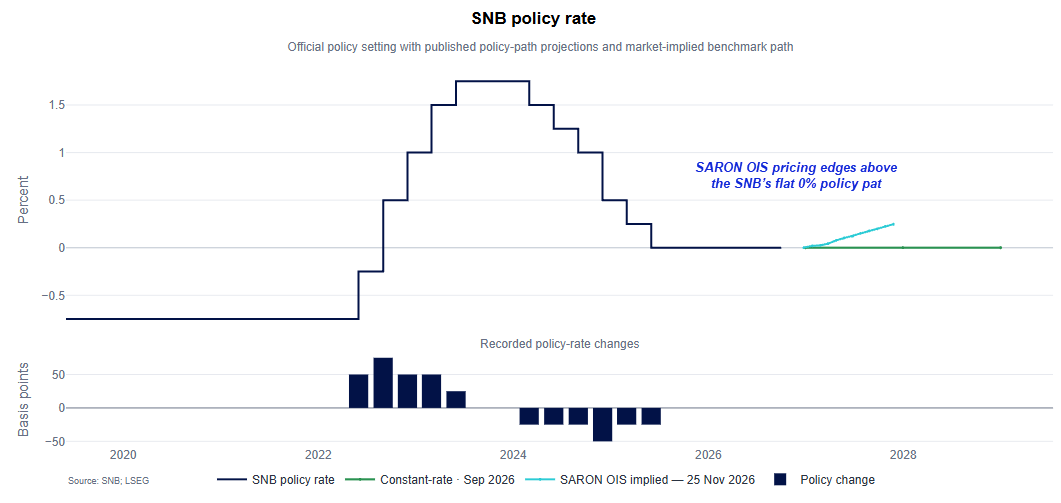
So, while rates remain at 0% for now, markets are betting that less-dovish pressures are building. Even if the repricing is modest, it removes some of the pressure that previously encouraged investors to use the franc as a funding currency.
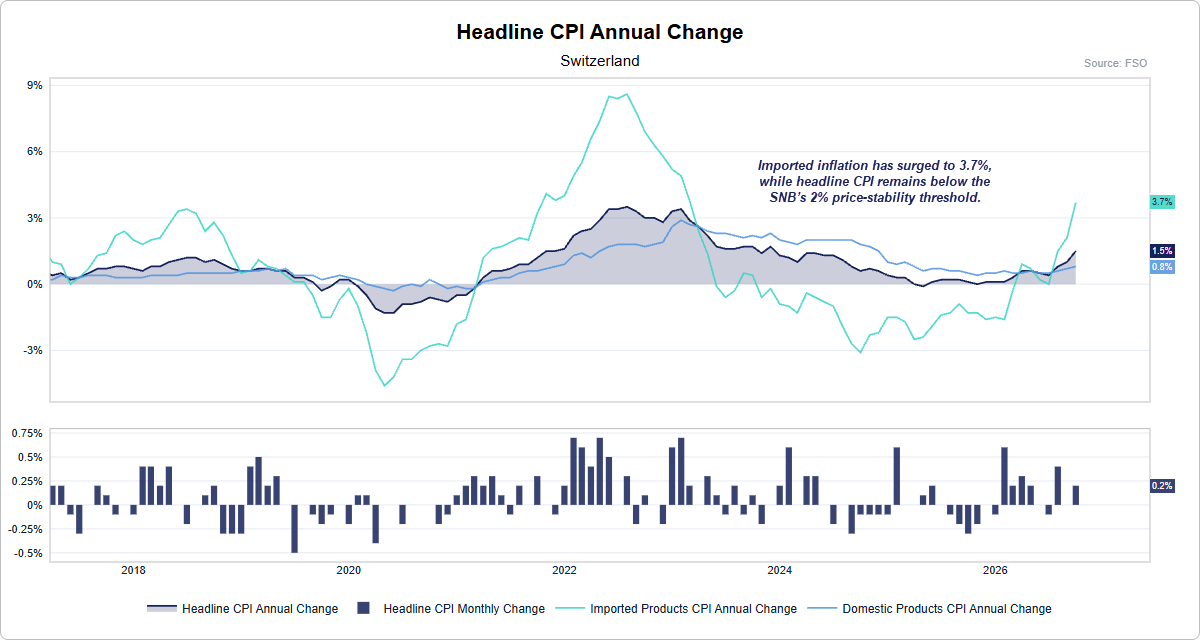
Source: ICE, TradingView
OIS Curve Edges Above SNB’s Flat Path
The September conditional forecast is based on the SNB policy rate remaining at 0%, whereas SARON OIS pricing now edges higher towards 0.25% by 2028. That is hardly an aggressive tightening cycle, but it does mark a modest shift away from a fully dovish outlook.
USD/CHF Technical Analysis: US Dollar vs Swiss Franc
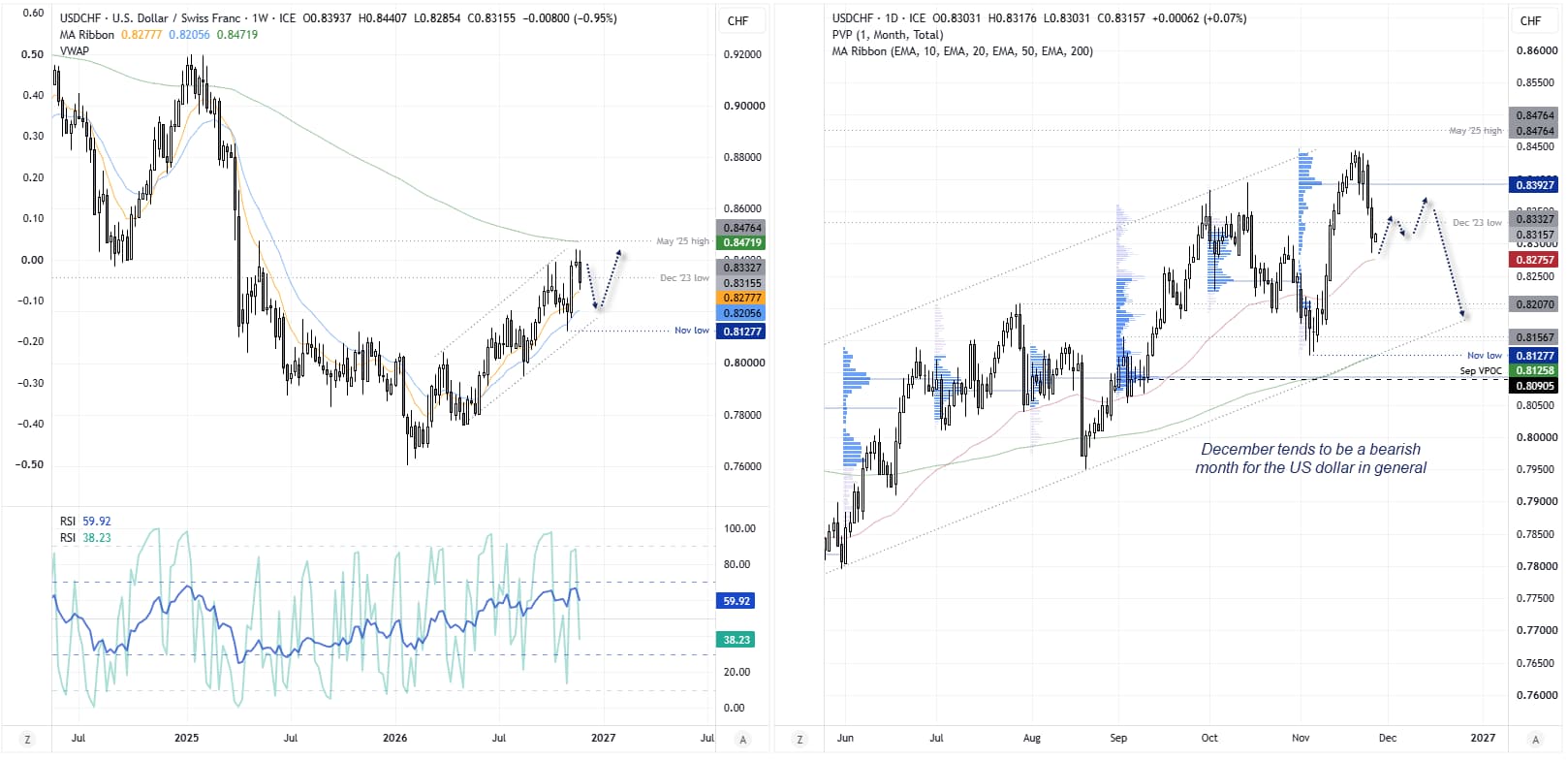
The bullish trend on USD/CHF has been one of the stronger trends across FX in recent months. But signs of exhaustion appeared with last week’s small shooting star, which formed near the top of its trend channel and just beneath the 200-day EMA.
Bearish momentum has since pushed USD/CHF back within its bullish channel, although we would need to see a break below the November low at 0.8127 to confirm a change in trend. For now, that appears unlikely given the prospect of a hawkish Fed.
However, prices are holding above the 10-week and 50-day EMAs for now, so perhaps bears can take a bit of a break over the Thanksgiving holiday. But if stock-market sentiment remains weak, USD/CHF could be staring at another leg lower towards 0.820 as we head into next week.
The closer we get to December, however, I suspect the pair could seek a swing low heading into the Fed meeting before bears regain control later in the year, amid a typically weak seasonal period for the US dollar.
USD/CHF has an average December return of -1.5% and a median return of -1.3%. It has closed lower in 68% of Decembers over the past 25 years, with those bearish months delivering an average return of -3.1%.
Swiss Franc Strength Broadens Across FX Majors
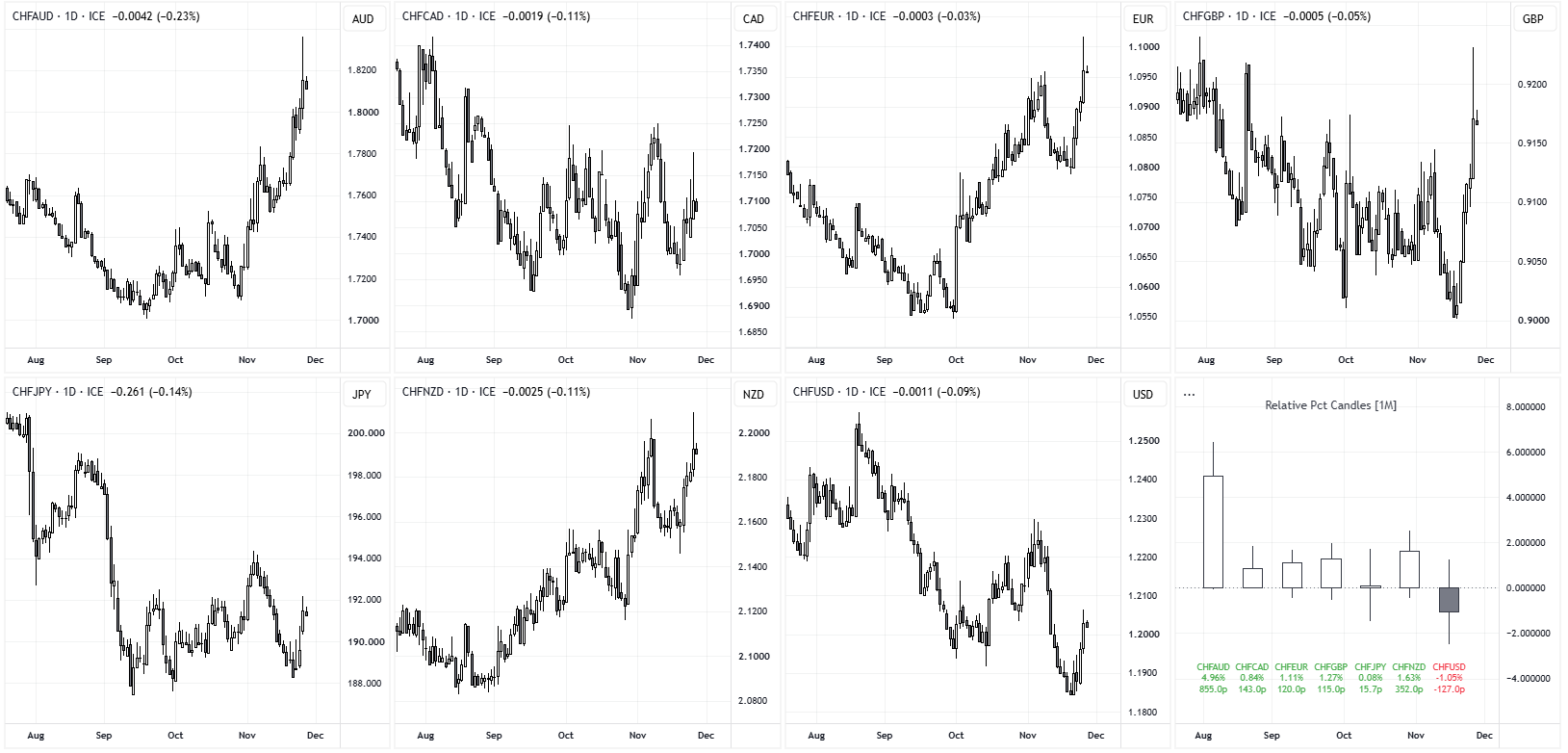
Although USD/CHF offers the cleanest technical setup, the franc’s strength is not isolated to the US dollar. CHF has risen against most major currencies this month, with the strongest recent moves against the Australian dollar and British pound.
That broad-based performance supports the safe-haven argument, particularly as the Australian dollar remains sensitive to risk appetite. The Canadian dollar has been more resilient, but the wider trend still points to stronger demand for the franc across FX.
Unless risk appetite improves materially, CHF strength could remain a broader theme rather than a move confined to one or two currency pairs.
Source: ICE, TradingView
Related tags:
Latest market news




Open an account in minutes
Experience award-winning platforms with fast and secure execution.
Economic calendar
Web Trader platform
Our sophisticated web-based platform is packed with features.
Related articles
USD/CHF Outlook: Swiss Franc Surges as AI Trade Capitulates and SNB Bets Shift
USD/CHF weakens as the Swiss franc surges amid AI trade capitulation and shifting SNB rate bets, with further downside possible as December approaches.
Gold Outlook: Dollar fatigue opens the door to a squeeze
Gold has been walloped, the dollar rally looks tired and seasonal patterns favour further dollar weakness into year-end. The ducks are lining up for a potential squeeze.


EUR/USD forecast: Markets bounce off lows after damaging week
At the time of writing markets were bouncing back from their earlier lows as European investors were heading out, and US investors were starting to look forward to Thanksgiving.

The information on this web site is not targeted at the general public of any particular country. It is not intended for distribution to residents in any country where such distribution or use would contravene any local law or regulatory requirement. The information and opinions in this report are for general information use only and are not intended as an offer or solicitation with respect to the purchase or sale of any currency or CFD contract. All opinions and information contained in this report are subject to change without notice. This report has been prepared without regard to the specific investment objectives, financial situation and needs of any particular recipient. Any references to historical price movements or levels is informational based on our analysis and we do not represent or warranty that any such movements or levels are likely to reoccur in the future. While the information contained herein was obtained from sources believed to be reliable, author does not guarantee its accuracy or completeness, nor does author assume any liability for any direct, indirect or consequential loss that may result from the reliance by any person upon any such information or opinions.
Futures, Options on Futures, Foreign Exchange and other leveraged products involves significant risk of loss and is not suitable for all investors. Losses can exceed your deposits. Increasing leverage increases risk. Spot Gold and Silver contracts are not subject to regulation under the U.S. Commodity Exchange Act. Contracts for Difference (CFDs) are not available for US residents. Before deciding to trade forex, commodity futures, or digital assets, you should carefully consider your financial objectives, level of experience and risk appetite. Any opinions, news, research, analyses, prices or other information contained herein is intended as general information about the subject matter covered and is provided with the understanding that we do not provide any investment, legal, or tax advice. You should consult with appropriate counsel or other advisors on all investment, legal, or tax matters. References to FOREX.com or GAIN Capital refer to StoneX Group Inc. and its subsidiaries. Please read Characteristics and Risks of Standardized Options.