



USD/JPY Analysis: Neutrality Holds in the Yen Ahead of Japan Inflation Data
With just a few days left before the end of the trading week, USD/JPY price action continues to show no meaningful directional changes in the short term. Over the past two sessions, the pair has posted an average move of around 0.1%.
Share this:

With just a few days left before the end of the trading week, USD/JPY price action continues to show no meaningful directional changes in the short term. Over the past two sessions, the pair has posted an average move of around 0.1%, suggesting that price action has not been able to establish a clear trend. This is starting to reflect a consistent phase of indecision in the short term.
This behavior is particularly relevant as both the Bank of Japan and the Federal Reserve decisions approach. On one hand, the market may be pausing ahead of these events, but at the same time, the recent stabilization in the US dollar has limited the yen’s ability to continue gaining ground. Taken together, these factors reinforce the idea of a neutral bias in USD/JPY in the coming sessions.


The dollar regains strength
Uncertainty around the Middle East situation remains elevated. At this stage, Iran has stated that reopening the Strait of Hormuz is not possible while the US blockade continues, while the United States has issued orders for direct military response to threats in the region. This has delayed potential negotiations and introduced a sense of caution in the markets in the short term.
This environment has had a direct impact on the US dollar, as uncertainty has slowed the weakness seen last week. In fact, the DXY index, which measures the strength of the dollar against its major peers, has shown a consistent recovery, moving back above the 98 level with a short-term upward slope.
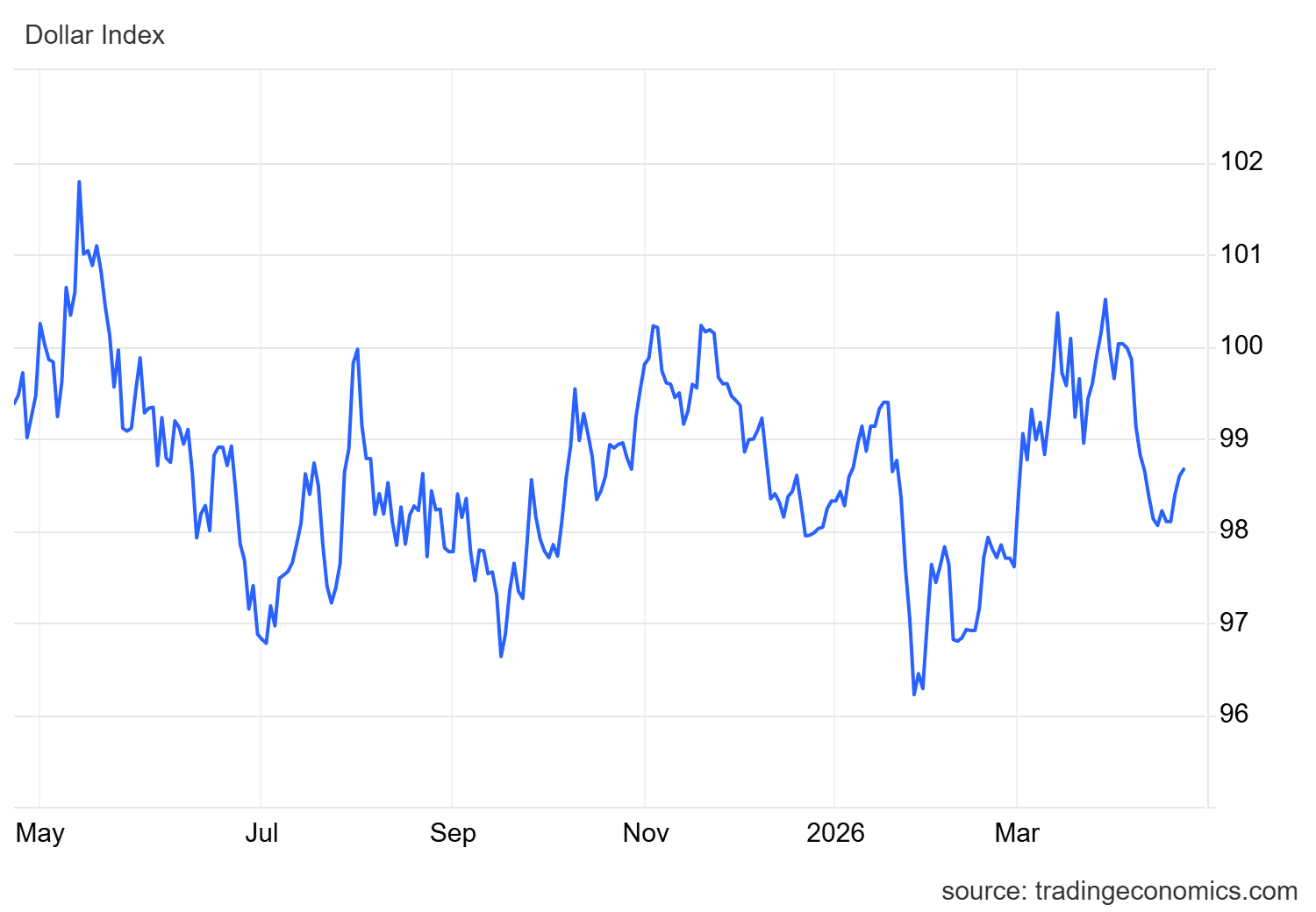
Source: TradingEconomics
This dynamic is key for USD/JPY, as the recent rebound in the dollar has limited the yen’s ability to continue appreciating. This has once again highlighted market indecision, and unless meaningful updates around the conflict emerge, this neutral phase is likely to continue dominating short-term price action.
Will central banks start to matter?
Next week could be critical for USD/JPY volatility, as interest rate decisions from both Japan and the United States are set to be released.
In the case of the Federal Reserve, the market continues to expect no significant changes. According to CME Group, there is around a 99.5% probability that the rate will remain unchanged at 3.75% in the April 29 decision. This scenario is already fully priced in, meaning no major surprises are expected in the short term.
On the other hand, the Bank of Japan is scheduled to announce its decision on April 27. While the rate is also expected to remain at 0.75%, a key factor will be the release of Japan’s CPI year-over-year data, where a reading of 1.7% is expected, slightly above the previous 1.6%. While the increase itself is modest, the key point is that the central bank has recently reiterated that inflationary pressures could require a more aggressive stance going forward.
In this context, one of the most important fundamental drivers has been the interest rate differential between the United States and Japan. With US rates at 3.75% and Japan at 0.75%, this gap has supported the dollar, as USD-denominated assets remain more attractive.
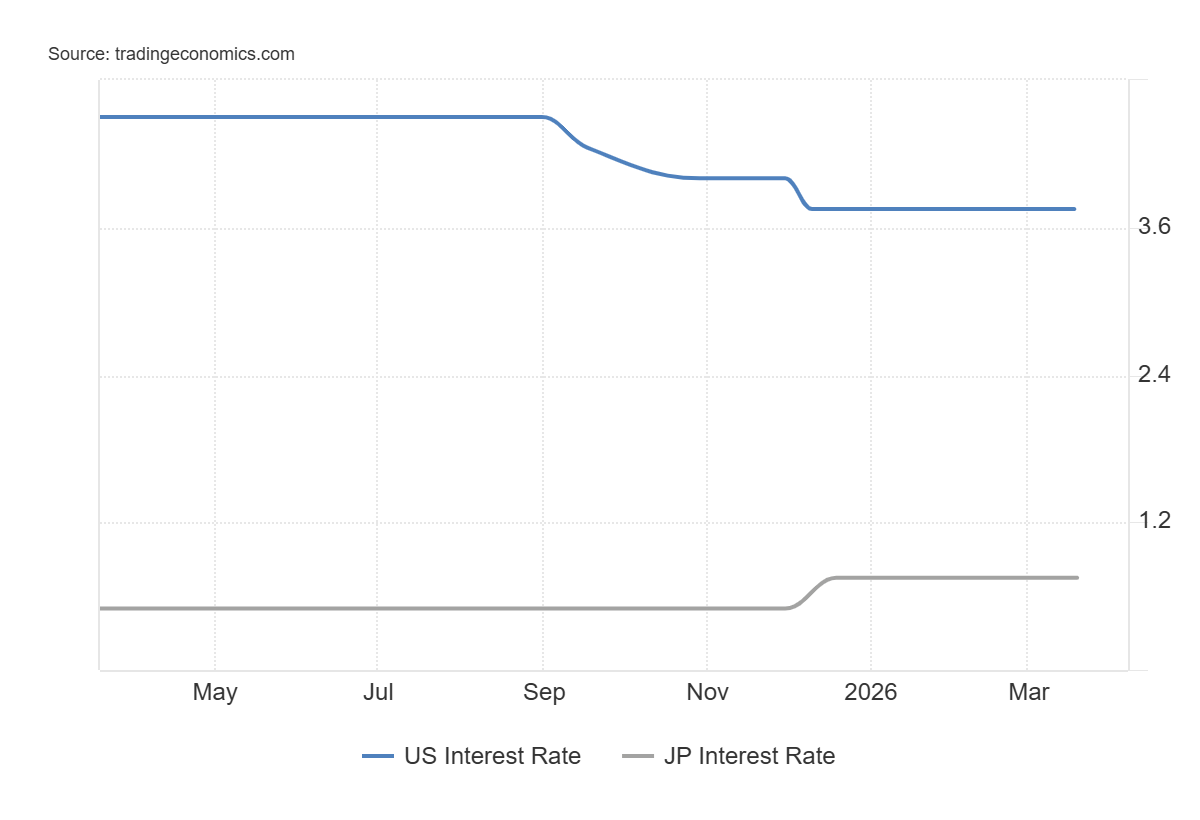
Source: TradingEconomics
Therefore, any signal pointing to a more restrictive stance from the Bank of Japan could shift this dynamic. A change in the rate differential could strengthen demand for the yen and generate clearer downside pressure on USD/JPY in the medium term.
Technical outlook for USD/JPY
Source: StoneX, Tradingview
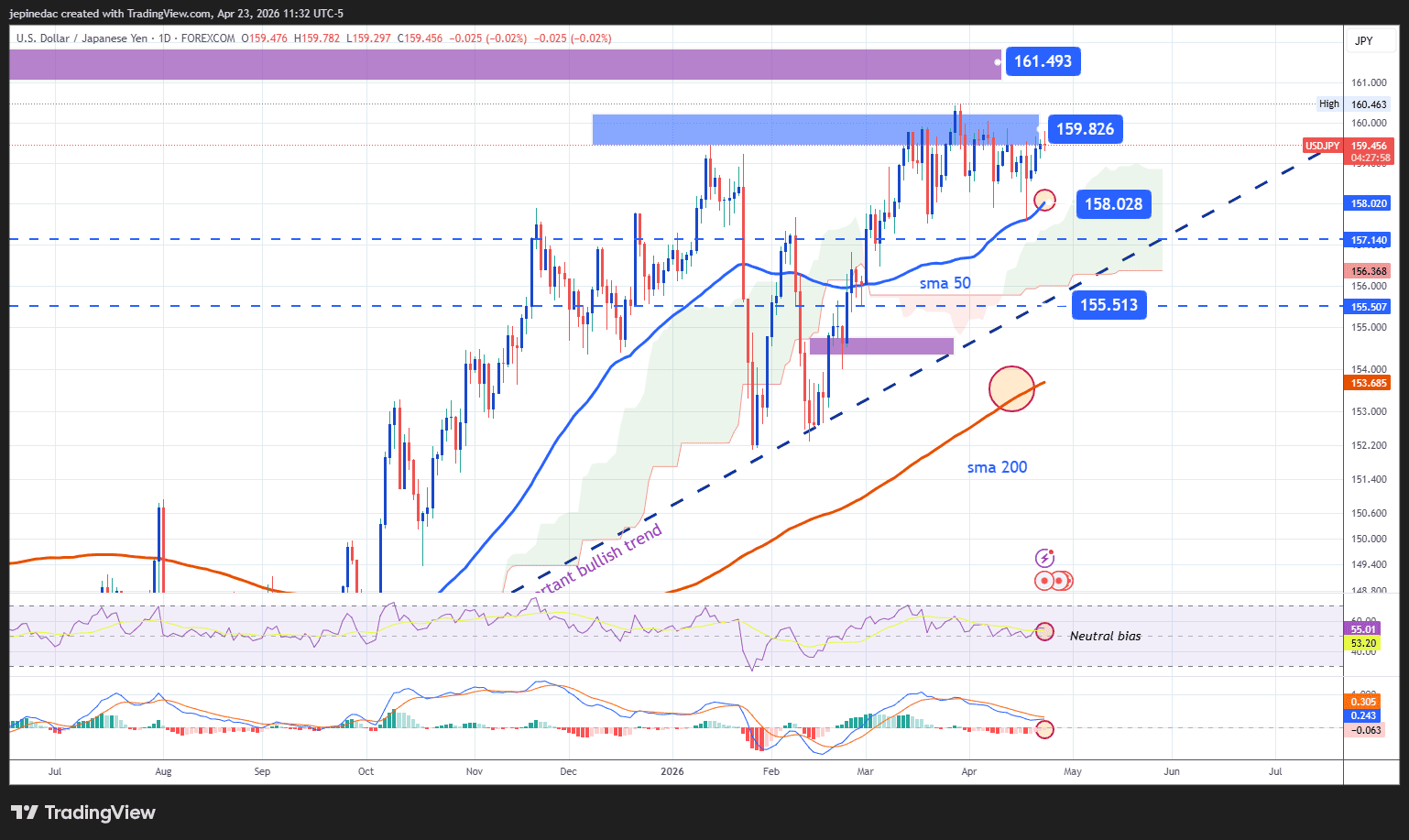
- Long-term uptrend remains the key technical factor: Despite recent phases of neutrality, the main technical structure remains the long-term upward trendline that the pair has maintained for several months. So far, no bearish moves have been strong enough to invalidate this structure, meaning it continues to act as the dominant pattern in price behavior.
- RSI: The RSI indicator remains close to the 50 level, reflecting a balance between buying and selling forces. This suggests that the current indecision phase could continue to dominate in the short term.
- MACD: Similarly, the MACD histogram remains close to the zero level, indicating a balance in short-term moving averages. This reinforces the view of a neutral market phase.
Key levels:
- 159.826 – Key resistance: A level of recent highs and a relevant barrier for bullish movements. A break above this level could reactivate a bullish bias and support the continuation of the uptrend in the coming sessions.
- 158.028 – Near-term barrier: A neutral zone aligned with the 50-period moving average. Moves toward this level could reinforce a bearish bias in the short term, which could be relevant in the coming trading sessions.
- 155.53 – Key support: A level of relevant lows that coincides with the base of the uptrend. A move toward this zone could begin to put the current structure at risk and open the door to a more significant trend change in the coming weeks.
Written by Julian Pineda, CFA, CMT – Market Analyst
Follow him on: @julianpineda25
Latest market news




Open an account in minutes
Experience award-winning platforms with fast and secure execution.
Economic calendar
Web Trader platform
Our sophisticated web-based platform is packed with features.
Related articles
US Dollar Price Action Setups: EUR/USD, USD/JPY
The US Dollar broke out to a fresh yearly high after the CPI report, and that Dollar strength was on full view in pretty much all major pairings with a particular push in EUR/USD.
US dollar forecast: USD/JPY and USD/CHF in focus | Forex Friday
Sticky US inflation and a hawkish Fed have kept the dollar firm across the majors, with USD/JPY pressing on the 160 handle. Here are the levels that matter on USD/JPY and USD/CHF as next week's retail sales, Nvidia results and FOMC minutes approach.

Swiss Franc Forecast: USD/CHF 3% Rally Threatens Multi-Year Downtrend 11 13 2026
USD/CHF has erased its October losses, but bulls still need a decisive weekly close above key resistance to confirm a larger bullish reversal.

The information on this web site is not targeted at the general public of any particular country. It is not intended for distribution to residents in any country where such distribution or use would contravene any local law or regulatory requirement. The information and opinions in this report are for general information use only and are not intended as an offer or solicitation with respect to the purchase or sale of any currency or CFD contract. All opinions and information contained in this report are subject to change without notice. This report has been prepared without regard to the specific investment objectives, financial situation and needs of any particular recipient. Any references to historical price movements or levels is informational based on our analysis and we do not represent or warranty that any such movements or levels are likely to reoccur in the future. While the information contained herein was obtained from sources believed to be reliable, author does not guarantee its accuracy or completeness, nor does author assume any liability for any direct, indirect or consequential loss that may result from the reliance by any person upon any such information or opinions.
Futures, Options on Futures, Foreign Exchange and other leveraged products involves significant risk of loss and is not suitable for all investors. Losses can exceed your deposits. Increasing leverage increases risk. Spot Gold and Silver contracts are not subject to regulation under the U.S. Commodity Exchange Act. Contracts for Difference (CFDs) are not available for US residents. Before deciding to trade forex, commodity futures, or digital assets, you should carefully consider your financial objectives, level of experience and risk appetite. Any opinions, news, research, analyses, prices or other information contained herein is intended as general information about the subject matter covered and is provided with the understanding that we do not provide any investment, legal, or tax advice. You should consult with appropriate counsel or other advisors on all investment, legal, or tax matters. References to FOREX.com or GAIN Capital refer to StoneX Group Inc. and its subsidiaries. Please read Characteristics and Risks of Standardized Options.