

USD/MXN is on track to close the session with gains of more than 0.85% in favor of the U.S. dollar, as markets await the Banco de México (Banxico) monetary policy decision, scheduled for February 5. The renewed weakness in the Mexican peso seen over recent sessions is largely driven by the strengthening of the U.S. dollar, a factor that could continue to reinforce buying pressure in the pair over the coming sessions.

Banxico decision day approaches
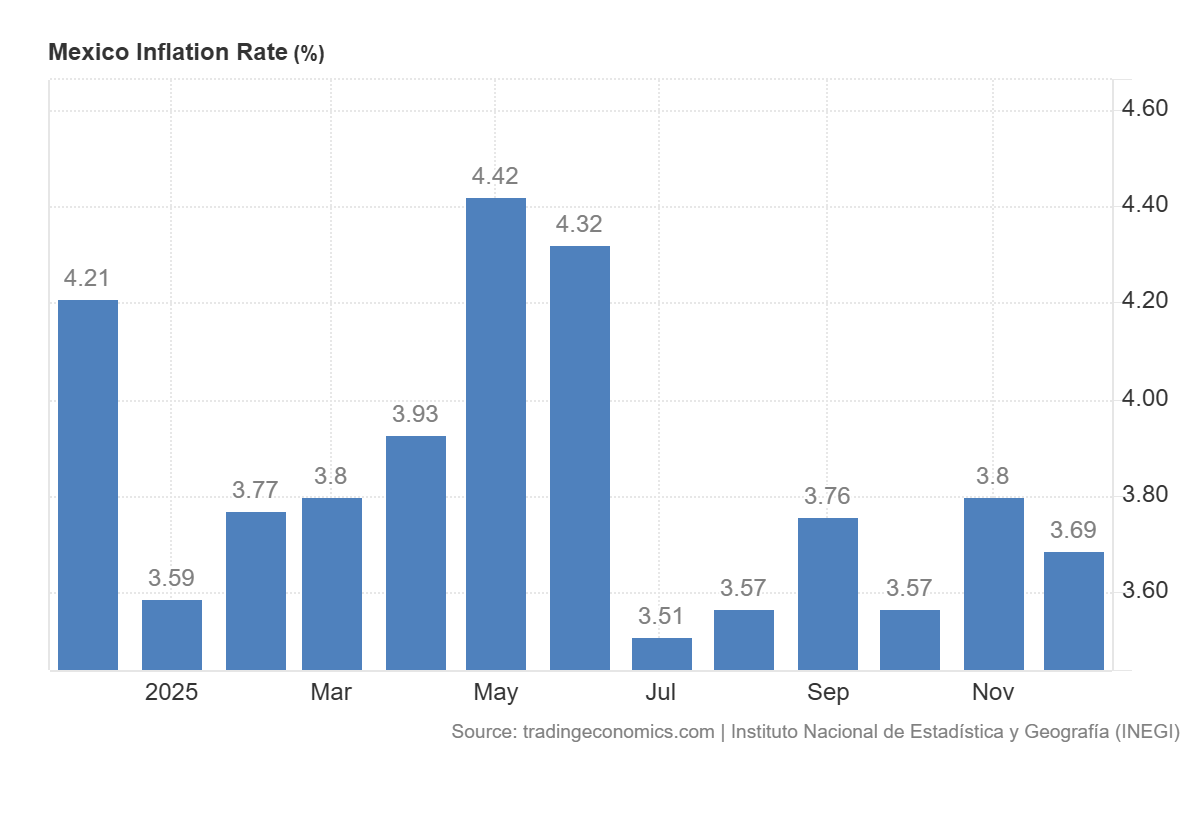
Tomorrow, February 5, 2026, Banxico is set to announce its interest rate decision. Current market consensus points to a 25-basis-point rate cut, which would lower the benchmark rate from 7.00% to 6.75%. This expectation is supported by the cooling of inflation, which came in at 3.69% in December 2025, down from 3.8% in November.
This moderation in inflation data does not justify a more restrictive stance from the central bank at this stage, keeping the gradual easing cycle in place and continuing to shape market expectations.
Source: TradingEconomics
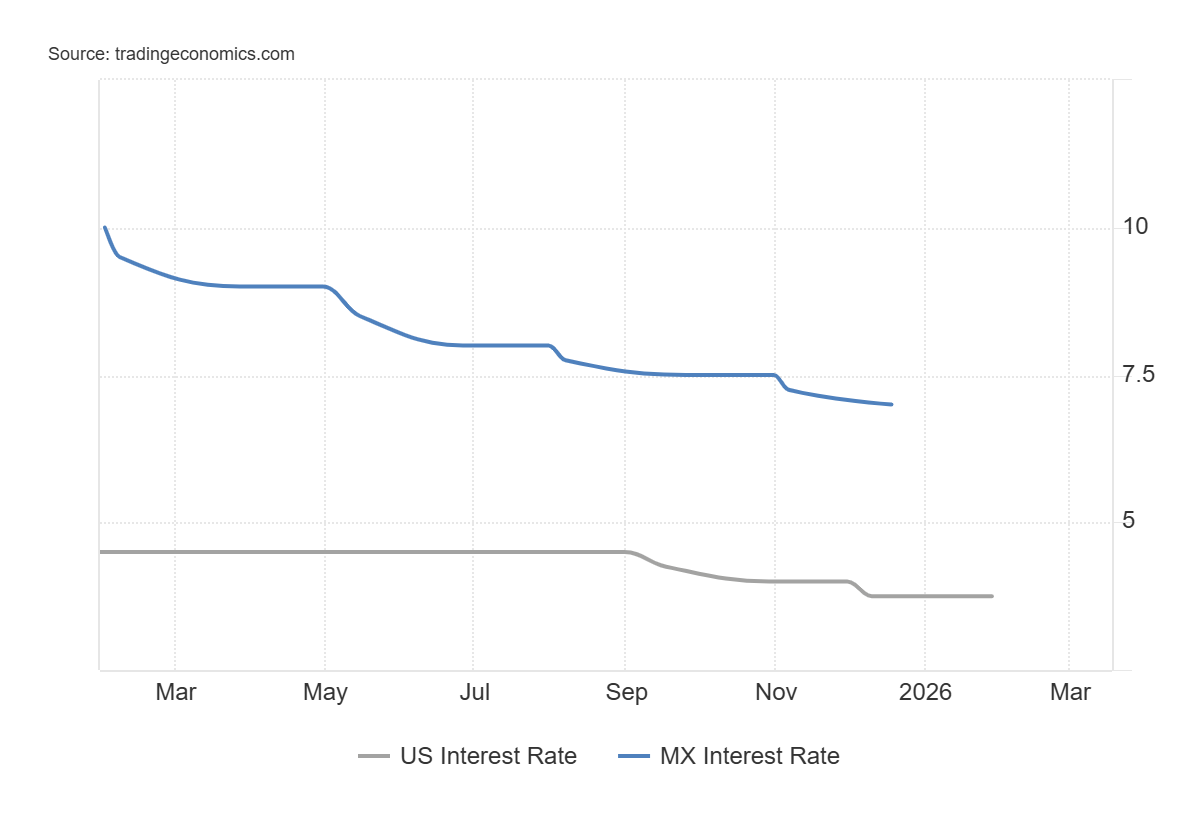
It is also important to recall that part of the peso’s earlier strength against the dollar was driven by the wide interest rate differential between Mexico and the United States. While Mexico currently maintains a 7.00% policy rate, the U.S. operates at 3.75%, a significantly lower level. This differential has supported the Mexican fixed-income market, attracting capital flows into local bonds and strengthening demand for pesos.
Source: TradingEconomics
However, if Banxico proceeds with the rate cut and the benchmark rate moves to 6.75%, the interest rate differential would begin to narrow, potentially reducing the attractiveness of Mexican fixed income. At the same time, a Federal Reserve committed to keeping rates neutral for longer could restore relative appeal to U.S. bonds, reinforcing dollar demand. Under this scenario, USD/MXN could begin to show greater structural dominance, particularly if Banxico maintains a dovish tone pointing toward further rate cuts.
The U.S. dollar remains a key threat
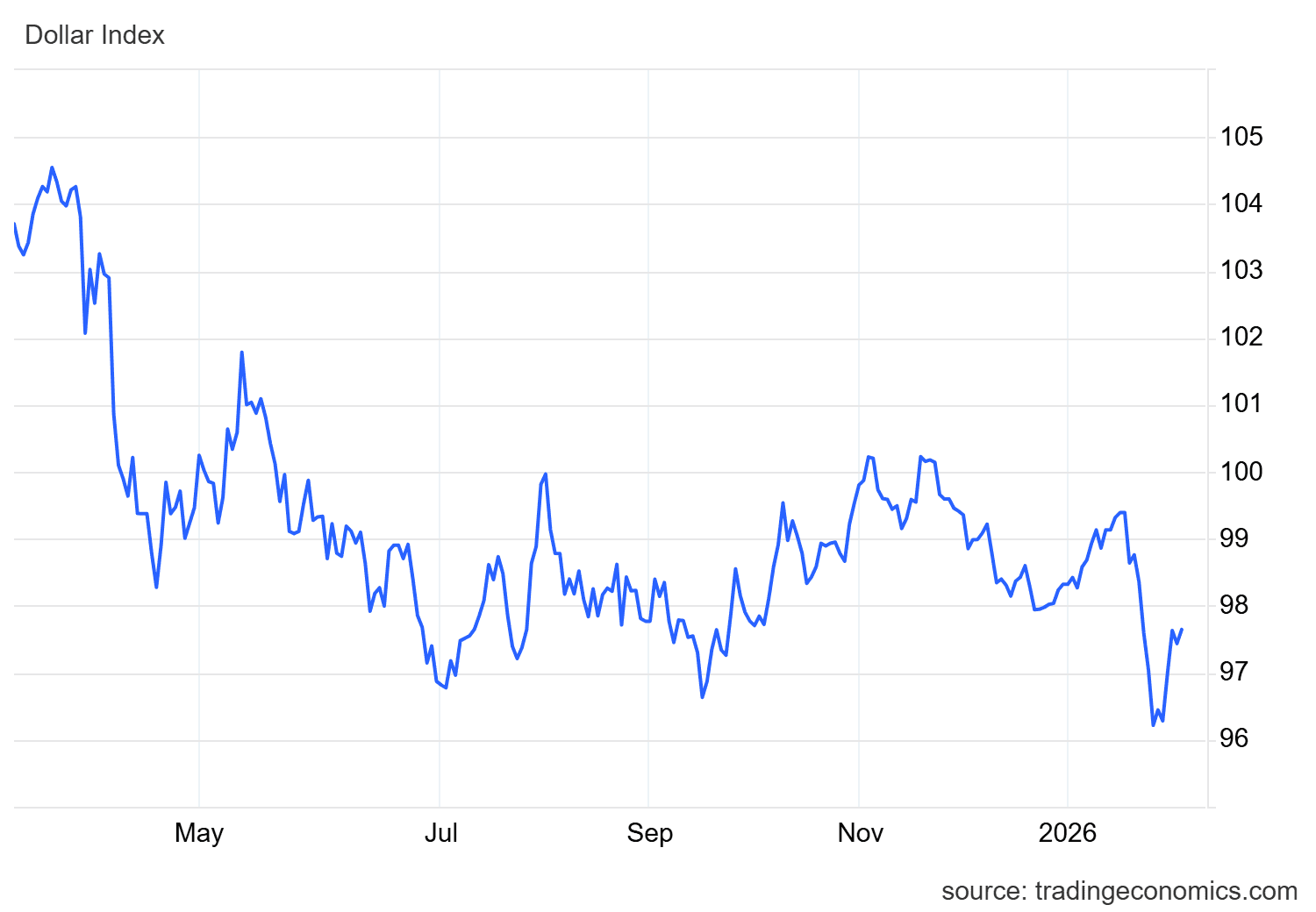
Beyond Banxico -related expectations, the recent strength of the U.S. dollar remains a key driver for USD/MXN. The DXY index, which measures the dollar’s performance against its major peers, has shown a sustained advance, trading above the 97 level and moving closer to the psychological 100 mark, signaling renewed confidence in the U.S. currency.
Source: TradingEconomics
If this dollar recovery continues, it could further pressure emerging market currencies such as the Mexican peso, reinforcing more consistent buying pressure in USD/MXN over the coming sessions.
USD/MXN Technical Outlook
Source: StoneX, Tradingview
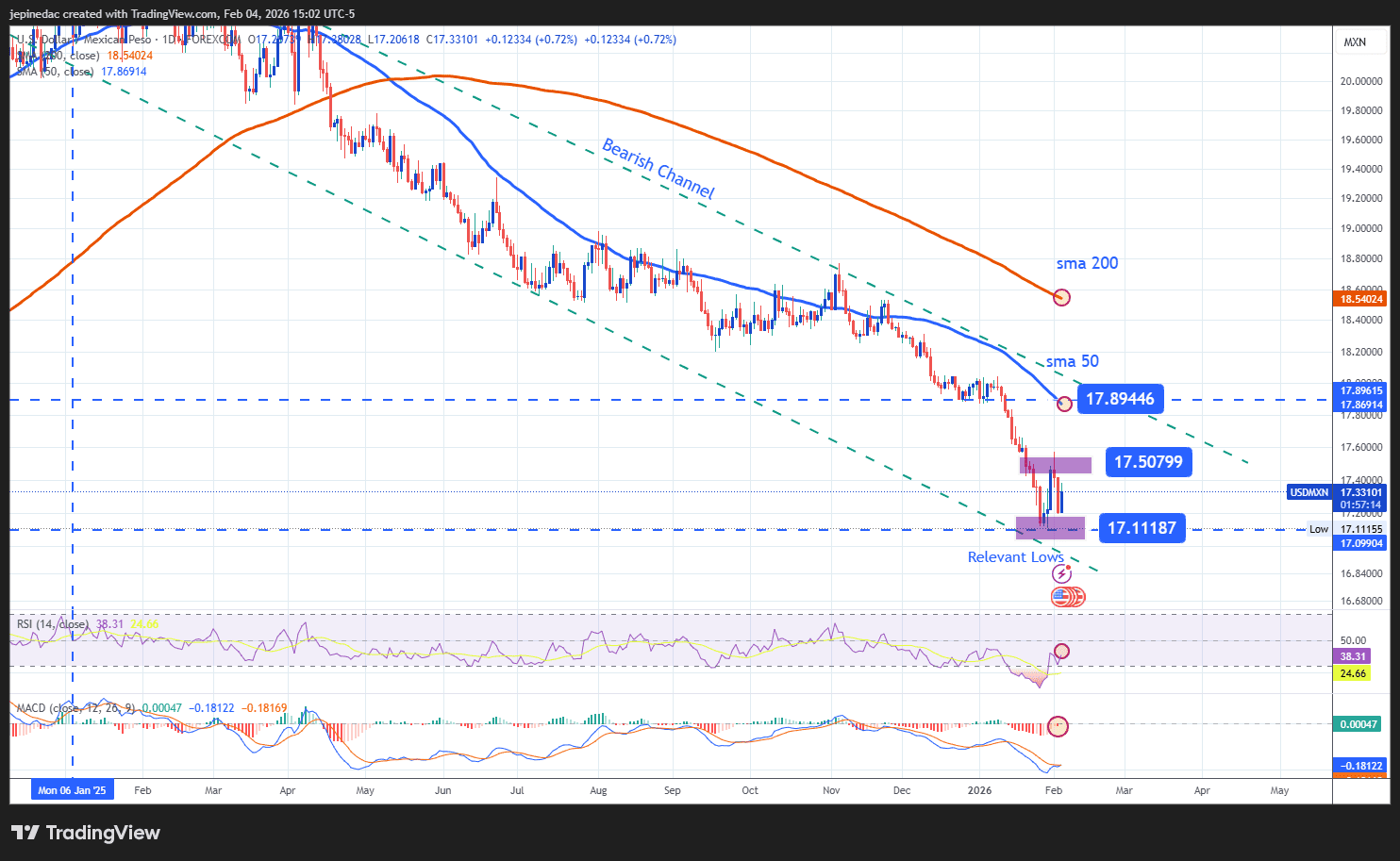
- The Broader Bearish Channel remains dominant: Despite the recent rebound in USD/MXN, the upside move remains insufficient to break the broader bearish channel that has dominated the chart for several months. As long as buying pressure fails to consolidate more convincingly, the long-term bias for the Mexican peso remains bearish.
- RSI: Although the RSI has started to show a positive slope, readings remain below the neutral 50 level, suggesting that selling momentum is still relevant. Until the RSI moves above this threshold, sustained buying strength is unlikely to take hold.
- MACD: The MACD is approaching a potential crossover above the zero line, which could signal a shift toward stronger short-term buying momentum. However, more decisive price action is still required to confirm a durable change in bias.
Key levels:
- 17.89 – Key resistance: A level aligned with the 50-period simple moving average. A sustained break above this area could trigger dominant upside pressure and put the prevailing bearish channel at risk.
- 17.50 – Current barrier: A near-term resistance zone, corresponding to the most recent area of neutrality. This level may act as a key reference during short-term corrective moves.
- 17.11 – Key support: A price zone not seen since April 2024. A sustained move toward this level could open the door to a more aggressive bearish channel, reinforcing the dominant selling bias in USD/MXN over the coming weeks.
Written by Julian Pineda, CFA, CMT – Market Analyst
Follow him on: @julianpineda25