

The week begins with a strengthening Mexican peso, and at this point the USD/MXN pair is posting a decline of more than 1.5% over the past two sessions, marking a renewed bearish bias that continues to favor the peso against the dollar. Selling pressure has remained consistent since Banxico’s decision and has been reinforced by renewed short-term weakness in the U.S. dollar. As long as these dynamics remain in place, selling pressure is likely to stay relevant in USD/MXN price action over the coming sessions.

Expectations focused on the Bank of Mexico
On February 5, the Bank of Mexico held its policy meeting and, in a surprise to the market, decided to keep the benchmark interest rate unchanged at 7.00%, pausing the easing cycle that had been in place since 2024. Post-decision comments were mainly driven by a recent uptick in inflation data, and for now the central bank has signaled it will maintain a pause before resuming further rate cuts. While future cuts have not been ruled out, they will depend strictly on how inflation evolves.
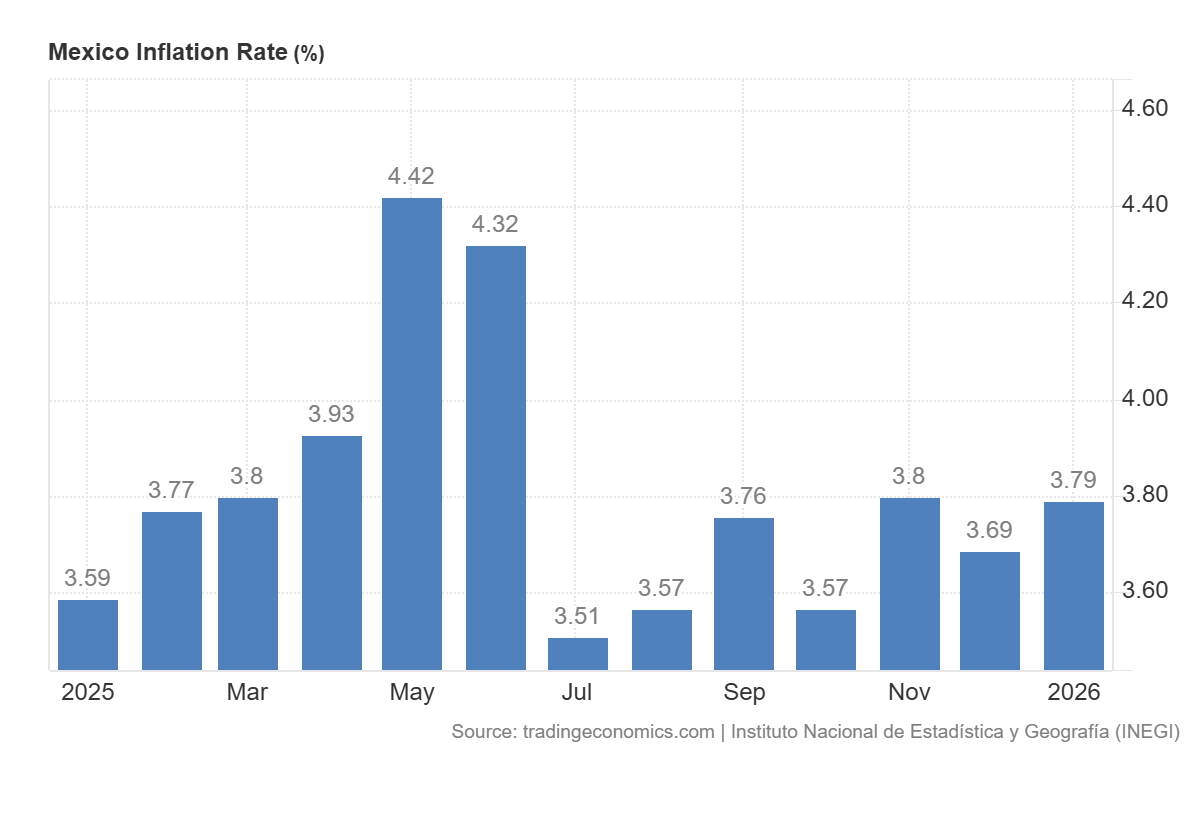
In this context, it is important to note that inflation stood at 3.69% in December, while January data showed an increase to 3.79%, moving further away from the 2% target set by the Bank of Mexico. This scenario has raised additional concerns within the institution and has prompted a shift in focus toward the possibility of maintaining higher interest rates for a longer period compared to other central banks.
Source: TradingEconomics
With this in mind, it is worth highlighting that the current 7.00% policy rate remains significantly higher than levels such as the 3.75% maintained by the U.S. Federal Reserve. This rate differential continues to support the attractiveness of peso-denominated investments, as Mexico’s fixed-income market offers higher short-term yields. This fundamental factor has been partly responsible for the peso’s strength in recent months and, if a high-rate environment persists, could continue to support stable demand for the Mexican peso relative to the U.S. dollar, reinforcing selling pressure on USD/MXN.
The U.S. dollar loses momentum
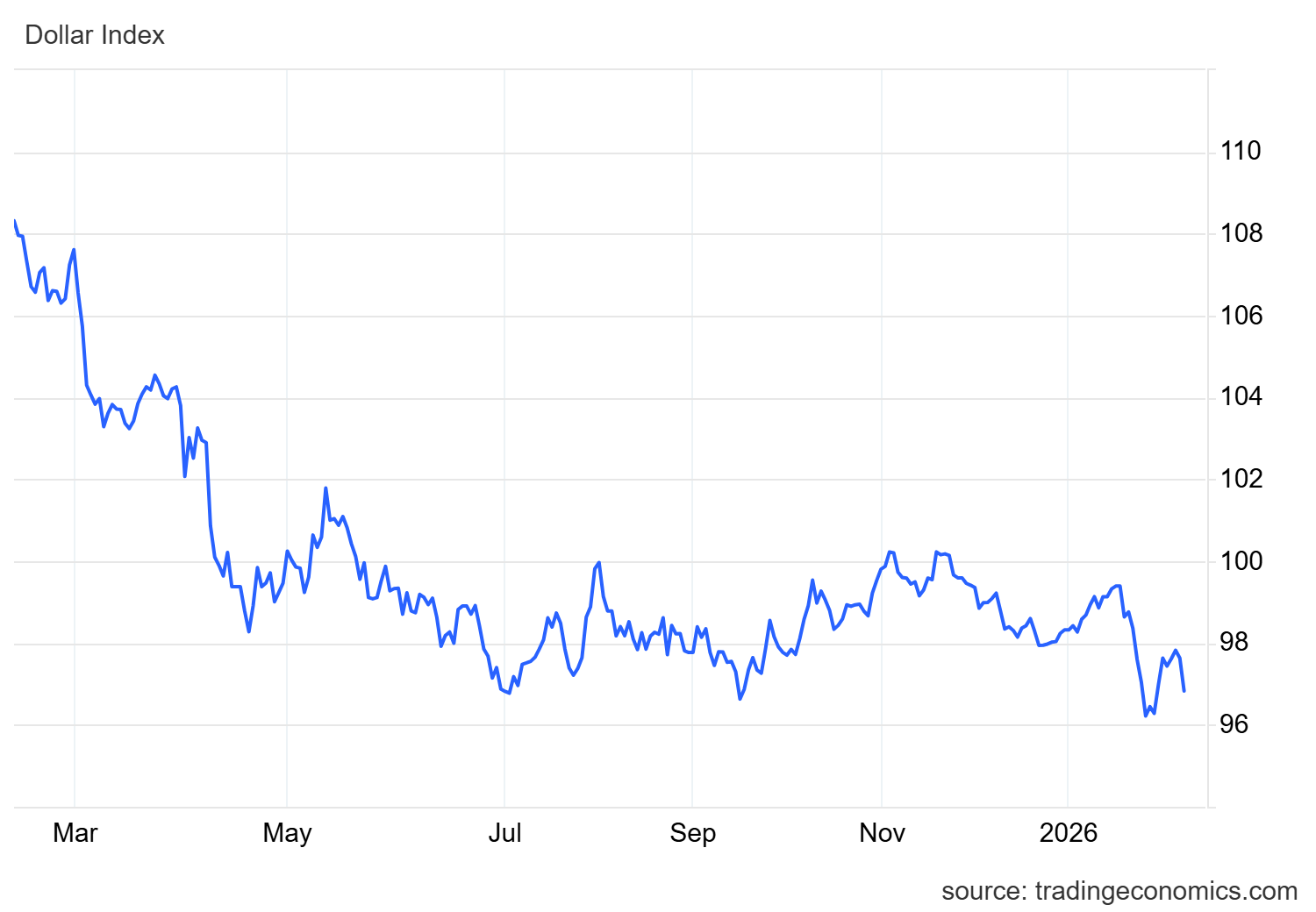
In addition to recent developments from the Bank of Mexico, another key factor has been the loss of momentum in the U.S. dollar over the short term. The DXY index, which tracks the dollar against its major peers, has recently traded below the 97-point level, reflecting a gradual loss of confidence in the currency over recent sessions.
Source: TradingEconomics
If the DXY continues to post lower readings, this behavior may point to weaker structural demand for the U.S. dollar, allowing the Mexican peso to continue recovering ground in a more sustained manner. This environment could further support consistent selling pressure in USD/MXN over the coming trading sessions.
USD/MXN technical Outlook
Source: StoneX, Tradingview
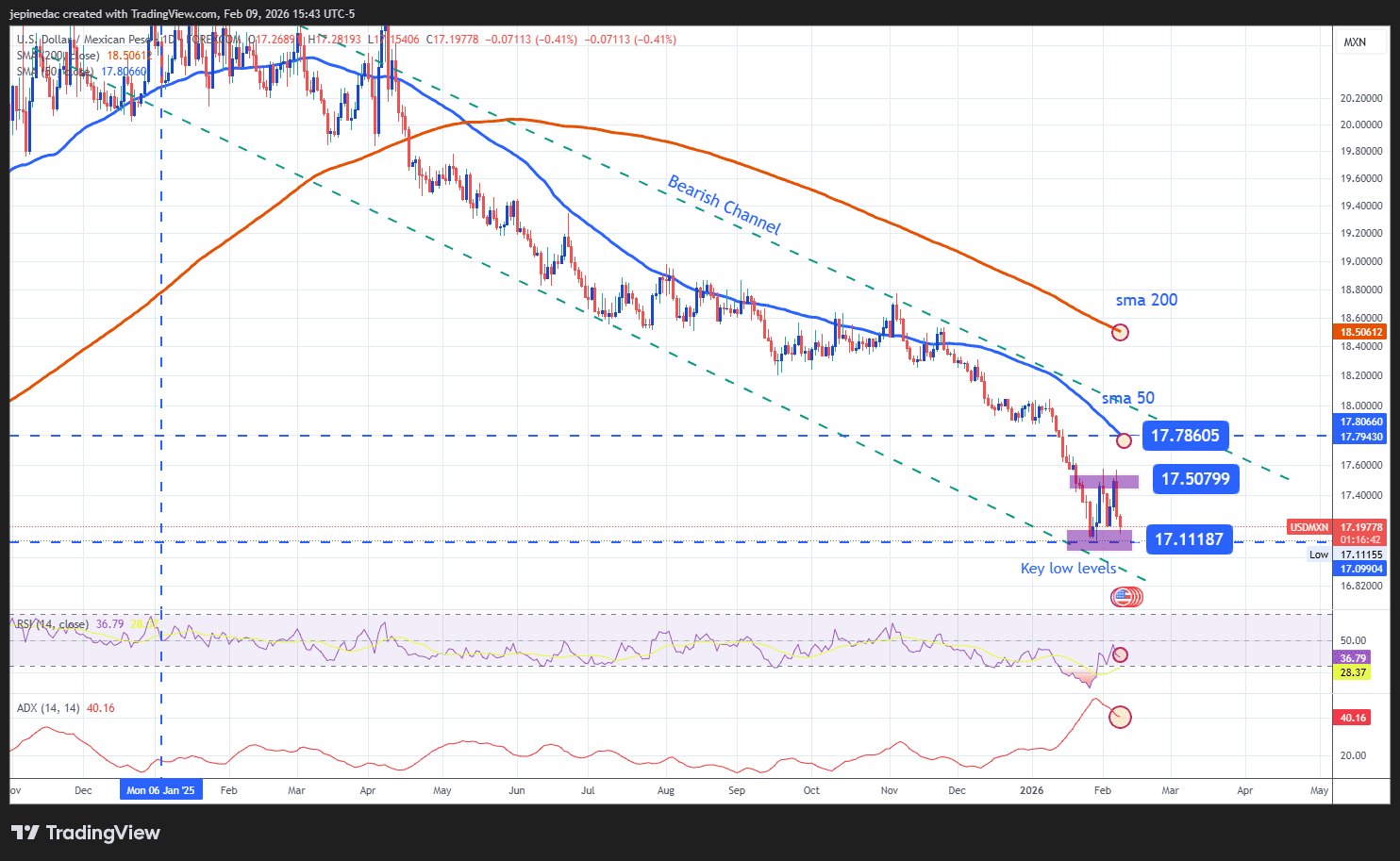
- The Broader Bearish Channel remains dominant: Despite recent rebound attempts in USD/MXN, bullish momentum has been insufficient to break the broader bearish channel that has dominated the chart for several months. As long as buying pressure fails to consolidate, the long-term bias continues to favor the Mexican peso. This technical structure may still have room to extend, particularly if price breaks below key prior lows, reinforcing the dominant bearish bias.
- RSI: Although the RSI has started to show a positive slope, readings remain below the neutral 50 level, suggesting that selling momentum remains relevant. Until the indicator moves above this threshold, it will be difficult for bullish momentum to consolidate in a sustained manner.
- ADX: The ADX currently remains above the 20 level, indicating that price volatility remains elevated. This environment of sustained volatility could favor the entry of more aggressive selling pressure in the short term.
Key levels:
- 17.78 – Main resistance: A level aligned with the 50-period simple moving average. A sustained break above this area could trigger renewed bullish pressure and put the validity of the bearish channel at risk.
- 17.50 – Current barrier: A nearby resistance zone corresponding to the most recent neutral price area, relevant during short-term bullish corrections.
- 17.11 – Key support: A level not seen since April 2024. A sustained move toward this area could open the door to a more aggressive bearish channel, reinforcing the dominant bearish bias.
Written by Julian Pineda, CFA, CMT – Market Analyst
Follow him on: @julianpineda25