

As the second week of February comes to an end, one of the dominant themes in the cryptocurrency market has been heightened risk aversion and a persistent loss of appetite. Beyond the fact that selling pressure was initially triggered by specific catalysts, the broad-based selloff has been driven mainly by the growing appeal of alternative markets, along with a series of forced liquidations stemming from the loss of confidence that has surrounded the market in the short term. In the absence of a clear fundamental catalyst capable of restoring confidence, selling pressure is likely to remain a dominant force in the sessions ahead.

Market appetite continues to weaken
The week has been particularly active in terms of downside moves across the crypto market. The deterioration in risk appetite has intensified largely due to the liquidation of positions that had been held for months, combined with the strengthening of other markets, such as the U.S. dollar, whose increased attractiveness has drawn interest away from risk assets, including cryptocurrencies.
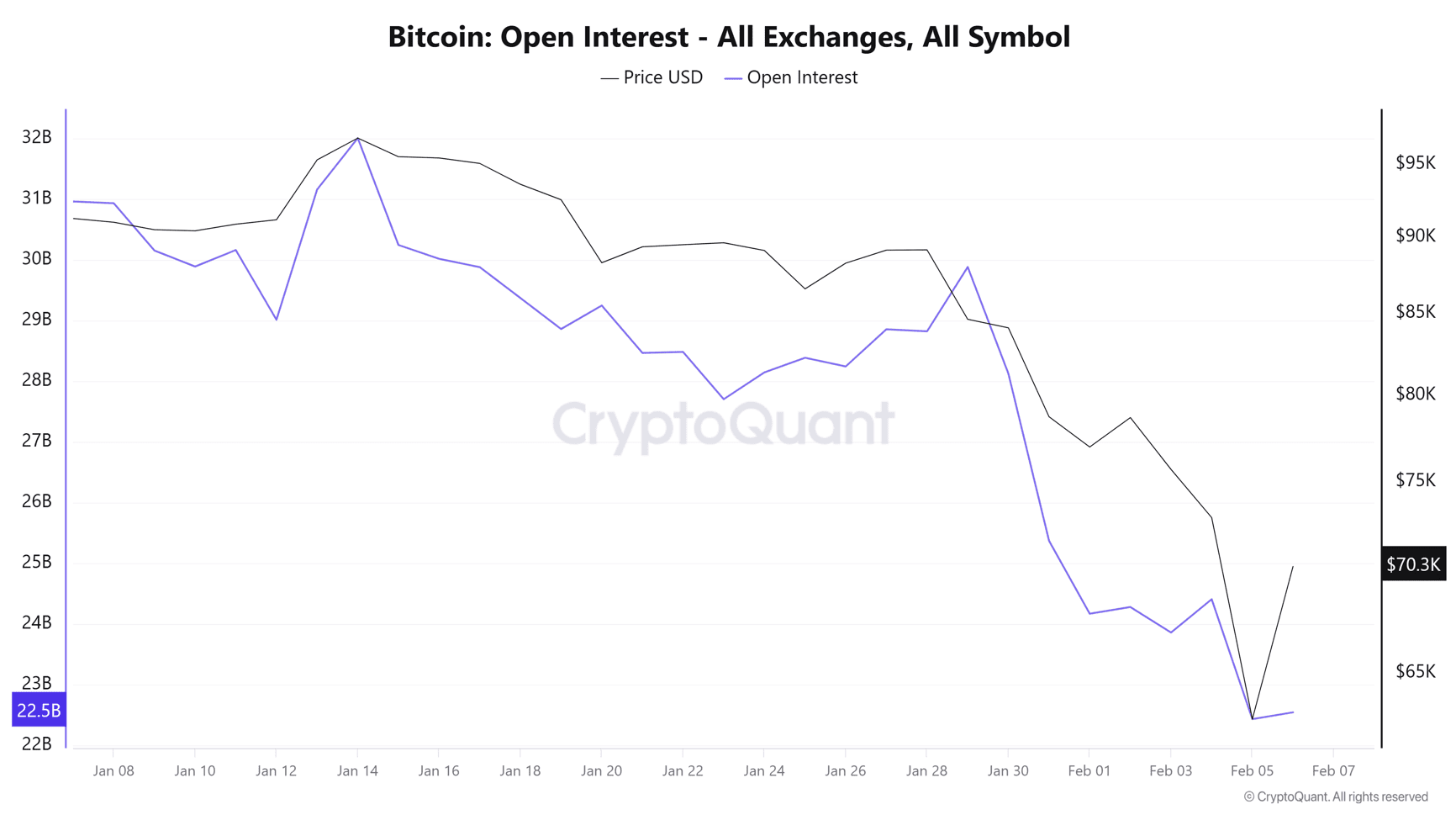
In this context, market behavior has been revealing. Using Bitcoin as the benchmark asset, it can be observed that toward the end of the week, open interest—the indicator that measures total open long and short positions in the institutional market—fell sharply toward the $22.5 billion area. Despite some recovery attempts, institutional activity shows a broad-based decline, suggesting that the drop in open interest is linked to the closure of long positions and a clear loss of short-term appetite.
Rather than signaling a specific directional move, this decline in open interest reflects a lack of conviction in the Bitcoin market. In this sense, the crypto market is currently failing to function either as a safe-haven asset or as a pure risk asset, reinforcing a scenario of structural weakness that could persist in the short term.
Source: Cryptoquant
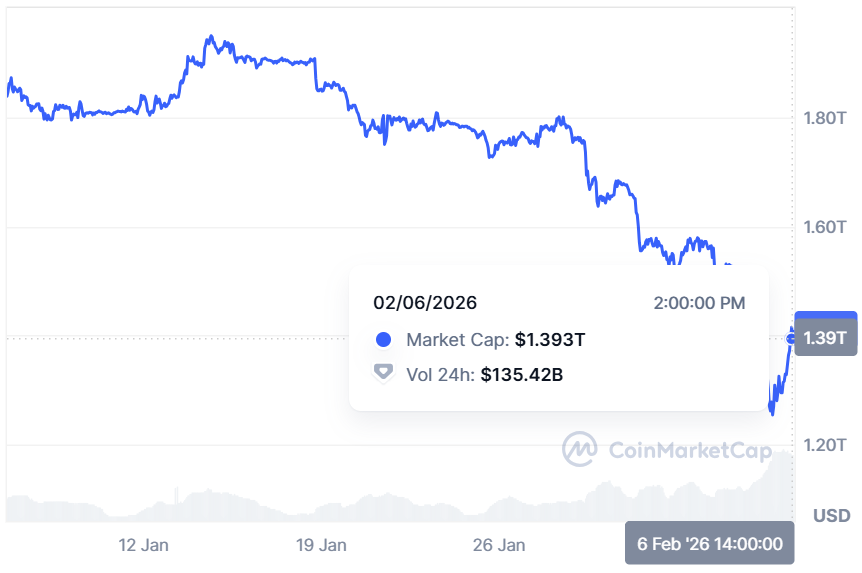
This dynamic has been accompanied by a sharp contraction in Bitcoin’s market capitalization. After starting the week above $1.5 trillion, it dropped to levels near $1.2 trillion, implying a loss of roughly $300 billion in market value in just a few sessions. Although capitalization has rebounded toward the $1.4 trillion area, this recovery has not been sufficient to offset the capital outflows observed throughout the week.
Source: Cryptomarketcap
This behavior indicates that, in addition to reduced institutional activity, there is also a decline in retail interest, reinforcing the idea that crypto market appetite continues to weaken. Until a catalyst emerges that can restore confidence, this dynamic is likely to continue shaping short-term price action.
Bitcoin versus other markets
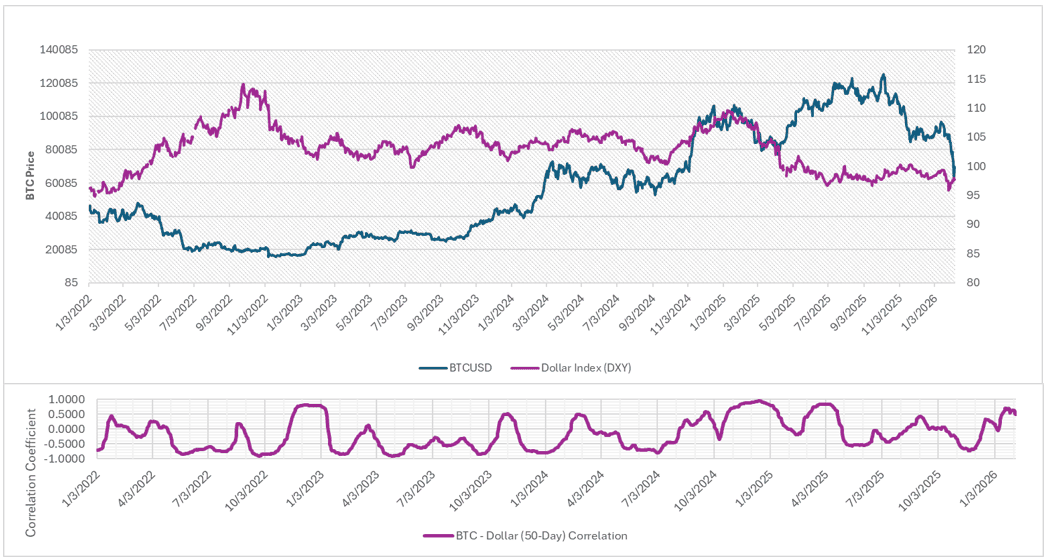
As the benchmark cryptocurrency, Bitcoin has begun to show a decline in its positive correlation with the DXY index, which had been higher in recent weeks. The correlation coefficient currently sits below 0.5, reflecting a moderate correlation over the average of the last 50 sessions. This suggests that the U.S. dollar’s recovery has not translated into Bitcoin’s price action. It is important to note that correlation coefficients can change over time.
This behavior indicates that as the dollar has regained attractiveness, risk markets—such as cryptocurrencies—have failed to follow, reinforcing the perception that Bitcoin has lost appeal both as a risk asset and as a temporary safe haven.
Source: Data – TVC, StoneX, Tradingview
Rather than benefiting Bitcoin, this dynamic highlight a persistent weakness bias, with capital flows appearing to move toward markets perceived as more stable, away from high-volatility assets like cryptocurrencies.
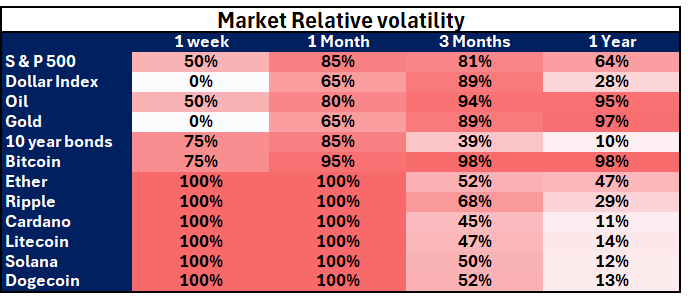
From a relative volatility perspective, major cryptocurrencies are currently showing price swings well above their weekly and monthly averages, reflecting a significant increase in volatility. This environment tends to undermine confidence, as the market is no longer perceived as stable by participants.
Source: Data – TVC, StoneX, Tradingview
Taken together, the combination of uncertainty, weak demand, and elevated volatility suggests that the cryptocurrency market is going through a challenging phase. As long as these factors persist, the dominant weakness is likely to continue shaping market behavior in the short term.
Confidence remains in sensitive territory
The Crypto Fear and Greed Index has registered a further deterioration, falling toward the 5-point area, marking a clear return to “extreme fear” territory. These levels have not been seen for several months and highlight that market confidence remains at depressed levels.
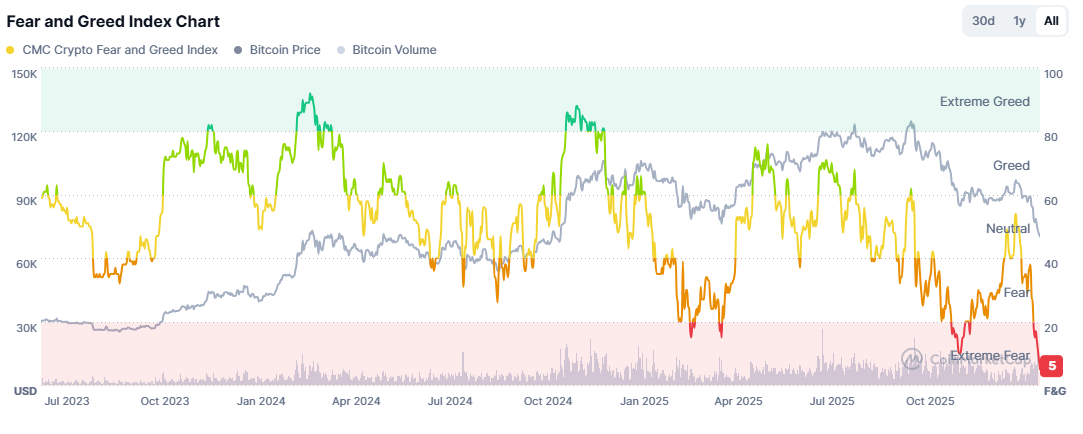
Source: Coinmarketcap
This low-confidence environment is not conducive to sustaining consistent demand. Until sentiment indicators show clear signs of recovery, this backdrop may continue to fuel meaningful weakness, which could remain dominant across the crypto market in the coming sessions.
Written by Julian Pineda, CFA, CMT – Market Analyst
Follow him on: @julianpineda25