

Financial instruments
A Beginner's Guide to Precious Metals
Learn what the gold standard is, its history, collapse, and impact on the US dollar. Explore how gold-backed currency shaped the global monetary system.
If you’re looking to diversify your portfolio beyond stocks and bonds, precious metals are one of the most common ways to do so. In this blog, we share what to know about investing in precious metals – including what defines a precious metal, the four major precious metals, ways to invest in precious metals, and the benefits and risks involved.
What are precious metals?
Precious metals are rare metallic elements with high economic value. Most belong to a group known as the ‘noble metals’, which means they’re highly resistant to corrosion and oxidation. They’re usually also ductile, meaning they can be hammered thin or drawn into wire without breaking, and possess a high luster or shine.
This combination of durability and beauty makes precious metals popular for jewelry, industrial applications, and investment assets.
What makes a metal precious?
To be considered ‘precious’, a metal must possess high economic value, scarcity, and unique physical properties.
Scarcity and rarity
The main reason why precious metals are so expensive is that there aren't many of them. While base metals, like aluminum or iron, are abundant in the Earth’s crusts, precious metals are found in very low concentrations.
Economic and industrial demand
Many precious metals have important industrial uses that add to their value. For example, silver is the most electrically conductive metal on earth, making it an essential component in solar panels and electronics. Platinum and palladium are used in catalytic converters, which help reduce harmful emissions in automobiles.
Monetary history
Because of their unique properties, gold and silver have been used as forms of money for most of human history. They’re easy to identify, difficult to fake, and don’t corrode or melt easily.
List of precious metals
The four major precious metals are gold, silver, platinum, and palladium. Other precious metals include rhodium, ruthenium, iridium, and osmium.
Gold
Gold is undoubtedly the most famous precious metal, known for its distinct yellow colour and incredible durability. It doesn’t rust or corrode, and its high malleability means it can be pressed into very thin sheets without breaking. Gold has some practical uses in dentistry and electronics, but it's mostly used in jewelry and as a form of currency.
Gold’s price is determined 24 hours a day on global markets and, unlike most commodities, is driven mostly by sentiment rather than supply and demand. This is because the amount of above-ground gold supply (held by central banks and investors) is much higher than the amount produced by mines each year. When holders of gold feel like selling, the price drops, and when they want to buy, the price increases.
People often flock to gold during:
- Systemic financial concerns: When banks or currencies feel unstable.
- Inflation: When the purchasing power of money declines.
- Geopolitical conflict: When periods of war or political instability make it more desirable to hold portable, physical wealth.
Gold’s main uses are in jewelry, radiation shielding, and thermal insulation. Its primary sources are South Africa, the United States, China, and Australia.
Silver
Silver is a unique metal because its price is determined by both its status as an investment (like gold) and its heavy use as an industrial metal. Because of this, silver prices tend to be more volatile compared to gold prices.
Silver has the highest electrical and thermal conductivity of all elements, making it essential for modern technology. When industries grow, demand for silver often increases, and vice versa. For example, silver once played an important role in photography, however its demand for this purpose fell with the advent of digital cameras.
Silver’s main uses are in jewelry, solar panels, electronics, dentistry, and antimicrobial medical products. The main sources of silver are Peru, Mexico, Chile, and China.
Platinum
Platinum is a silvery-white metal that’s dense, malleable, and highly resistant to corrosion. It’s much rarer than gold and has significantly lower annual mine production.
Like gold and silver, platinum trades 24 hours a day on global commodities markets. Its main source of demand comes from the automotive industry, where it’s used in catalytic converters which reduce harmful emissions. It’s also often used in jewelry and petrochemical refining.
Platinum mining is heavily concentrated in South Africa and Russia, so its price can also be affected by political or labor issues in those regions.
Palladium
Palladium is a silvery-white metal that belongs to the same family as platinum. It’s rare, malleable, can withstand high temperatures, and is exceptionally good at absorbing hydrogen.
Like platinum, palladium’s main use is in catalytic converters for gasoline engines. It’s also often used in jewelry to create white gold alloys. Other uses include dentistry, solar energy, medicine, groundwater treatment, and electronics.
Most of the world’s palladium comes from the U.S., Russia, South Africa, Zimbabwe, Canada, and Australia.
Other precious metals
Other precious metals are often referred to as Platinum Group Metals (PGMs). These include:
- Rhodium: A highly reflective metal used for mirrors, searchlights, and high-end jewelry finishes. It’s one of the rarest elements in the world.
- Ruthenium: An extremely hard metal used to coat electrical contacts or harden other metal alloys.
- Iridium: One of the densest metals, with an extremely high melting point. Iridium is the most corrosion-resistant element and is used in specialized electronics and medical devices as well as compasses, pen nibs, and watches.
- Osmium: Another extremely dense metal, though very brittle. Osmium has a high melting point and unpleasant odor, but is used to harden alloys and add durability to electrical contacts.
Ways to invest in precious metals
There are several ways to invest in precious metals, including buying physical bullion, purchasing stocks in precious metal mining companies, investing in precious metal ETFs, and trading futures and options.
Physical metal ownership
The most direct way to invest in precious metals is to buy physical coins and bars. This is an option for those who want a tangible asset that can be used as a hedge in crisis or instability.
However, owning physical bullion comes with the extra consideration of storage and security. It can also be less liquid than other forms of precious metal investments, meaning it’ll take a bit more time and effort to sell.
Precious metal stocks
Instead of holding physical metals, you can buy stock market shares in companies that mine for gold, silver, platinum, or palladium. These stocks are leveraged, which means their price often moves more significantly than the price of the metal itself. If the price of gold goes up by 5%, for example, the price of a mining company’s stock might move 10%.
However, these stocks also come with additional risks, such as company management and mining operations. They also don’t offer a hedge against the financial system itself.
ETFs and funds
Exchange-traded funds (ETFs) allow you to buy precious metals just like stocks on an exchange. This makes them highly liquid (you can buy or sell at the click of a button) and you don’t need to consider storage.
However, most ETFs will not give you a claim on the physical metal, meaning you cannot trade your shares for an actual gold bar. So if you’re looking for tangibility, you will not get that through this route.
Futures and derivatives
The futures and options markets offer leverage to precious metals investors who want to make big bets on price movements. These products allow you to control a large amount of metal with a relatively small amount of money, which can result in magnified wins but also major losses.
We don’t recommend investing in these products unless you’re extremely experienced. Increased leverage increases risk.
Bullion bars, investment coins, and purity
Here’s what to know about investing in precious metal bullion bars or coins.
Bullion bars
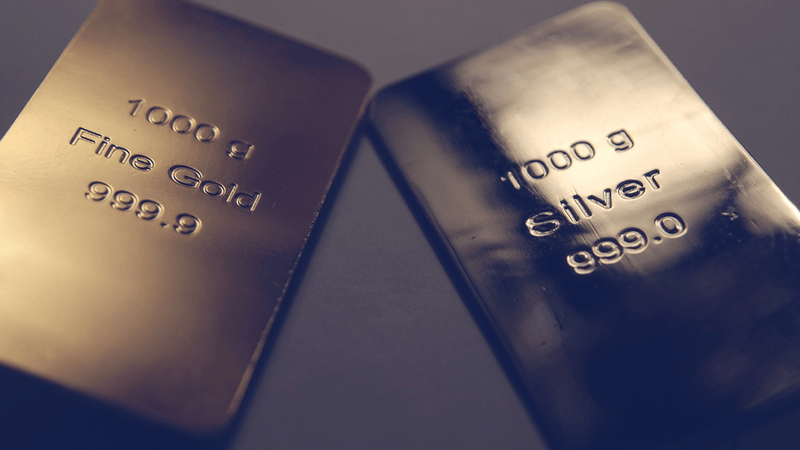
Bullion bars or ingots are refined, high-purity blocks of precious metal. Their value depends almost entirely on their intrinsic precious metal content (weight and purity), rather than any collectability or historical significance.
Bullion bars are manufactured by private or government mints and are stamped with their weight, purity, and mark. They tend to come in standardized weights, ranging from 1 gram to 400 ounces for gold and silver bars (sizes vary for palladium and platinum bars). Most investment-grade bullion has a purity of at least 99.9% for gold and silver, and 99.95% for platinum and palladium bars.
Investors often choose bullion bars for their cost-effectiveness – they carry lower premiums than bullion coins, meaning you get more precious metal for the same investment. However, they are harder to sell in parts compared to coins (e.g. if you want to sell a 400 oz gold bar you either need to sell the whole thing or melt it down, while coins come in smaller fractional sizes).
Investment coins
Investment coins, or bullion coins, are minted by government mints in gold, silver, platinum, and palladium. Unlike rare or collectible coins, their value is based mostly on the metal they contain (though some may carry additional value based on rarity, design, or historical significance).
The standard size for bullion coins is 1 oz, however you can often buy fractional sizes as small as 1/10 oz and larger sizes up to 5 oz, depending on the coin. Because of their unique designs and artistry, investment coins carry a slightly higher premium compared to bullion bars. Their purity can also vary.
Some of the most popular investment coins include the American Eagle, Canadian Maple Leaf, and South African Krugerrand, which are available in gold, silver, and sometimes in platinum or palladium.
Purity and mass standards
Precious metals are measured in troy ounces, which are slightly heavier than the standard ounce used for cooking. 24-karat gold is considered pure gold, but because it’s very soft, it’s often mixed with other metals like copper or silver (called alloys) to add durability.
Investment-grade bullion products from reputable sources will come with an assay card or certificate that verifies the purity and weight of the metal.
Gold vs platinum: Key investment differences
Price stability and volatility
Physical gold is considered a stable, long-term store of value. Its prices typically rise during periods of inflation, economic uncertainty, or financial crises, when investors turn to it for wealth preservation.
Platinum is much more volatile than gold. Because it’s used so heavily in the automotive and technology industries, its price often depends on how well these sectors are performing. Its price can also swing depending on regulatory shifts, supply-demand imbalances, and technological advancements.
Liquidity and resale value
Gold is a highly liquid, universally recognized asset. Investors can sell gold, whether it’s in the form of bullion bars, coins, jewelry, or ETFs, generally without major price discrepancies. Platinum has a smaller resale market compared to gold, which can make it more challenging to sell.
Gold’s price also tends to rise during periods of economic uncertainty, making it easy to resell. But because platinum is so dependent on industry, there can be less demand for the metal during these periods, especially if manufacturing is slowing down.
Industrial vs investment demand
Gold’s value is mostly driven by investment demand, central bank policies, and macroeconomic factors. Those who hold gold investments should stay updated on global economic stability, inflation rates, and geopolitical factors.
Platinum’s value, on the other hand, is directly tied to its industrial applications. This means investors must keep informed about industrial trends and innovations, since they can affect its price movements.
Benefits of investing in precious metals
The benefits of precious metals investing include portfolio diversification, inflation hedge, and protection in times of crisis.
Portfolio diversification
Diversification is an essential part of any investment strategy. Precious metals, especially gold, have historically shown a low or even negative correlation with stocks and bonds. This means they often move differently from traditional markets – when equities perform poorly, precious metals often hold their value (or even increase in price).
For that reason, even a small allocation of precious metals can help reduce overall risk and stabilize a diversified portfolio over time.
Inflation hedge
Precious metals, particularly gold, are generally considered to be effective long-term inflation hedges. This means they tend to maintain purchasing power over extended periods, with their value often rising as the U.S. dollar weakens.
Crisis protection
During major economic downturns or financial instability, investors often move away from riskier assets and into safer stores of value. Physical assets, like bullion bars and coins, also become more attractive when investors lose confidence in the financial system. This shift in demand can support or increase the price of metals like gold.
Precious metals risks
Some of the risks of investing in precious metals include volatility, storage considerations, and opportunity cost.
Price volatility
Although precious metals are seen as stable over the long term, their prices can still fluctuate in the short term. Precious metals prices can fluctuate based on:
- Changes in supply and demand
- Investor sentiment
- Interest rates & currency movements
- Geopolitical events
- Technological advancements.
Storage and security costs
If you plan to invest in physical precious metals, you need to consider storage and security, which can come at an additional cost. This might include paying for a safe, deposit box, vault storage, and insurance.
Opportunity cost
Opportunity cost is the potential value you miss out on when choosing one investment over another. In this case, precious metals don't generate income like stocks (which pay dividends) or bonds (which pay interest).
Instead, you’re solely relying on price appreciation for returns. This is especially important to consider during strong equity markets, when other assets might deliver higher returns.
Share this:



Open an account in minutes
Experience award-winning platforms with fast and secure execution.
Go to our Trading Academy
Choose one of our four market-leading educational courses.
A better trading experience
Discover how FOREX.com's platforms can give you an edge.
Economic calendar
Precious metals FAQs
Related guides
A Beginner's Guide to Precious Metals
Financial instruments
|
10 minutes read
Learn what the gold standard is, its history, collapse, and impact on the US dollar. Explore how gold-backed currency shaped the global monetary system.

American depositary receipts (ADRs)
Financial instruments
|
10 minutes read
Learn what American depositary receipts (ADRs) are, how they work, their types, pricing, fees, and tax implications, plus the pros, cons, and real-world examples for investors.
Commodity currencies explained
Financial instruments
|
7 minutes read
There are certain currencies that are linked to the price movements of commodities. Once you get to grips with the relationship phenomenon, you can take advantage of these trading opportunities. Find out what commodity currencies are and how to get started trading.
The information on this website is not targeted at the general public of any particular country. It is not intended for distribution to residents in any country where such distribution or use would contravene any local law or regulatory requirement. The information and opinions in this report are for general information use only and are not intended as an offer or solicitation with respect to the purchase or sale of any currency or CFD contract. All opinions and information contained in this report are subject to change without notice. This report has been prepared without regard to the specific investment objectives, financial situation and needs of any particular recipient. Any references to historical price movements or levels is informational based on our analysis and we do not represent or warranty that any such movements or levels are likely to reoccur in the future. While the information contained herein was obtained from sources believed to be reliable, author does not guarantee its accuracy or completeness, nor does author assume any liability for any direct, indirect or consequential loss that may result from the reliance by any person upon any such information or opinions.
Futures, Options on Futures, Foreign Exchange and other leveraged products involves significant risk of loss and is not suitable for all investors. Losses can exceed your deposits. Increasing leverage increases risk. Spot Gold and Silver contracts are not subject to regulation under the U.S. Commodity Exchange Act. Contracts for Difference (CFDs) are not available for US residents. Before deciding to trade forex, commodity futures, or digital assets, you should carefully consider your financial objectives, level of experience and risk appetite. Any opinions, news, research, analyses, prices or other information contained herein is intended as general information about the subject matter covered and is provided with the understanding that we do not provide any investment, legal, or tax advice. You should consult with appropriate counsel or other advisors on all investment, legal, or tax matters. References to FOREX.com or GAIN Capital refer to StoneX Group Inc. and its subsidiaries. Please read Characteristics and Risks of Standardized Options.