



EUR/USD Forecast: The Euro Fails to Recover Despite U.S. Political Uncertainty
The EUR/USD has posted two consecutive losing sessions, with a short-term decline of nearly 0.6% in favor of the U.S. dollar. For now, the pair shows a neutral bias, mainly due to political uncertainty in the U.S., which has pushed the market into a sideways pattern and prevented the formation of consistent directional moves.
Share this:

The EUR/USD has posted two consecutive losing sessions, with a short-term decline of nearly 0.6% in favor of the U.S. dollar. For now, the pair shows a neutral bias, mainly due to political uncertainty in the U.S., which has pushed the market into a sideways pattern and prevented the formation of consistent directional moves. As long as this situation persists, neutrality could continue to dominate in the coming trading sessions.


What’s Happening in the U.S.?
The government shutdown has entered its second day, and there is still no clarity on how it will be resolved or how long it might last. Non-essential government activities have been suspended, leaving hundreds of thousands of federal employees without pay or work, and so far neither the Executive nor the Senate has given clear signs that the situation will be resolved this week.
This event reflects a deterioration in political confidence and poses an institutional risk regarding government functionality. If prolonged, it could cause billions in losses to U.S. GDP due to the paralysis of key economic agencies. Although the impact has not yet been strongly reflected in the dollar, a longer shutdown—like the last one, which lasted more than a month—could significantly erode confidence in the currency.
Another point to consider is that among the agencies affected by the shutdown are those responsible for releasing employment data, meaning tomorrow’s scheduled Non-Farm Payrolls report could be delayed. Without such key economic indicators, the Federal Reserve would have fewer tools for decision-making, reinforcing expectations that there could still be two more rate cuts before the end of the year. Lower rates reduce the appeal of dollar-denominated assets and could, in the medium term, weaken the currency as an indirect consequence of the shutdown.
In conclusion, while the dollar has not yet shown a sharp decline in the face of political risk, if the shutdown continues for several weeks, it would heighten distrust in the greenback—both due to institutional instability and the lack of economic data. In that case, the euro could benefit from more consistent buying pressure in the short term.
What Does the European Central Bank Think?
There were also important ECB updates this week. President Christine Lagarde stated that inflation risks in the eurozone are under control and highlighted that the eurozone economy has held up well despite U.S. tariffs. However, she also noted that the central bank would likely maintain a neutral stance in upcoming decisions to prevent inflation from rising again.
Recent data shows that annual inflation for September rose to 2.2%, up from 2.0% in August, confirming that prices have started to climb again.
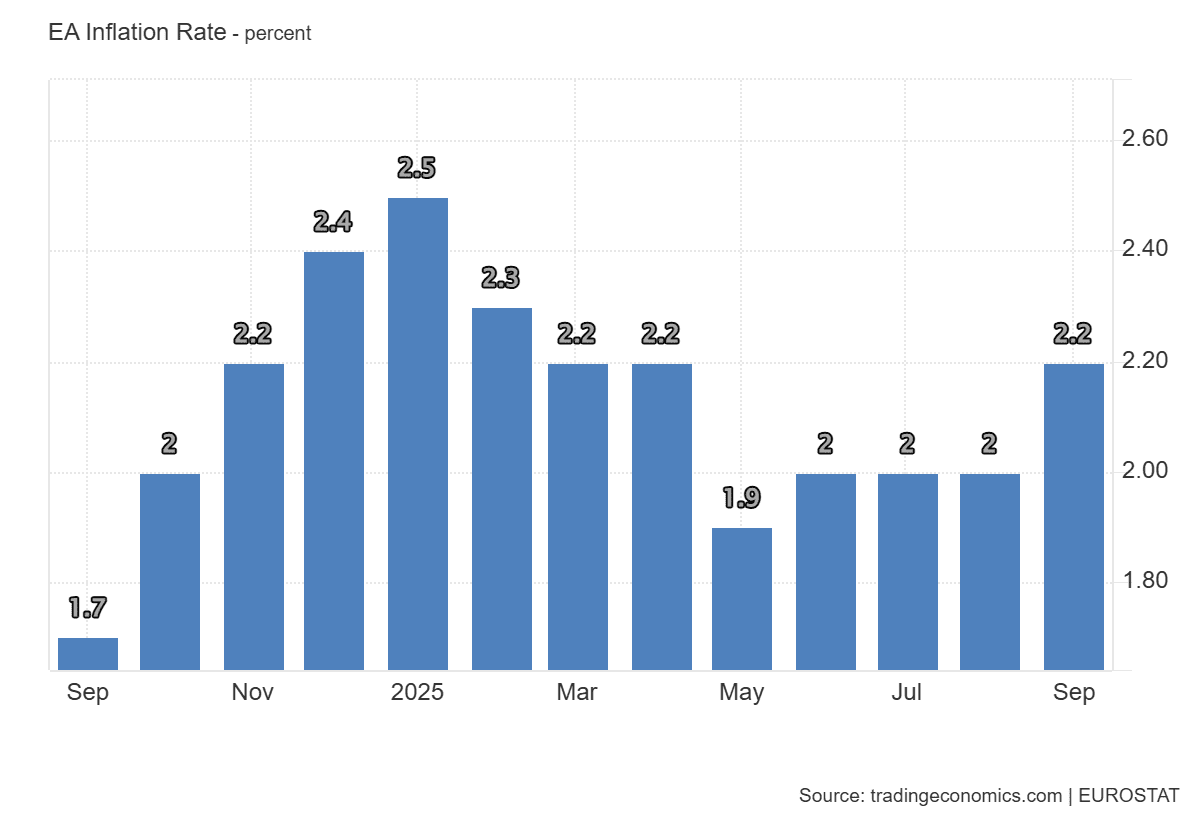
Source: TradingEconomics
Following these remarks, the ECB Watch tool now shows a 98.2% probability that the current 2.00% deposit rate will remain unchanged at the October 28 meeting. This is in line with the ECB’s rhetoric of prioritizing stability without resorting to rate cuts.
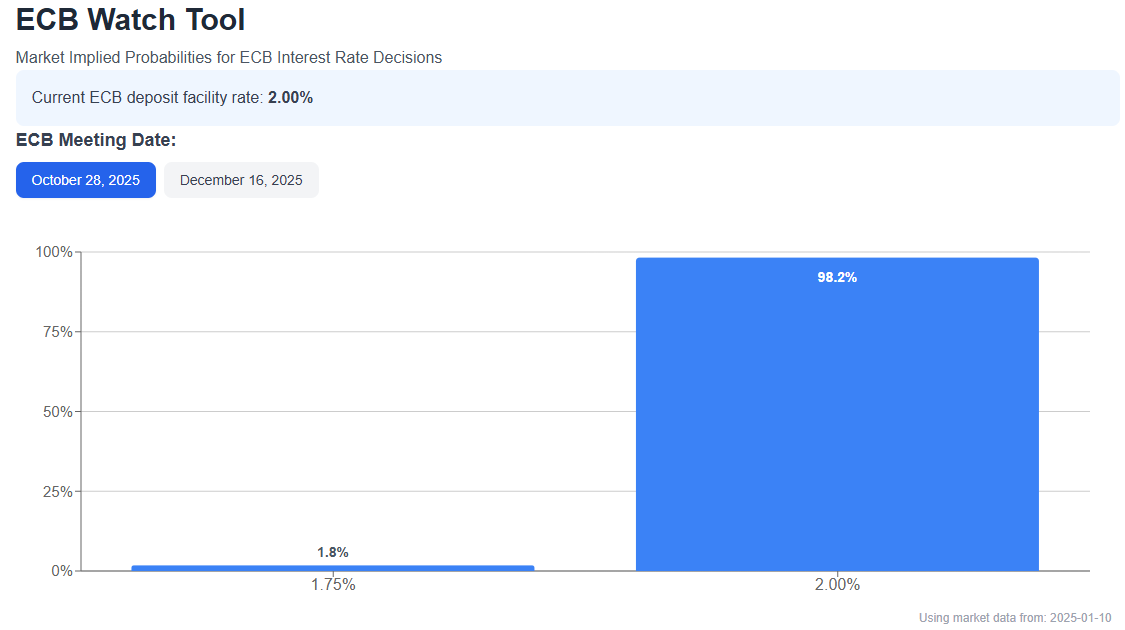
Source: ECBWATCH
In this context, it appears the ECB will remain neutral through the rest of the year. This stance contrasts with the more accommodative policy the Fed may adopt, which would reduce the interest rate differential between the two regions. Over time, this dynamic could make dollar investments less attractive while generating buying pressure on the euro, potentially paving the way for a relevant bullish bias in EUR/USD in the coming weeks.
EUR/USD Technical Outlook
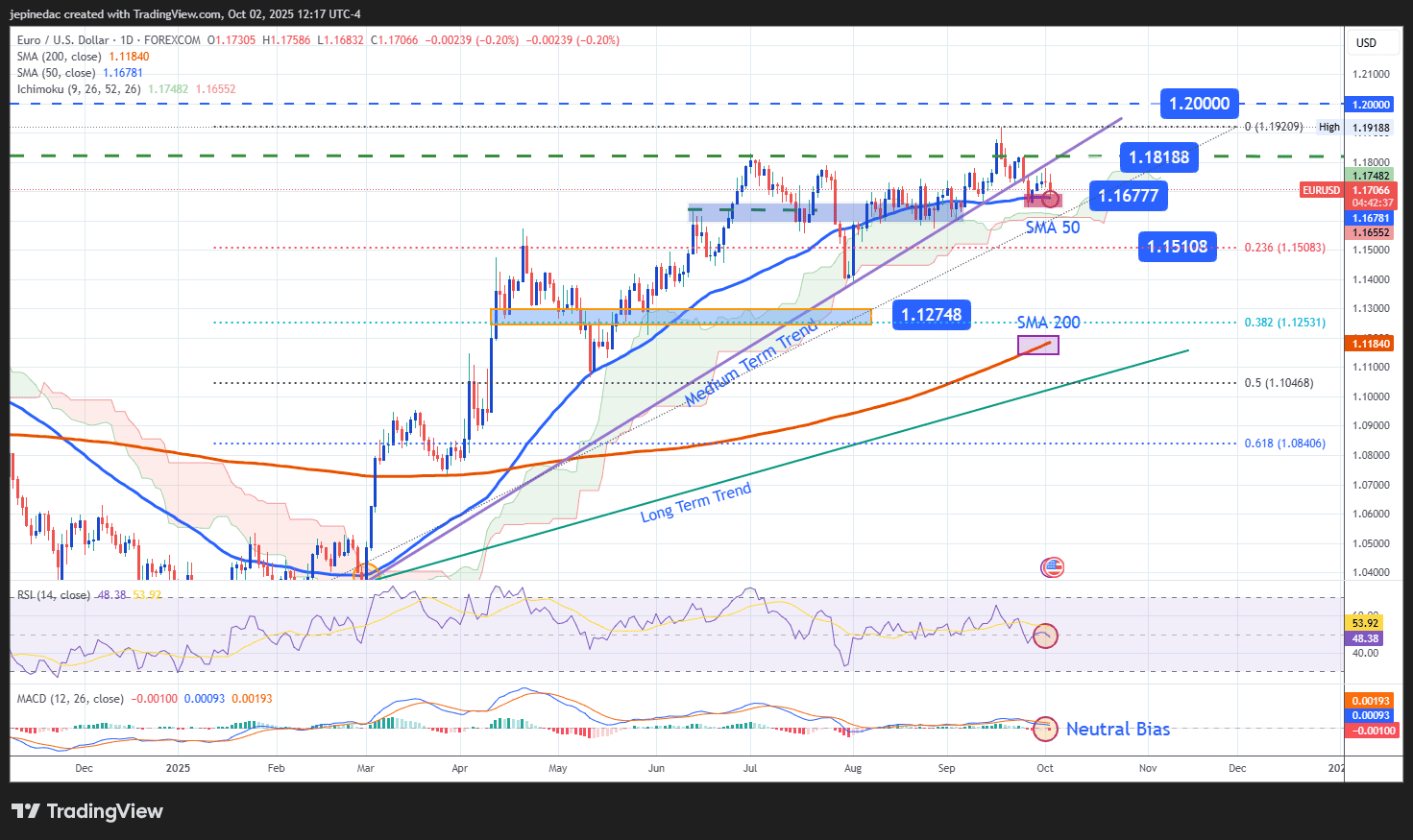
Source: StoneX, Tradingview
- Bearish momentum emerges: Since September 17, EUR/USD has been setting progressively lower lows, reinforcing a short-term bearish bias. However, the emergence of indecision candles around key support levels casts doubt on the strength of this move, which is not yet enough to establish a solid downtrend. Unless selling pressure breaks through key barriers, a neutral scenario could prevail in the short term.
- RSI: The RSI line has crossed below the 50 neutral level and continues to oscillate beneath it in recent sessions, signaling that bearish momentum has taken hold over the average of the last 14 sessions. As long as this downward slope persists, selling pressure could become more relevant in the coming days.
- MACD: The MACD shows a somewhat different picture. While the histogram continues to oscillate below the zero line, it remains close to neutrality, reflecting indecision in short-term moving averages. Unless the histogram pushes further into negative territory, this could indicate the formation of a neutral consolidation around the current EUR/USD support zone.
Key Levels:
- 1.16777 – Current Barrier: Corresponds to the zone marked by the 50-period simple moving average and is also near the Ichimoku cloud, making it the most important bearish barrier to watch. A sustained break below could mark a true reversal of the previous bullish trend and open the door to a new bearish phase.
- 1.18188 – Nearby Resistance: A zone of recent weekly highs where price has repeatedly retreated. As long as price action struggles to break this level, the pair could consolidate into a short-term sideways range.
- 1.20000 – Major Resistance: A key psychological level. A clean breakout above could trigger a more aggressive rally and reactivate the long-term bullish trendline that was broken in previous sessions.
Written by Julian Pineda, CFA – Market Analyst
Follow him: @julianpineda25
Related tags:



Open an account in minutes
Experience award-winning platforms with fast and secure execution, and enjoy tight spreads from 0.5 pts on FX and 0.3 pts on indices.
Economic calendar
Web Trader platform
Our sophisticated web-based platform is packed with features.
Related articles

EUR/USD Forecast: Euro Struggles to Find Support Even After U.S. PCE Data
The euro continues to face a challenging environment in the short term. The currency has struggled to regain ground against a U.S. dollar that remains firmly supported, a dynamic reflected in EUR/USD, which has now recorded three consecutive losing sessions and a decline of roughly 0.6%.

EUR/USD forecast: Eurozone stagflation risks mount as dollar holds firm ahead of data
The dollar was bouncing back at the time of writing, after it had eased overnight on the back of some weaker-than-expected economic data yesterday which had prompted markets to scale back expectations of an October Fed rate hike. However, with more significant US data due today and Friday, and with oil prices continuing to remain elevated, the dollar’s broader direction remains bullish.


Euro Forecast: EUR/USD Tumbles Towards Yearly Low as Daily RSI Goes Oversold
EUR/USD has been hit hard in the final month of the quarter as USD strength has shown up in a big way. With the pair set to challenge its yearly low as RSI has pushed into oversold territory, is there a chance for a pullback with some big headline risk hitting in the US over the next few days?

This report is intended for general circulation only. It should not be construed as a recommendation, or an offer (or solicitation of an offer) to buy or sell any financial products. The information provided does not take into account your specific investment objectives, financial situation or particular needs. Before you act on any recommendation that may be contained in this report, independent advice ought to be sought from a financial adviser regarding the suitability of the investment product, taking into account your specific investment objectives, financial situation or particular needs.
StoneX Financial Pte. Ltd., may distribute reports produced by its respective foreign entities or affiliates within the StoneX group of companies or third parties pursuant to an arrangement under Regulation 32C of the Financial Advisers Regulations. Where the report is distributed to a person in Singapore who is not an accredited investor, expert investor or an institutional investor (as defined in the Securities Futures Act), StoneX Financial Pte. Ltd. accepts legal responsibility to such persons for the contents of the report only to the extent required by law. Singapore recipients should contact StoneX Financial Pte. Ltd. at 6826 9988 for matters arising from, or in connection with the report.
In the case of all other recipients of this report, to the extent permitted by applicable laws and regulations neither StoneX Financial Pte. Ltd. nor its associated companies will be responsible or liable for any loss or damage incurred arising out of, or in connection with, any use of the information contained in this report and all such liability is hereby expressly disclaimed. No representation or warranty is made, express or implied, that the content of this report is complete or accurate.
StoneX Financial Pte. Ltd. is not under any obligation to update this report.
Trading CFDs carries a high level of risk that may not be suitable for some investors. Consider your investment objectives, level of experience, financial resources, risk appetite and other relevant circumstances carefully. The possibility exists that you could lose some or all of your investments, including your initial deposits. If in doubt, please seek independent expert advice. Visit www.forex.com/en-sg/terms-and-policies for the complete Risk Disclosure Statement.