



Gold 2026 Outlook: Fundamental XAU/USD analysis
Gold is heading into 2026 after one of its strongest years on record. Fuelled by aggressive central bank buying, a global interest rate cutting cycle and elevated safe-haven demand, the metal had surged nearly 65% and was on track to post its fifth consecutive monthly gain as well as a hat-trick of positive annual returns. The key question now is whether gold can hold on to those gains as we move through 2026.
Share this:

Gold is starting 2026 after ending one of its strongest years on record. Fuelled by aggressive central bank buying, a global interest rate cutting cycle and elevated safe-haven demand, the metal ended 2025 nearly 65% better off, posting its fifth consecutive monthly gain in December as well as a hat-trick of positive annual returns. The key question now is whether gold can hold on to those gains as we move through 2026. While the metal has made a positive start to the year and the long-term bullish case remains intact, meaning selling gold aggressively is still difficult to justify, the macro backdrop looks more finely balanced this year than last. Central bank demand may not be as relentless at elevated prices, much of the global easing cycle may already be priced in, bond yields remain high, and easing geopolitical tensions could gradually reduce gold’s safe-haven appeal. As a result, 2026 may not be super bullish for gold, and the metal could be heading for a long-overdue consolidation rather than a repeat of 2025’s explosive rally.
Gold 2026 outlook: A potentially hawkish year for central banks
Gold has enjoyed a remarkable run in 2025, rising about 65% on the year. The metal surged higher at the start of the year, pausing for breather during the summer months, before extending the rally in the second half of the year. Some bullish momentum was lost in mid-October after the metal hit a record peak of $4381. The metal then bounced back heading into the final weeks of 2025, before breaking out to a new record above $4,500, where the rally faltered in the closing days of December. But that wasn’t enough to prevent the metal making another positive return on the month.
After such a powerful rally in 2025, that caused the already-overbought prices to get even more stretched, we are not expecting gold to make any groundbreaking gains in 2026. Granted, the metal may go on to achieve that $5K hurdle, which would point to a further roughly 10% upside above the December’s high, the macro backdrop may not be as welcoming for gold as has been the case in 2025 and earlier. Indeed, the list of reasons why the rally could start to cool is growing steadily. We are alert to the possibility of a short-term reversal — but only when the charts confirm. More on this in the technical analysis section of this gold 2026 outlook guide.
After the Fed and most other central banks trimmed rates in 2025 as inflation eased, expectations for further policy easing have fallen sharpy. For some central banks, one or two additional cuts might be forthcoming. For others, a long pause or even a hike in interest rates may may well be the case in 2026. The Bank of Japan has indicated that it needs to further normalise it monetary policy while central banks in Australia, New Zealand and Canada, among others, have signalled the end of their easing cycles. The European Central Bank has turned neutral amid mild improvement in data and Germany’s big fiscal stimulus, while the fallout from Trump’s tariffs haven’t been as bad as feared.
If the broad global policy narrative shifts towards gradual tightening or at least “less easing” in 2026, it becomes far harder for gold to extend its rally without fresh catalysts.
Will central banks continue to buy gold?
Much of gold’s strength in recent times has been driven by strong central-bank demand — especially from China. The country’s role remains pivotal shaping the gold 2026 outlook. Will the PBOC and other central banks continue to purchase gold at these elevated prices?
Chart 1: Central bank gold buying

According to the World Gold Council, central bank demand for gold totalled 53 tonnes in October 2025, which was +36% m/m increase. Central bank buying has been strong throughout the year as per the above chart. It hasn’t just been the PBOC, but in October, buying remained concentrated among a small number of central banks, led by the National Bank of Poland.
However, the pace of central bank buying in 2025 was slower compared to the previous few years, no doubt due to the significantly higher prices.
Chart 2: Central bank gold buying trend
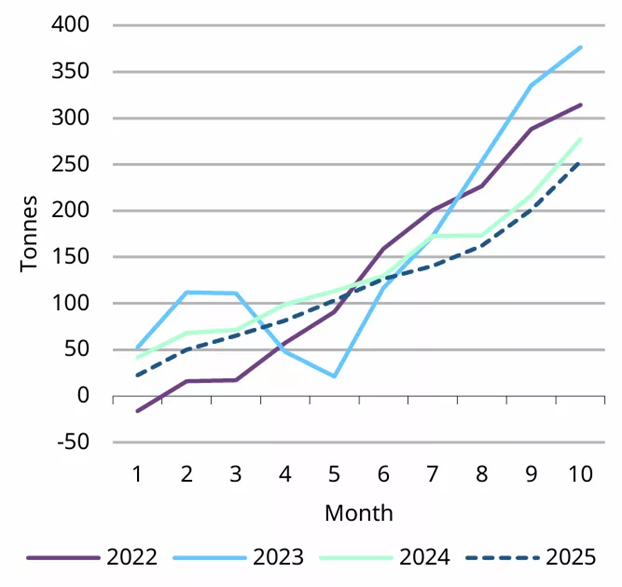
While purchases ramped up from the National Bank of Poland (83t), Kazakhstan (41t) and most other emerging-market central banks, People’s Bank of China has slowed down its purchases.
If the PBOC further tempers its buying at these elevated price levels, leveraged positions could unwind quickly on realisation of cooling Chinese demand. Indeed, we have already seen several central banks reducing their gold reserves in 2025, including those in Singapore and Uzbekistan. At some point, the opportunity to make a handsome profit will be too tempting to ignore.
What other factors could undermine the rally?
Much of gold’s strength in recent times has been driven by familiar factors: geopolitical uncertainty around Russia and Ukraine, ongoing discussion about de-dollarisation, and consistently strong central-bank demand. These factors have acted as reliable supports throughout 2025. But once you strip them back, the rally is arguably running a little thin on new fuel. For the gold 2026 outlook, this raises an important question: how much upside is left?
From a geopolitical front, there were glimmers of risks easing up until the first week of January: slow-moving peace conversations in Ukraine, a ceasefire in Gaza, and more stable trade relations between Washington and Beijing. In theory, each of these should trim gold’s safe-haven demand, yet the metal has barely reacted. Granted, some of this has been due to the recent tensions between the US and Venezuela which took a dramatic turn with the capture of Nicolás Maduro. Whether this will keep gold’s haven appeal supported in the slightly longer run remains to be seen.
Meanwhile, the softer US dollar throughout 2025 helped maintain a floor, but it remains to be seen how much further the dollar selling will continue, especially if there is a supply side shock that boosts inflation again – for example from oil prices. Japan may well be another wildcard. Rising JGB yields, driven by expectations of policy normalisation by the BoJ, may spark concerns about the unwinding of the carry trade, hurting all sorts of leveraged positions including precious metals. Yet this hadn’t been the case in 2025, with the USD/JPY rising above 155.00 handle, threatening to push even higher.
In summary
In 2026, the gold outlook is far more finely balanced. While the bullish case is likely to remain intact in as far as the long-term is concerned, some of the factors that pushed gold to repeated all-time highs may become less dominant. Central bank buying, the direction of global bond yields, and how much easing is truly left in the pipeline will matter more than ever. With geopolitical risks (outside of Venezuela) showing signs of stabilising and real yields remaining elevated, gold may need fresh catalysts to extend its rally. In short, the trend is still constructive, but after such an exceptional run, the margin for disappointment is growing and the risk of a corrective phase in 2026 should not be underestimated.

-- Written by Fawad Razaqzada, Market Analyst
Follow Fawad on Twitter @Trader_F_R
Related tags:



Open an account in minutes
Experience award-winning platforms with fast and secure execution, and enjoy tight spreads from 0.5 pts on FX and 0.3 pts on indices.
Economic calendar
Web Trader platform
Our sophisticated web-based platform is packed with features.
Related articles

Gold Price Outlook: XAU/USD Resistance at $4200 Sets Up for NFP
It was a strong sell-off to start the week in gold and despite a Tuesday bounce, sellers are continuing to push following a resistance hit at the $4200 level.


Gold Forecast: Are Bears Regaining Control of XAU/USD?
The start of the trading week has not been particularly favorable for gold. This can be seen in recent XAU/USD price action, with the metal falling nearly 4.00% over the last two trading sessions and bringing renewed attention to a bearish bias within the market.


Gold outlook: XAU/USD hammered, stretched and vulnerable to a sharp rebound
Gold is getting hammered for solid fundamental reasons, but history suggests extreme four-hourly oversold conditions can produce violent countertrend rallies.
This report is intended for general circulation only. It should not be construed as a recommendation, or an offer (or solicitation of an offer) to buy or sell any financial products. The information provided does not take into account your specific investment objectives, financial situation or particular needs. Before you act on any recommendation that may be contained in this report, independent advice ought to be sought from a financial adviser regarding the suitability of the investment product, taking into account your specific investment objectives, financial situation or particular needs.
StoneX Financial Pte. Ltd., may distribute reports produced by its respective foreign entities or affiliates within the StoneX group of companies or third parties pursuant to an arrangement under Regulation 32C of the Financial Advisers Regulations. Where the report is distributed to a person in Singapore who is not an accredited investor, expert investor or an institutional investor (as defined in the Securities Futures Act), StoneX Financial Pte. Ltd. accepts legal responsibility to such persons for the contents of the report only to the extent required by law. Singapore recipients should contact StoneX Financial Pte. Ltd. at 6826 9988 for matters arising from, or in connection with the report.
In the case of all other recipients of this report, to the extent permitted by applicable laws and regulations neither StoneX Financial Pte. Ltd. nor its associated companies will be responsible or liable for any loss or damage incurred arising out of, or in connection with, any use of the information contained in this report and all such liability is hereby expressly disclaimed. No representation or warranty is made, express or implied, that the content of this report is complete or accurate.
StoneX Financial Pte. Ltd. is not under any obligation to update this report.
Trading CFDs carries a high level of risk that may not be suitable for some investors. Consider your investment objectives, level of experience, financial resources, risk appetite and other relevant circumstances carefully. The possibility exists that you could lose some or all of your investments, including your initial deposits. If in doubt, please seek independent expert advice. Visit www.forex.com/en-sg/terms-and-policies for the complete Risk Disclosure Statement.