



Limit Down and Rough Open Expected For Wall Street
The toxic combination of an oil price collapse along with escalating coronavirus fears is setting the scene for one of the wildest days in years for global markets and US indices.
Share this:

The toxic combination of an oil price collapse along with escalating coronavirus fears is setting the scene for one of the wildest days in years for global markets and US indices.
Panic selling is engulfing the markets as traders attempt to figure out how the oil price war and the rapid spread of coronavirus and the associated supply demand shock will impact the global economy.
The toxic combination of an oil price collapse along with escalating coronavirus fears is setting the scene for one of the wildest days in years for global markets and US indices.Indices in Europe have plunged sharply in the European session. The FTSE experienced losses of 8.5% at its worst and US index futures have plunged 5%, indicating a sharp fall on the open. The panic exists because traders cannot quantify either the oil price war or the coronavirus impact. Markets hate uncertainty and recession fears are growing, fanned further by dismal data from China
Over in the US, futures trading was suspended in the Asian session on limit down after the S&P fell 5% making for a very uncertain US open.
What is limit down or circuit breaker?
A limit down price is the maximum sell-off permitted under NYSE rules in a market on a single day of trading. Once this level has been reached, the market is then suspended to prevent significant volatility and potential panic selling. A limit down price is typically determined as a percentage decline in a given market, rather than a nominal decline in price.
A limit down price is the maximum sell-off permitted under NYSE rules in a market on a single day of trading. Once this level has been reached, the market is then suspended to prevent significant volatility and potential panic selling. A limit down price is typically determined as a percentage decline in a given market, rather than a nominal decline in price.
Circuit breakers levels
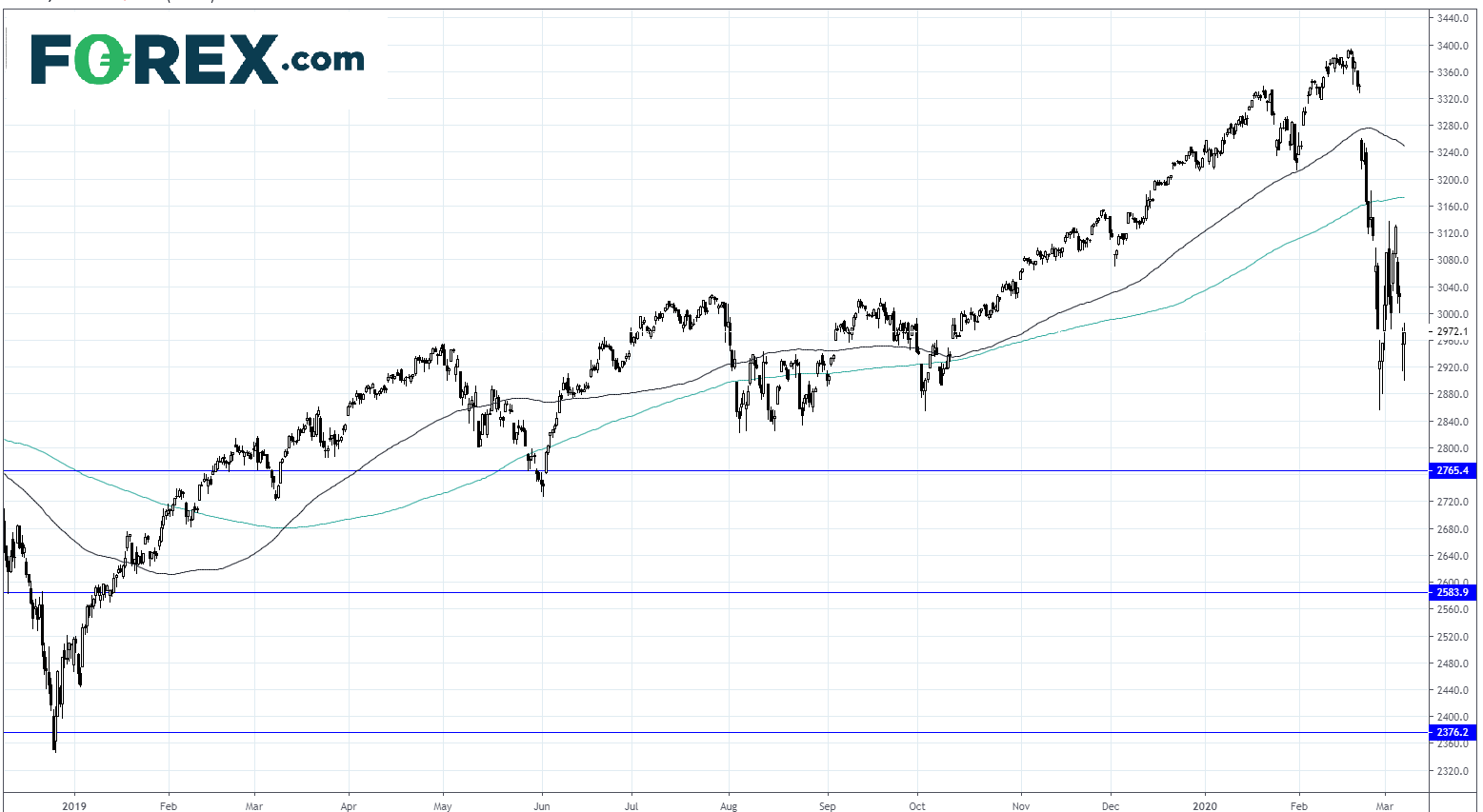
There are three circuit breaker levels, when declines in the S&P breach 7% and 13%, trading will pause for 15 minutes. A 20% decline would shut trading for the rest of the day under current NYSE trading rules.
There are three circuit breaker levels, when declines in the S&P breach 7% and 13%, trading will pause for 15 minutes. A 20% decline would shut trading for the rest of the day under current NYSE trading rules.
Not the first time
This is not the first time that the markets have experienced limit down. US equity futures trading were limit down after President Trump’s surprise 2016 election. Whilst there was significant volatility on days following the results, this actually calmed relatively quickly and saw the US stock markets rally across the following 4 year to reach an all-time high in February.
On the other hand, limit down was also experienced in the 2008 financial crash. The markets plunged as traders feared the banking crisis would lead to a global recession, which it did.
Recession coming?
The one two punch of an oil price war, coronavirus outbreak escalation, combined with dismal data from China has investors fearing a global recession. It is impossible to tell right now how this will pan out. Limit down does not in itself mean that a recession will pursue. However, the bond market is pointing to some dark days ahead.
Circuit breaker level chart S&P
Panic selling is engulfing the markets as traders attempt to figure out how the oil price war and the rapid spread of coronavirus and the associated supply demand shock will impact the global economy.
Indices in Europe have plunged sharply in the European session. The FTSE experienced losses of 8.5% at its worst and US index futures have plunged 5%, indicating a sharp fall on the open. The panic exists because traders cannot quantify either the oil price war or the coronavirus impact. Markets hate uncertainty and recession fears are growing, fanned further by dismal data from China
Over in the US, futures trading was suspended in the Asian session on limit down after the S&P fell 5% making for a very uncertain US open.
What is limit down or circuit breaker?
A limit down price is the maximum sell-off permitted under NYSE rules in a market on a single day of trading. Once this level has been reached, the market is then suspended to prevent significant volatility and potential panic selling. A limit down price is typically determined as a percentage decline in a given market, rather than a nominal decline in price.
A limit down price is the maximum sell-off permitted under NYSE rules in a market on a single day of trading. Once this level has been reached, the market is then suspended to prevent significant volatility and potential panic selling. A limit down price is typically determined as a percentage decline in a given market, rather than a nominal decline in price.
Circuit breakers levels
There are three circuit breaker levels, when declines in the S&P breach 7% and 13%, trading will pause for 15 minutes. A 20% decline would shut trading for the rest of the day under current NYSE trading rules.
There are three circuit breaker levels, when declines in the S&P breach 7% and 13%, trading will pause for 15 minutes. A 20% decline would shut trading for the rest of the day under current NYSE trading rules.
Not the first time
This is not the first time that the markets have experienced limit down. US equity futures trading were limit down after President Trump’s surprise 2016 election. Whilst there was significant volatility on days following the results, this actually calmed relatively quickly and saw the US stock markets rally across the following 4 year to reach an all-time high in February.
On the other hand, limit down was also experienced in the 2008 financial crash. The markets plunged as traders feared the banking crisis would lead to a global recession, which it did.
Recession coming?
The one two punch of an oil price war, coronavirus outbreak escalation, combined with dismal data from China has investors fearing a global recession. It is impossible to tell right now how this will pan out. Limit down does not in itself mean that a recession will pursue. However, the bond market is pointing to some dark days ahead.
Circuit breaker level chart S&P
The toxic combination of an oil price collapse along with escalating coronavirus fears is setting the scene for one of the wildest days in years for global markets and US indices.
Panic selling is engulfing the markets as traders attempt to figure out how the oil price war and the rapid spread of coronavirus and the associated supply demand shock will impact the global economy.
Indices in Europe have plunged sharply in the European session. The FTSE experienced losses of 8.5% at its worst and US index futures have plunged 5%, indicating a sharp fall on the open. The panic exists because traders cannot quantify either the oil price war or the coronavirus impact. Markets hate uncertainty and recession fears are growing, fanned further by dismal data from China
Over in the US, futures trading was suspended in the Asian session on limit down after the S&P fell 5% making for a very uncertain US open.
What is limit down or circuit breaker?
A limit down price is the maximum sell-off permitted under NYSE rules in a market on a single day of trading. Once this level has been reached, the market is then suspended to prevent significant volatility and potential panic selling. A limit down price is typically determined as a percentage decline in a given market, rather than a nominal decline in price.
A limit down price is the maximum sell-off permitted under NYSE rules in a market on a single day of trading. Once this level has been reached, the market is then suspended to prevent significant volatility and potential panic selling. A limit down price is typically determined as a percentage decline in a given market, rather than a nominal decline in price.
Circuit breakers levels
There are three circuit breaker levels, when declines in the S&P breach 7% and 13%, trading will pause for 15 minutes. A 20% decline would shut trading for the rest of the day under current NYSE trading rules.
There are three circuit breaker levels, when declines in the S&P breach 7% and 13%, trading will pause for 15 minutes. A 20% decline would shut trading for the rest of the day under current NYSE trading rules.
Not the first time
This is not the first time that the markets have experienced limit down. US equity futures trading were limit down after President Trump’s surprise 2016 election. Whilst there was significant volatility on days following the results, this actually calmed relatively quickly and saw the US stock markets rally across the following 4 year to reach an all-time high in February.
On the other hand, limit down was also experienced in the 2008 financial crash. The markets plunged as traders feared the banking crisis would lead to a global recession, which it did.
Recession coming?
The one two punch of an oil price war, coronavirus outbreak escalation, combined with dismal data from China has investors fearing a global recession. It is impossible to tell right now how this will pan out. Limit down does not in itself mean that a recession will pursue. However, the bond market is pointing to some dark days ahead.
Circuit breaker level chart S&P
Related tags:




Open an account in minutes
Experience award-winning platforms with fast and secure execution, and enjoy tight spreads from 0.5 pts on FX and 0.3 pts on indices.
Economic calendar
Web Trader platform
Our sophisticated web-based platform is packed with features.
Related articles

Crude Oil Analysis: Geopolitical Risk Continues to Drive the WTI Barrel Higher
During recent trading sessions, a new wave of buying momentum has continued to gain relevance around WTI crude oil price action. Over the last three trading sessions, the market has maintained a bullish streak and is now up more than 5.5%, highlighting significant buying pressure in the short term.

Nikkei 225 Eyes Wall Street Bounce Ahead of NFP
Wall Street rebounds as Fed hike bets ease, while Nikkei 225 futures eye 66k resistance ahead of US nonfarm payrolls.


Crude Oil Forecast WTI Prices Come Under Pressure as Middle East Risks Ease
Over the last two trading sessions, WTI crude oil has once again displayed a notable bearish bias, with prices falling nearly 6%. Part of this renewed selling pressure has been driven by recent developments in the Middle East, which have helped temporarily ease the geopolitical tensions that had supported the oil risk premium in previous weeks.
This report is intended for general circulation only. It should not be construed as a recommendation, or an offer (or solicitation of an offer) to buy or sell any financial products. The information provided does not take into account your specific investment objectives, financial situation or particular needs. Before you act on any recommendation that may be contained in this report, independent advice ought to be sought from a financial adviser regarding the suitability of the investment product, taking into account your specific investment objectives, financial situation or particular needs.
StoneX Financial Pte. Ltd., may distribute reports produced by its respective foreign entities or affiliates within the StoneX group of companies or third parties pursuant to an arrangement under Regulation 32C of the Financial Advisers Regulations. Where the report is distributed to a person in Singapore who is not an accredited investor, expert investor or an institutional investor (as defined in the Securities Futures Act), StoneX Financial Pte. Ltd. accepts legal responsibility to such persons for the contents of the report only to the extent required by law. Singapore recipients should contact StoneX Financial Pte. Ltd. at 6826 9988 for matters arising from, or in connection with the report.
In the case of all other recipients of this report, to the extent permitted by applicable laws and regulations neither StoneX Financial Pte. Ltd. nor its associated companies will be responsible or liable for any loss or damage incurred arising out of, or in connection with, any use of the information contained in this report and all such liability is hereby expressly disclaimed. No representation or warranty is made, express or implied, that the content of this report is complete or accurate.
StoneX Financial Pte. Ltd. is not under any obligation to update this report.
Trading CFDs carries a high level of risk that may not be suitable for some investors. Consider your investment objectives, level of experience, financial resources, risk appetite and other relevant circumstances carefully. The possibility exists that you could lose some or all of your investments, including your initial deposits. If in doubt, please seek independent expert advice. Visit www.forex.com/en-sg/terms-and-policies for the complete Risk Disclosure Statement.