



RBA Rate Cut Odds Collapse as Inflation Surges Past Forecasts
A material upside surprise on inflation has left the RBA cornered. Unless the labour market weakens sharply, the central bank may have no choice but to hold, or even hike.
Share this:

- Inflation surged past forecasts in Q3
- RBA’s preferred measure hit top of target band
- Rate cut odds for November collapsed
- AUD rallied, bonds and stocks fell
- Labour market now key to future rate moves
Summary
The door has been slammed shut on another RBA cut in November. The next move in Australia’s cash rate now carries a very real risk of being higher, unless the labour market weakens meaningfully in the months ahead. That’s the blunt assessment following an uncomfortably hot Australian inflation report for the September quarter, with headline and underlying measures coming in well above market and RBA expectations. The Australian dollar has rallied, while stocks and bonds are sinking, reflecting growing doubts about whether there’ll be another cut this cycle.
Inflation Print Snookers RBA
Australian inflation surged in the September quarter, with headline CPI rising 1.3%, the fastest quarterly increase since early 2023. Annual inflation jumped to 3.2%, up from 2.1% in Q2, driven by a 23.6% spike in electricity costs as rebates rolled off and price reviews took effect. Housing, recreation, and transport were key contributors to quarterly inflation, with holiday travel and fuel prices climbing. Food inflation remained sticky, particularly for takeaway meals and coffee, the latter up nearly 15% amid global supply constraints.
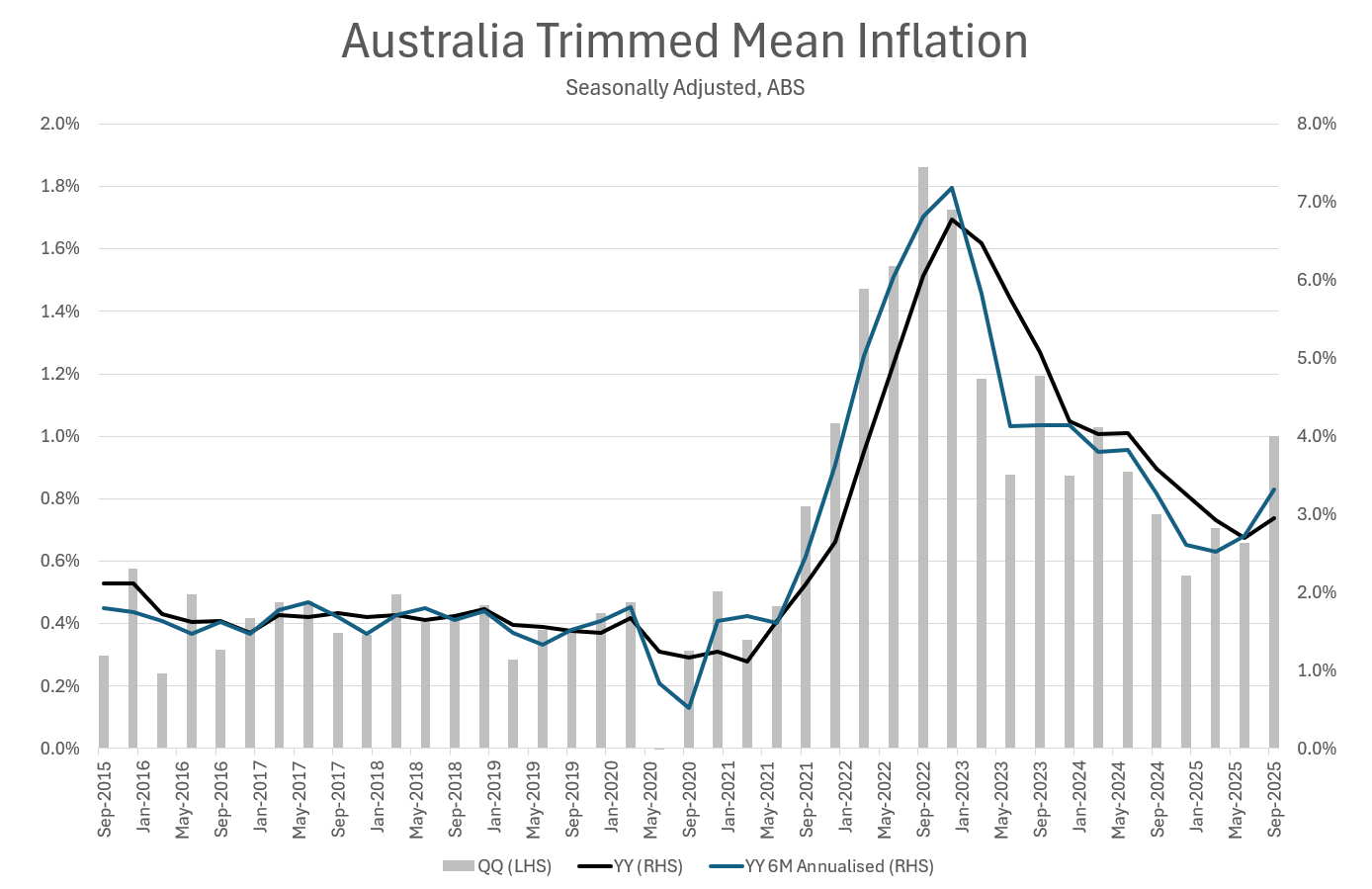
More importantly for the Reserve Bank, trimmed mean inflation—its preferred underlying measure—rose 3.0% from a year earlier, hitting the top of its 2–3% target band for the first time since late 2024. The RBA targets trimmed mean inflation of 2.5% over the year, viewing it as a more reliable lead indicator on where headline inflation is likely to trend. When the last two quarterly trimmed mean readings are annualised, the pace jumps to 3.3%, well above the RBA’s comfort zone.
Source: David Scutt, ABS
That’s a problem. The RBA had forecast trimmed mean inflation to come in just above 0.6% for the quarter. Instead, it printed at 1.0%. Earlier this week, Governor Michele Bullock suggested a 0.9% outcome would be a “material miss” on the bank’s expectations—enough, in isolation, to imply that a rate cut next week would be a long shot. With the actual print even hotter, the door may not just be closed on a Cup Day cut, it might be bolted shut on any further easing in the near term.
Other underlying measures also point to persistent price pressures. Market goods inflation excluding volatile items—which captures supply and demand-driven pricing in the private sector—accelerated to 2.4% annually, up from 2.0% last quarter. Market services inflation excluding volatiles held steady at 2.9%, marking the first time since mid-2023 that the disinflationary trend hasn’t continued. Given this category’s sensitivity to the jobs market, the stall suggests labour market conditions may be stabilising.
More broadly, the acceleration in inflation raises questions about the level of unemployment in Australia where wage and price pressures begin to build—known as NAIRU. If it’s higher than many currently estimate, and we won’t know for several quarters, it could significantly limit the RBA’s scope to cut rates beyond what’s already been delivered.


RBA Rate Cut Odds Slashed. Next Move Up?

Source: Bloomberg
The reaction in Australian swaps markets was swift. Having surged to over 80% earlier this month following the release of Australia’s September jobs report, the implied probability of a 25bp cut in November now sits at just 6.9%. That increases marginally to 16.7% by the RBA’s December meeting. It’s a stark turn in sentiment given a full cut was priced by Christmas not long ago, with meaningful risk of a second. Now, a full cut isn’t priced until June next year, where the cash rate is expected to trough for the cycle at 3.35%.
Given recent trends, it wouldn’t surprise if swaps begin pricing hikes should labour market data begin to firm. With inflation accelerating, weakness in the labour market will be required to keep the prospect of rate cuts alive in the absence of a black swan event.
AUD/USD Stages Brief Bounce

Source: TradingView
As flagged in a separate note released on Tuesday, the reaction in AUD/USD was sharp but short-lived, reflecting that rates are not the primary driver of AUD volatility right now. That’s risk appetite, largely linked to trade headlines regarding China.
The data has further solidified the bullish breakout seen earlier this week, with the pair now trading well above former resistance at .6580. That level may now revert to offering support, providing a potential entry level for longs should we see the price ease lower as we approach far more significant risk events ahead.
.6625, .6666 and .6700 are the key levels above where AUD/USD now trades. Below .6580, the 50-day moving average, 2021 downtrend (.6545), and .6521 are the ones to watch. Momentum indicators are providing an increasingly bullish signal, favouring buying dips and bullish breakouts over playing the pair from the short side.

Open an account in minutes
Experience award-winning platforms with fast and secure execution, and enjoy tight spreads from 0.5 pts on FX and 0.3 pts on indices.
Economic calendar
Web Trader platform
Our sophisticated web-based platform is packed with features.
Related articles
Japanese Yen Forecast: USD/JPY 4% Rally Challenges Post-Intervention Downtrend 9 24 2026
USD/JPY momentum has shifted sharply higher, putting a major resistance confluence in focus as U.S. and Japanese event risk builds.

Oil Quietly Hands the Fed a Reason to Stay Hawkish
Oil prices and the U.S. dollar are both on the front foot as elevated energy costs feed Fed warnings that inflation may prove sticky.


GBP/USD, DJIA Outlook: Support Levels Meet Oversold Risks
GBP/USD and the Dow test key support levels as rising Treasury yields, Fed rate-hike expectations and oversold momentum increase reversal risks.

This report is intended for general circulation only. It should not be construed as a recommendation, or an offer (or solicitation of an offer) to buy or sell any financial products. The information provided does not take into account your specific investment objectives, financial situation or particular needs. Before you act on any recommendation that may be contained in this report, independent advice ought to be sought from a financial adviser regarding the suitability of the investment product, taking into account your specific investment objectives, financial situation or particular needs.
StoneX Financial Pte. Ltd., may distribute reports produced by its respective foreign entities or affiliates within the StoneX group of companies or third parties pursuant to an arrangement under Regulation 32C of the Financial Advisers Regulations. Where the report is distributed to a person in Singapore who is not an accredited investor, expert investor or an institutional investor (as defined in the Securities Futures Act), StoneX Financial Pte. Ltd. accepts legal responsibility to such persons for the contents of the report only to the extent required by law. Singapore recipients should contact StoneX Financial Pte. Ltd. at 6826 9988 for matters arising from, or in connection with the report.
In the case of all other recipients of this report, to the extent permitted by applicable laws and regulations neither StoneX Financial Pte. Ltd. nor its associated companies will be responsible or liable for any loss or damage incurred arising out of, or in connection with, any use of the information contained in this report and all such liability is hereby expressly disclaimed. No representation or warranty is made, express or implied, that the content of this report is complete or accurate.
StoneX Financial Pte. Ltd. is not under any obligation to update this report.
Trading CFDs carries a high level of risk that may not be suitable for some investors. Consider your investment objectives, level of experience, financial resources, risk appetite and other relevant circumstances carefully. The possibility exists that you could lose some or all of your investments, including your initial deposits. If in doubt, please seek independent expert advice. Visit www.forex.com/en-sg/terms-and-policies for the complete Risk Disclosure Statement.