





USD/CAD forecast: NFP miss should increase pressure on dollar - Forex Friday
The USD/CAD started rising sharply on the back of Trump’s imposition of tariffs on Canada and Mexico, before falling back equally sharply this week when the US President significantly expanded the goods exempted from his new tariffs that were only imposed two days earlier. Then, today, we had jobs data from both North American nations causing even more volatility for the pair. If you think that was enough, the week ahead promising to further impact the USD/CAD forecast, with key US data and a rate decision by the Bank of Canada to come.
Share this:
The US dollar is likely to come under increased pressure as weakening US data raises the prospects of a sooner-than-expected rate cut by the Federal Reserve. It will be interesting to see if the commodity dollars will now show some strength like we have seen the likes of the EUR, GBP and JPY display in recent trade. I suppose a lot will depend on the direction of stock markets, with major US indices such as the Nasdaq 100 testing some key support levels. Can we see a rebound for risk appetite today, in light of a weaker US jobs report, which increases the likelihood of rate cut by the Fed by May? If so, then watch pairs such as the AUD/USD, NZD/USD and USD/CAD. For the USD/CAD, it has been quite a busy last couple of weeks amid the escalation and then the de-escalation of trade wars. The pair started rising sharply on the back of Trump’s imposition of tariffs on Canada and Mexico, before falling back equally sharply this week when the US President significantly expanded the goods exempted from his new tariffs that were only imposed two days earlier. Then, today, we had jobs data from both North American nations causing even more volatility for the pair. If you think that was enough, the week ahead promising to further impact the USD/CAD forecast, with key US data and a rate decision by the Bank of Canada to come.
NFP disappoints, could send dollar lower
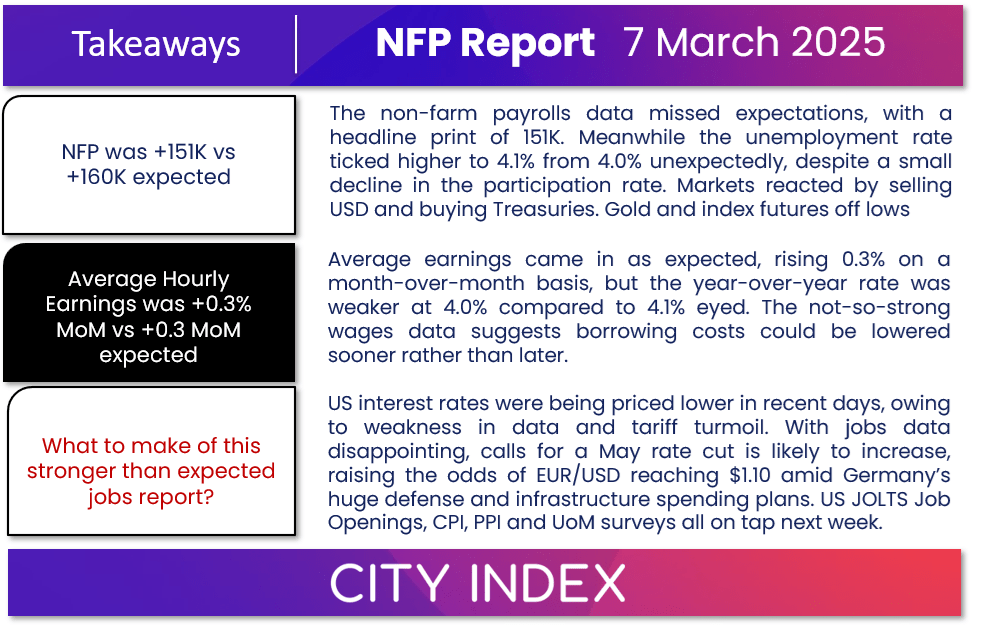
Today’s US jobs report surprised to the downside, coming in at 151K instead of 160K expected. Worryingly, the household survey showed job losses of 588K. Meanwhile the unemployment rate ticked higher to 4.1% from 4.0% unexpectedly, despite a small decline in the participation rate. Markets initially reacted by mildly selling the USD and buying Treasuries. Gold and index futures bounced off their lows. But the USD/CAD pair held onto its earlier gains because we had an even weaker jobs report from Canada. More on that later.
US interest rates were being priced lower in recent days, owing to weakness in data and tariff turmoil. With the February jobs data now disappointing, calls for a May rate cut is likely to increase, raising the odds of EUR/USD reaching $1.10 amid Germany’s huge defense and infrastructure spending plans. But was the US job weak enough to cause a more general dollar sell-off, including against the Canadian dollar?

Canadian jobs report missed forecasts ahead of BOC rate decision
The Canadian employment data released at the same time as the US non-farm payrolls report, showed a grand total of just 1.1K net growth in the economy. That was weaker than 20K expected but comes on the back of forecast-beating job gains in the last three months. Understandably, the Canadian dollar weakened.
Next week, the Bank of Canada will make its rate decision on Wednesday, March 12. The BOC has been cutting interest rates in each of its past 5 meetings, bring the benchmark Overnight Rate down to 3.00% at the end of January from the peak of 5.00% when it started cutting at the start of last summer. Many economists believe the cutting cycle will continue for at least the next few meetings amid trade uncertainty. Though US President Donald Trump has signed orders broadening exemptions on newly imposed tariffs for Canada (and Mexico), this is only adding to business uncertainty and market jitters. Against this backdrop, another 25 bps cut is expected for this meeting. It is all about how many more cuts should we expect heading towards the summer.
What’s next for US dollar?
Well next week, we have at least four key economic reports to look forward to. These include the increasingly important JOLTS jobs openings on Tuesday, followed by the CPI report on Wednesday, PPI data on Thursday, and then the University of Michigan’s consumer confidence and inflation expectations surveys on Friday.
US CPI inflation has been climbing again in the last 5 months and providing a dilemma for the Fed with signs of economic strain emerging in certain sectors of the economy. Worryingly, consumer’s inflation expectations have been rising noticeably with concerns about tariffs and Trump’s tax-cut and spending plans at the forefront of their minds. Let’s see if rising inflation expectations manifest into accelerating inflation, or whether weakness in data and oil prices have helped to ease price levels in February.
Meanwhile, PPI data will be important to watch as it contains a few sub-categories that feed into the Fed’s preferred measure of inflation that comes out towards the end of the month – namely Core PCE Price Index. Therefore, pay close attention to the PPI report, as it could have implications for the Fed’s policy in the months ahead, and it could impact the Dollar Index and pairs such as USD/CAD.
Once inflation data is out of the way, the focus will then turn to the University of Michigan’s surveys on Friday. After last month’s surprise drop to 64.7 from 71.1 in this leading indicator of US consumer sentiment, let’s see if Trump’s protectionist policies have further dented confidence. The UoM report is based on a survey of about 420 consumers, asking respondents to rate the relative level of current and future economic conditions. Of equal importance is the survey on inflation expectations, released at the same time. The latter has been climbing steadily, and last month jumped to 4.3% from 3.3% in a surprise move. Watch this closely as it could have implications for actual future inflation.
Technical USD/CAD forecast: key levels to watch
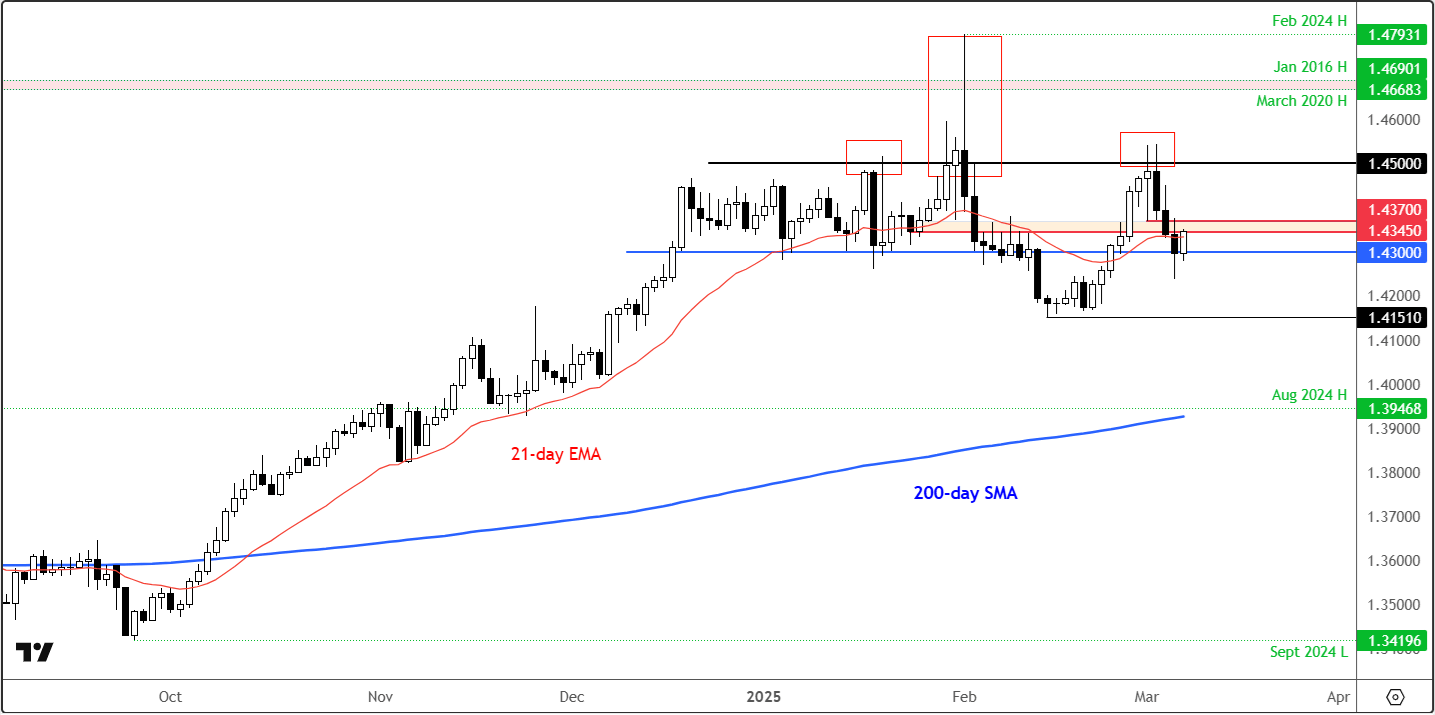
The USD/CAD has been all over the place, making it a trick pair to trade compared to the likes of the USD/JPY and EUR/USD, which have both establish cleaner trends in recent times. Nonetheless, the near-term USD/CAD forecast remains uncertain in light of today’s macro releases from both North American nations (see above) and amid ongoing trade uncertainty.
Source: TradingView.com
The longer-term trend on the USD/CAD seems to have turned bearish, ever since it formed a false break reversal above the highs of 2016 and 2020 at around the 1.4260-1.4690 area in February. The pair made a high of 1.4793 before plunging lower. Interestingly, the psychologically-important 1.45 handle has not been breached decisively, with the USD/CAD potentially creating the two shoulders of a head-and-shoulders reversal pattern around that area. The neckline for this pattern is a bit vague, though, but the recent lower low beneath 1.4300 handle suggests there has already been a breakdown in the longer-term market structure of higher highs and higher lows.
But for the USD/CAD to form a decisive bearish trend, we will now need to see a clean breakdown below the 1.4300 handle on a closing basis. The next downside target is the liquidity beneath last month’s low of 1.4151. Further lower, we have the August 2024 high and the 200-day moving average coming into focus around the 1.39-1.40 area. That, to me, is the main downside objective for this pair.
-- Written by Fawad Razaqzada, Market Analyst
Follow Fawad on Twitter @Trader_F_R
How to trade with City Index
You can trade with City Index by following these four easy steps:
- Open an account, or log in if you’re already a customer
• Open an account in the UK
• Open an account in Australia
• Open an account in Singapore
- Search for the company you want to trade in our award-winning platform
- Choose your position and size, and your stop and limit levels
- Place the trade
Related tags:

Open an account in minutes
Experience award-winning platforms with fast and secure execution, and enjoy tight spreads from 0.5 pts on FX and 0.3 pts on indices.
Economic calendar
Web Trader platform
Our sophisticated web-based platform is packed with features.
Related articles
Japanese Yen Forecast: USD/JPY 4% Rally Challenges Post-Intervention Downtrend 9 24 2026
USD/JPY momentum has shifted sharply higher, putting a major resistance confluence in focus as U.S. and Japanese event risk builds.

Oil Quietly Hands the Fed a Reason to Stay Hawkish
Oil prices and the U.S. dollar are both on the front foot as elevated energy costs feed Fed warnings that inflation may prove sticky.

S&P 500 forecast: Stocks extend drop as correction risks grow
US and global equity markets have extended Wednesday’s sell-off, with Wall Street opening lower after a weak handover from Asia and Europe. The deterioration in risk appetite has been spreading across global markets. The dollar was firmer, Treasury yields were holding onto yesterday’s gains, while gold, silver and bitcoin were all under pressure alongside equities and major currencies.
This report is intended for general circulation only. It should not be construed as a recommendation, or an offer (or solicitation of an offer) to buy or sell any financial products. The information provided does not take into account your specific investment objectives, financial situation or particular needs. Before you act on any recommendation that may be contained in this report, independent advice ought to be sought from a financial adviser regarding the suitability of the investment product, taking into account your specific investment objectives, financial situation or particular needs.
StoneX Financial Pte. Ltd., may distribute reports produced by its respective foreign entities or affiliates within the StoneX group of companies or third parties pursuant to an arrangement under Regulation 32C of the Financial Advisers Regulations. Where the report is distributed to a person in Singapore who is not an accredited investor, expert investor or an institutional investor (as defined in the Securities Futures Act), StoneX Financial Pte. Ltd. accepts legal responsibility to such persons for the contents of the report only to the extent required by law. Singapore recipients should contact StoneX Financial Pte. Ltd. at 6826 9988 for matters arising from, or in connection with the report.
In the case of all other recipients of this report, to the extent permitted by applicable laws and regulations neither StoneX Financial Pte. Ltd. nor its associated companies will be responsible or liable for any loss or damage incurred arising out of, or in connection with, any use of the information contained in this report and all such liability is hereby expressly disclaimed. No representation or warranty is made, express or implied, that the content of this report is complete or accurate.
StoneX Financial Pte. Ltd. is not under any obligation to update this report.
Trading CFDs carries a high level of risk that may not be suitable for some investors. Consider your investment objectives, level of experience, financial resources, risk appetite and other relevant circumstances carefully. The possibility exists that you could lose some or all of your investments, including your initial deposits. If in doubt, please seek independent expert advice. Visit www.forex.com/en-sg/terms-and-policies for the complete Risk Disclosure Statement.