The AUD/USD slipped below 0.6900 last week, as weak risk appetite and a much stronger-than-expected October jobs report combined to give the US dollar a lift against risk-sensitive commodity dollars. In the first half of today’s session, risk appetite has been slightly firmer with equity indices bouncing back. This has helped the Aussie a little bit. But with the potential for stock market volatility to return, and US inflation data likely to show an acceleration in price pressures, the risks to the near-term AUD/USD forecast remain tilted to the downside.
FX markets not too bothered about recent tech rout – for now
During last week’s tech rout, the dollar gains some decent ground on haven flows. But with concerns over the impact of potential AI spending slowdown on US economy at the forefront, traders have been reluctant to chase the dollar higher. Thus, foreign exchange markets have so far reacted only modestly to the sell-off in technology stocks, but the Aussie remains the currency to watch should the selling resume.
With the pair now having broken a few important supports and the trend starting to look bearish, the near-term AUD/USD forecast is tilted to the downside. That’s despite the fact it has been able to rebound and making back some of its weakness following Friday’s stronger-than-expected US jobs report.
Investors remain preoccupied with the recent technology sell-off and the consequences of the Democratic takeover of Congress for the AI investment boom.
The prospect of greater regulatory scrutiny of Big Tech, alongside questions over the sustainability of enormous AI capital expenditure, has left investors reassessing their exposure to the tech sector. Today Nvidia (as well as other major technology names) remains firmly in the spotlight, keeping the risk of further equity market volatility elevated.
A potentially deeper equity sell-off could trigger another round of forced liquidation in all sorts of risk assets, and that could be bad news for the Aussie. A recovery in the dollar would make matters worse for the AUD/USD
Payrolls beat gives the greenback an extra lift
There are some supportive factors for the AUD/USD. Short-dated US Treasury yields have declined recently, reducing the dollar’s interest-rate advantage. Much of that move coincided with falling oil prices amid hopes of progress towards ending the war on Iran.
But in the last couple of session yields have tried to stabilise. If that recovery gathers momentum, we could see a more meaningful recovery in the dollar.
After all, US data remains strong. While the October employment report was never going to command the usual attention, with investors far more concerned about the tech rout, it did catch some traders by surprise given how strong it was. Expectations were for a reading of 65,000, though the whisper number was a little higher, but as it turned out, non-farm payrolls rose by 165,000, while the previous month's figure was revised sharply higher to 60,000 from 29,000. The unemployment rate fell unexpectedly to 4.1% and average hourly earnings rose 0.4% month on month, against 0.3% expected. This solid report reinforces the Federal Reserve's assessment that the labour market remains in good shape, potentially stabilising front-end yields and providing some support for the dollar.
US CPI and Chinese data take centre stage
US CPI on Tuesday at 13:30 GMT could arguably have a larger impact on the dollar than the jobs report was saw on Friday. The Fed is on inflation watch and, so far, not very concerned about a labour market that has been more than holding its own. The recent tech selling and the pullback in oil prices following the Democrats' midterm sweep have reduced expectations of Fed tightening. But inflation remains sticky, and any overshoot in CPI or in PPI, due on Friday 13 November, should boost expectations of a December hike.
Headline CPI is expected to print 3.9% year-over-year, against the previous reading of 3.7%. Month-on-month, CPI is expected to climb 0.3% vs. 0.6% last month. Core CPI is seen at 2.8% y/y vs. 2.6% y/y last, or 0.2% m/m.
Meanwhile, we will have China's trade data on Tuesday, which could also move China-linked currencies, including the Aussie, the Kiwi and the yuan. Weak domestic demand is holding back consumer prices despite the energy shock.
Dovish RBA could provide additional pressure on AUD/USD forecast
Despite raising rates last week, the decision and accompanying commentary were widely characterized by markets as a "dovish hike" by the Reserve Bank of Australia. For a start, it was a split decision (6 - 3), signalling a lack of complete consensus among policymakers and pointing to internal hesitation about tightening further. On top of that, Governor Michele Bullock’s remarks and the bank's tone led traders to price in a high likelihood of a pause at the upcoming December meeting as traders pared back expectations for subsequent aggressive tightening.
Technical AUD/USD forecast and key levels to watch
From a technical analysis point of view, the AUD/USD forecast has turned bearish. The pair has formed a series of lower highs, broken its bullish trend line and slipped below both the 200-day moving average and the 21-day exponential moving average during the earl November drop.
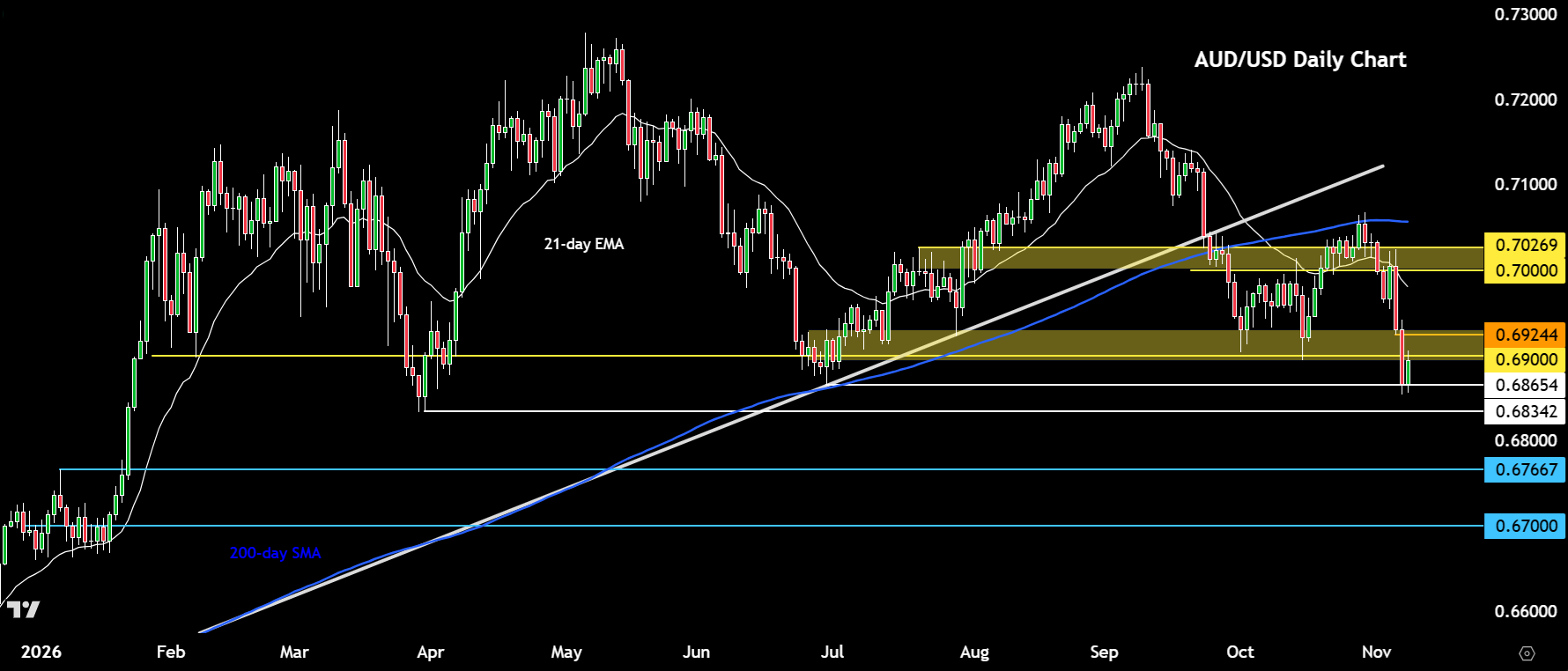
The AUD/USD has also broken the 0.6900–0.6925 area, which was support and could act as resistance now that price is testing it from underneath. The June low around 0.6865 has already been tagged, leaving the March low at 0.6835 as the next downside target, followed by 0.6765 and then 0.6700. Only a break back above 0.6925 on a closing basis would turn the picture slightly bullish again, although even then a confirmation would be needed that price topped out. For example by price rising above the next band of resistance between 0.7000 to 0.7050 area.
Frequently asked questions
Why has the AUD/USD been falling?
A dovish rate hike by the RBA was the main reason. But the US dollar has held firm during the tech sell-off and received a further lift from a strong October jobs report. Risk-sensitive commodity currencies such as the Australian dollar have borne the brunt of that defensive positioning.
What would turn the AUD/USD outlook bullish?
The pair needs to break above 0.7000-0.7050 area on a closing basis. While it remains below that zone, the path of least resistance is to the downside.
When is the next US CPI release?
US CPI is due on Tuesday 10 November at 13:30 GMT, with PPI following on Friday 13 November. An overshoot in either could boost expectations of a December Fed hike and lend the dollar further support.
-- Written by Fawad Razaqzada, Market Analyst | Follow Fawad on Twitter @Trader_F_R