
- AUD/USD correlations with copper and yuan hit multi-month extremes
- Rate differentials show weak influence on price action
- Bullock signals more data needed before RBA moves
- Technicals tilt bullish with key resistance broken
Summary
The Australian dollar is trading more like a proxy for global risk appetite and China-linked markets than a rates story. Correlation analysis shows AUD/USD moving in lockstep with copper and the yuan while largely ignoring rate differentials, underscoring that macro sentiment and trade optimism are driving the narrative.
While Australia’s Q3 inflation report and the Fed decision may spark short-term volatility, their influence looks secondary to broader risk trends. Michele Bullock’s comments have tempered expectations for near-term RBA action, lifting the bar for a November cut and reinforcing that policy decisions hinge on incoming data.
Technically, AUD/USD has broken through key resistance, shifting the bias toward buying dips and bullish breakouts. Momentum indicators are turning supportive, suggesting the directional tide may be moving in favour of the bulls.
AUD a risk-orientated China proxy
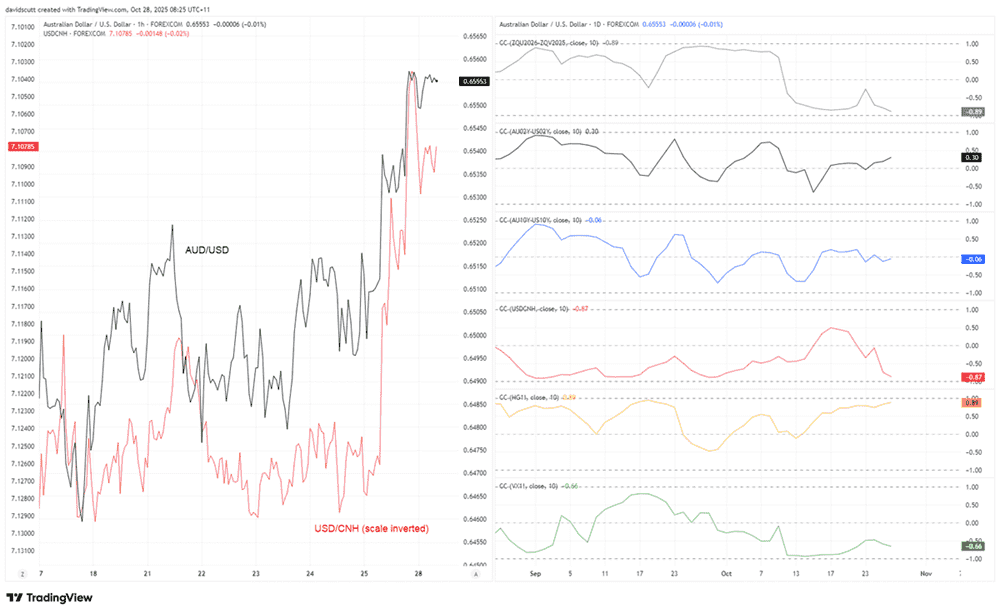
The Australian dollar has reverted to its traditional role as a barometer of risk appetite, with strong linkages to China, as demonstrated by the strength of the correlation coefficients in the chart below.
Source: TradingView
Against USD/CNH (red line) and COMEX copper futures (yellow line), AUD/USD has registered scores of -0.87 and 0.89 respectively, hitting extremes not seen in several months. The Aussie has also shown a reasonably strong inverse relationship with VIX futures (green line). In contrast, its relationship with rate differentials between Australia and the United States has been far weaker, especially at the longer end of the curve. This suggests that while there may be an abrupt one-off price adjustment in response to Australia’s Q3 inflation report on Wednesday, its influence may be fleeting beyond the short term.
The Aussie’s once strongly positive relationship with pricing for Fed rate cuts out to September 2026 (grey line) has also flipped strongly negative, with AUD/USD rising as the amount of expected easing has fallen. While contrary to what you would normally expect, it hints that optimism around trade negotiations—which has undoubtedly contributed to the unwind in Fed pricing—has benefited the cyclically oriented AUD recently.
Putting it all together, the correlation analysis suggests that while Australia’s inflation report and the Fed interest rate decision may deliver short-term bursts of volatility this week, more broadly, the performance of Chinese-linked markets and overall risk appetite are likely to have a stronger influence on the Aussie’s performance.

RBA November Cut Pricing Curtailed
Ahead of Australia’s inflation report, RBA Governor Michele Bullock pushed back on market expectations that had placed the odds of a 25bp November hike above 80% earlier this month. Speaking in Sydney on Monday, she signaled the board would likely need additional data before deciding on further policy moves.
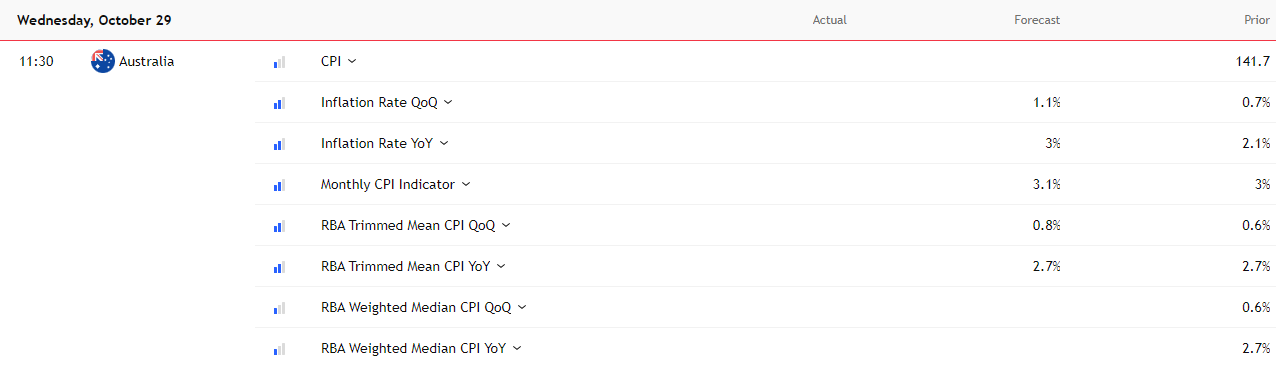
Bullock reiterated that policy remains “a little bit restrictive” and that a stronger inflation print this week would be “material” for the Board’s decision. She later clarified that a 0.9% rise in core inflation for the September quarter would be a “material miss” versus the RBA’s 0.6% forecast, while 0.8% would make it a line-ball call. She downplayed the jump in unemployment to 4.5% in September, saying it wasn’t far from the bank’s forecast and may even come back down next month, adding there’s no sign the labour market is “about to fall off a cliff.”
Source: TradingView
Based on economist forecasts for the key quarterly trimmed mean inflation rate, the median view looks for a 0.8% print, with many shops predicting 0.9% or higher. As such, at face value, her remarks have raised the bar for a near-term rate cut, hinting she and the board may want to see another labour force survey before deciding how to proceed.

Source: Bloomberg
In response to Bullock’s comments, implied pricing based on overnight index swap rates skidded to just 37% for a November rate cut, working in tandem with trade optimism and earlier strength in the Chinese yuan to push AUD/USD higher.
AUD/USD Directional Risks Skew Higher
Source: TradingView
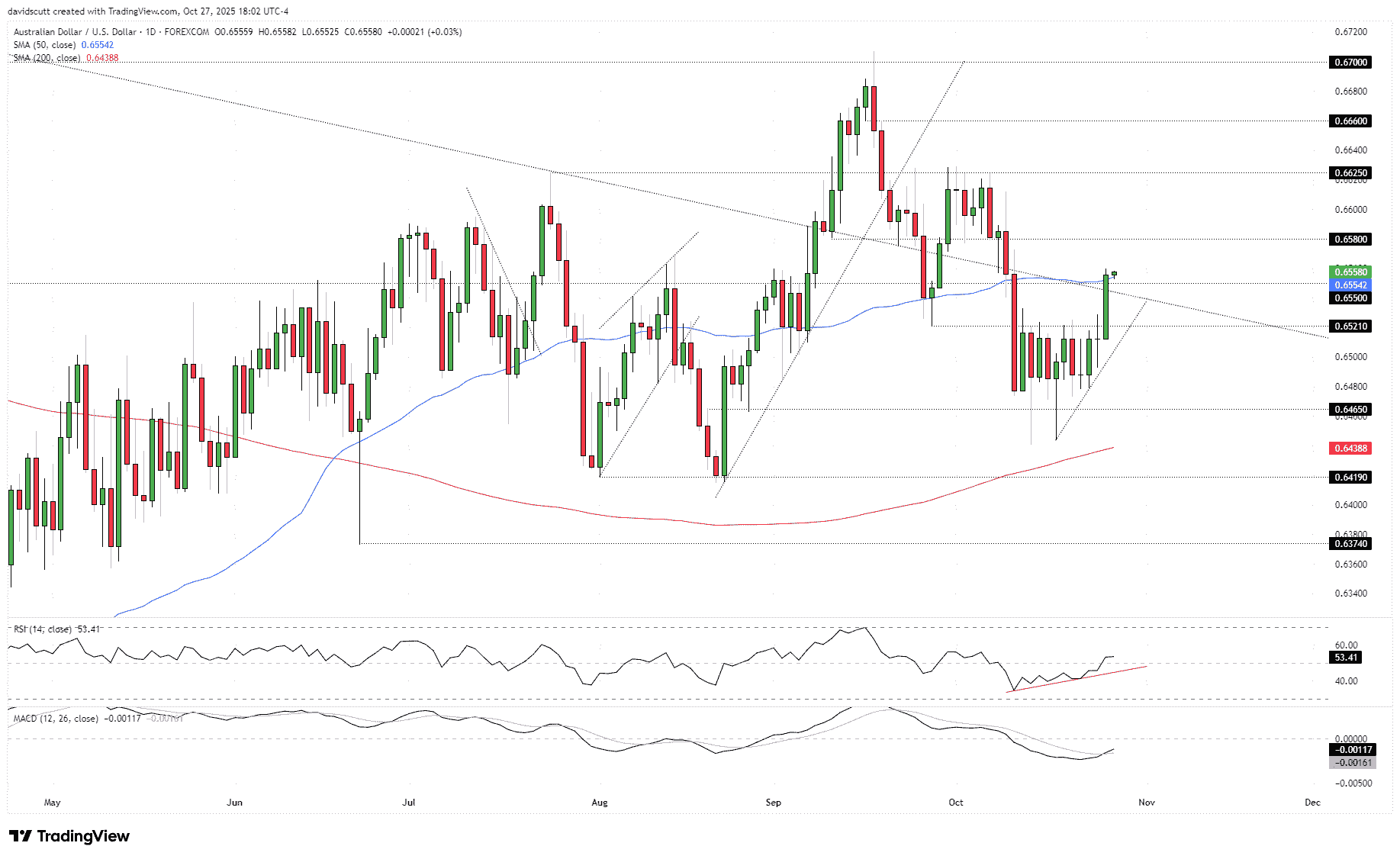
AUD/USD has broken through a resistance zone consisting of the 50-day moving average, the downtrend from the pandemic highs in early 2021, and horizontal resistance at .6550, providing a potential platform to establish fresh long positions around. Traders could buy ahead of the 50-day moving average with a stop below for protection, targeting .6580 resistance initially, with .6625, .6666, and .6700 as potential options after that. Should we see a reversal through the former resistance zone, it would put support at .6521 and beneath .6480 on the radar for bears.
With both the 50 and 200-day moving averages starting to flick higher, the preference is now skewing towards buying dips and bullish breakouts rather than trying to play the pair from the short side. Momentum indicators are providing a complementary message over a shorter time horizon, with RSI (14) trending higher and pushing further away from 50, indicating that momentum is now starting to skew in favour of the bulls. While MACD remains in negative territory, it has already crossed the signal line from below and is moving towards neutral territory, adding to the sense that the directional risks may be turning.