

Key Events
- OPEC confirms a modest 137,000-barrel output increase, while U.S.–China tariff negotiations continue in a constructive tone, raising hopes for a more sustainable recovery in oil prices.
- The agreement marks a temporary truce, not a comprehensive trade pact, and will require annual renegotiation.
- Meanwhile, the upcoming U.S. Non-Farm Payrolls (NFP) report, alongside the ongoing U.S. government shutdown, continues to cloud risk sentiment across markets.
The world’s two largest oil consumers, the United States and China, are extending their trade truce. The U.S. has reduced tariff magnitudes, while China has resumed large-scale purchases of U.S. agricultural goods, lifted export controls on rare earths (crucial for semiconductors and EVs), and paused retaliatory measures against U.S. technology firms.
Despite these constructive developments, oversupply risks heading into 2026 remain a concern for oil markets. This aligns with labor market uncertainty and demand potential, reinforcing the importance of upcoming macro data in shaping near-term price direction.
Technical Analysis: Quantifying Uncertainties
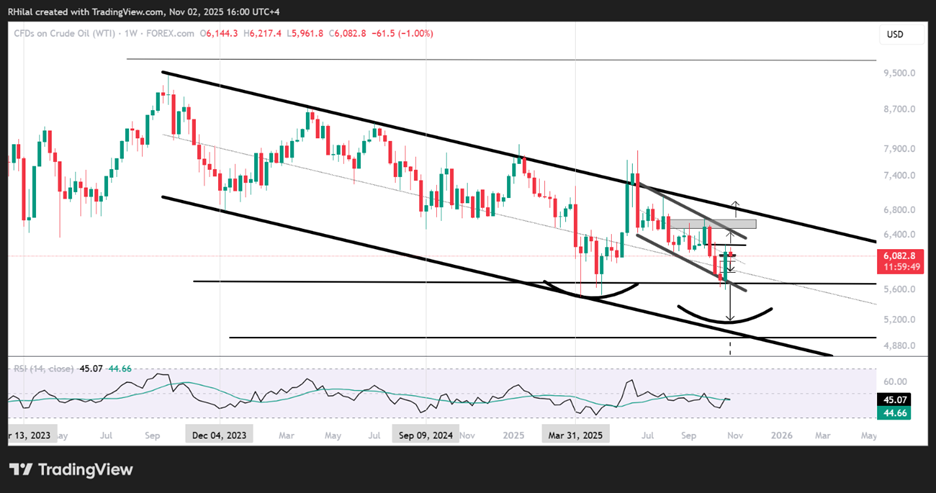
Crude Oil Outlook: Weekly Time Frame – Log Scale
Source: Trading view
Crude prices have rejected the yearly lows ($55) twice, leaving room for either the formation of a long-term double bottom or the possibility of another dip before establishing a sustainable uptrend.
- If the $55 support holds and price action moves above $60 and $62.50, upside targets align with the upper boundary of a downtrend channel established since 2022, converging near $65, $66.60, and $70.
- The $70 mark remains the technical pivot separating bullish from bearish bias.
- Conversely, a close below $59 risks further declines toward $58, $56.30, and $55 — the defining support zone. A decisive break below this region could expose deeper retracement levels near $49, and in more extreme cases, $37, before a structural rebound emerges.
The next three months will be crucial in determining whether crude consolidates within the current range or extends toward a more definitive reversal setup.
Crude Oil Outlook: 3-Month Time Frame – Log Scale
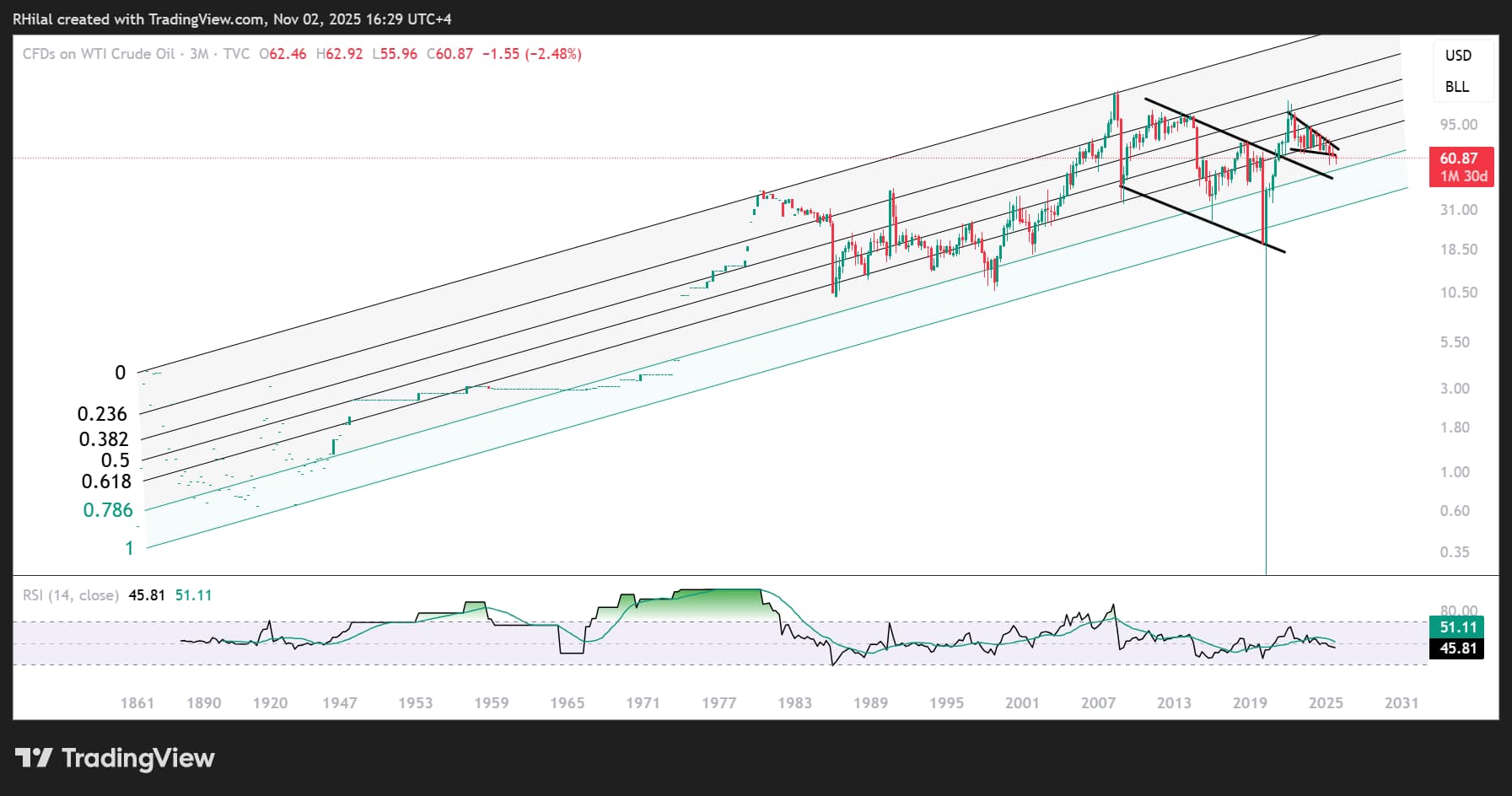
Over the three-month horizon, crude remains confined within a multi-decade channel, whose lower boundary extends back to the 1860s. The current price structure forms a pennant-like pattern sitting just above the historical support zone observed between 2008 and 2020.
This long-term configuration continues to suggest a broad bullish bias within an enduring secular uptrend, unless a clear structural breakdown occurs.
The combination of measured OPEC output policy, U.S.–China tariff de-escalation and tightening long-term technical structures paints a cautiously optimistic picture for oil. However, macroeconomic uncertainty, particularly from the U.S. labor market and fiscal gridlock — continues to pose near-term downside risks.
Written by Razan Hilal, CMT
Follow on X: @Rh_waves