The Democratic sweep in the US midterms delivered the negative dollar reaction I had anticipated, but that upsurge in stocks was not something I or many others had anticipated. Fears that a Democrat-controlled Congress would trigger a broader sell-off in technology stocks proved premature. Nevertheless, the sector remains under pressure. The political outcome may help explain the Nasdaq’s relative underperformance with futures falling 0.8% today. Sharp falls in shares of Arm and Qualcomm following their results are certainly not helping. While the removal of midterm uncertainty provided a broad-based boost to risk appetite yesterday, investors may be starting to price in the prospect of tighter regulatory scrutiny of Big Tech, particularly around AI, under greater Democratic influence in Congress. This could become a headwind for technology valuations, even if the immediate impact on corporate earnings remains unclear. We maintain a cautious Nasdaq 100 forecast.
Nasdaq 100 underperforms as AI concerns linger
The broader market reaction to the mid-term results was positive, with global equity benchmarks and gold rallying as investors welcomed the removal of a key political risk and a sharp retreat in oil prices further boosted sentiment. However, the Nasdaq’s inability to participate fully in that recovery suggests that underlying concerns about the technology trade remain unresolved. The subsequent rebound in oil prices today has held back risk appetite.
The handover from Asia was not very convincing, with the latest price action across semiconductor and memory stocks reinforcing recent concerns about the sector. South Korea’s KOSPI fell by more than 5% overnight, with index heavyweights SK Hynix and Samsung losing big grounds. Japan’s Kioxia also slumped. Some of this weakness reflects a catch-up with selling in US technology stocks, but concerns about the regulatory implications of the Democratic victory appear to be adding to the pressure.
Interestingly, this is happening despite increasingly constructive commentary on underlying memory demand. Kioxia recently indicated that customers were negotiating supply contracts extending into 2029, while Samsung expects memory supply to remain tight through 2027 and 2028. The fundamental demand outlook, therefore, has not materially deteriorated. Rather, investors appear increasingly concerned about valuations, the sustainability of AI-related spending and the possibility that regulatory intervention could alter the industry’s longer-term growth trajectory.
The pressure is also evident in individual US technology stocks. Arm Holdings fell 6% in premarket trading today after reporting weaker-than-expected royalty revenue, partly reflecting weakness in the memory-sensitive smartphone market, while its quarterly guidance offered only modest reassurance. Qualcomm suffered a 10% decline after disappointing smartphone chip sales, with sluggish handset demand, rising memory costs and declining Apple-related revenue weighing on its outlook. Disappointing margin and earnings guidance added to the negative reaction.
Nasdaq 100 forecast: Technical analysis and key levels to watch
From a technical analysis point of view, the Nasdaq 100 forecast remains modestly bearish despite the global equity rally. The tech-heavy index is one of the weaker-looking charts among the major global equity indices. It has been forming a succession of lower highs and lower lows since peaking in October, leaving the short-term trend firmly tilted to the downside. Until that sequence is broken, rallies are arguably corrective rather than evidence of a sustained recovery.
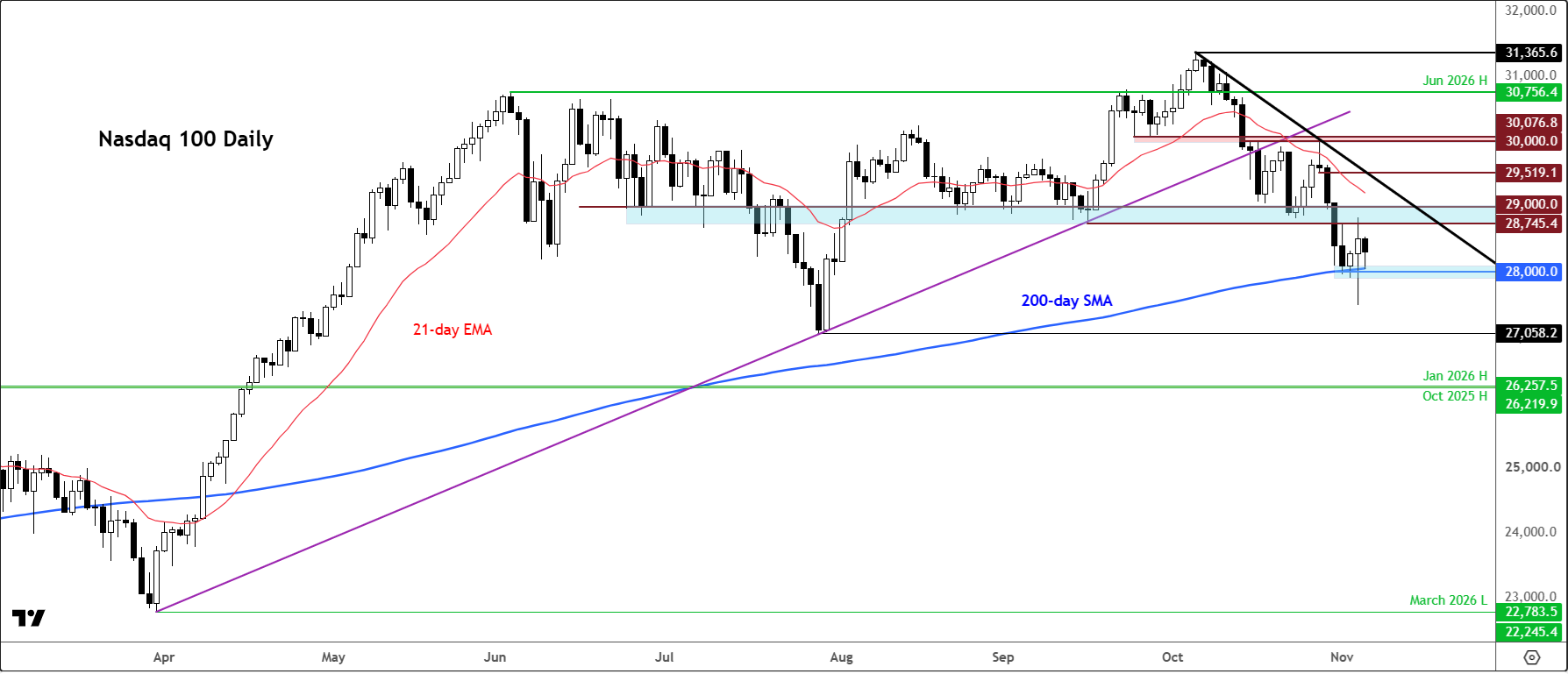
The above is our US tech 100 daily chart, derived from underlying Nasdaq 100 futures. The 200-day moving average, currently around 28,000, is the most important level on the downside. It has provided support on a closing basis so far, but I would be watching closely for a decisive break. A daily close below this threshold would represent a deterioration in the broader technical picture and potentially expose the summer low around 27,060. Below there, the previous all-time high in the 26,220–26,260 region becomes the next significant area of potential support.
On the upside, the immediate challenge is the 28,745–29,000 region. This area had previously acted as support in late August and early to mid-September, as well as attracting buyers when revisited on 23 October. However, following last week’s breakdown, the former support zone has become resistance. The index has since tested it twice from underneath, first on Monday and again on Wednesday following the midterm results, with sellers stepping in on both occasions.
That repeated rejection reinforces the importance of this area. A sustained move back above 28,745–29,000 is therefore the minimum requirement for improving the near-term technical outlook. It would suggest that buyers are beginning to regain control, although stronger confirmation would require a break of the short-term descending trendline, which would invalidate the prevailing sequence of lower highs. The low of last Wednesday’s inverted hammer candle also comes into play around the trend, near 29,500.
Should that area break, the Nasdaq 100 could begin rebuilding upward momentum, with the next significant resistance area lying around 30,000. This is where the previous wave of selling gathered momentum, eventually driving the index towards its recent lows. Clearing that region would provide a more convincing signal that the recovery could extend further, potentially putting another attempt at record highs back on the radar.
In short
For now, however, the balance of risks remains tilted to the downside for the Nasdaq 100 forecast. The combination of renewed pressure on AI-related stocks, political and regulatory uncertainty and a deteriorating technical structure leaves the Nasdaq vulnerable to further weakness. The 28,745–29,000 region is the key resistance to reclaim, while 28,000 is the crucial support to defend. A break of either boundary could set the tone for the index’s next significant move.