
WTI crude has now posted more than four consecutive losing sessions, with a decline of over 5% in the short term. This pullback has been driven mainly by recent OPEC+ comments, which raised the possibility of an oversupply scenario in the near term. As long as expectations for sustained supply growth persist while demand risks slowing, selling pressure could remain a key driver of WTI price action in the coming sessions.

Where Does OPEC+ Stand After Its Recent Meetings?
The path of production increases remains steady, and OPEC+ appears determined to keep raising supply in the months ahead. In its latest meeting, the group agreed on an additional 137,000 barrels per day in October. However, Saudi Arabia has started pushing for a more aggressive stance, which could lead the eight key members to consider a hike of between 274,000 and 411,000 barrels per day in November, returning the organization to a faster pace of supply growth.
Currently, OPEC+ still has a margin of around 1.6 million barrels per day available for further increases, leaving room for larger adjustments in the short term. Moreover, the EIA had already projected production growth of about 2.3 million barrels per day in 2025, but if OPEC+ keeps up this pace, that number could be easily exceeded.
Adding to this is the concern over the recent U.S. government shutdown. The closure of federal institutions could subtract billions of dollars from U.S. GDP, reducing economic activity and threatening short-term oil demand. Given that the U.S. is one of the world’s largest crude consumers, weaker economic activity toward year-end could translate into falling energy consumption, heightening oversupply risks.
In this new backdrop, where higher supply levels meet the possibility of weaker demand, the market is increasingly considering that an oversupply phase may be underway. This, in turn, could consolidate a dominant bearish bias for WTI in the short term.
What About Oil Market Confidence?
The CBOE OVX Index has begun rising in the short term, approaching the 40-point level. The steeper slope of recent sessions reflects a steady increase in implied volatility in oil-related ETFs.
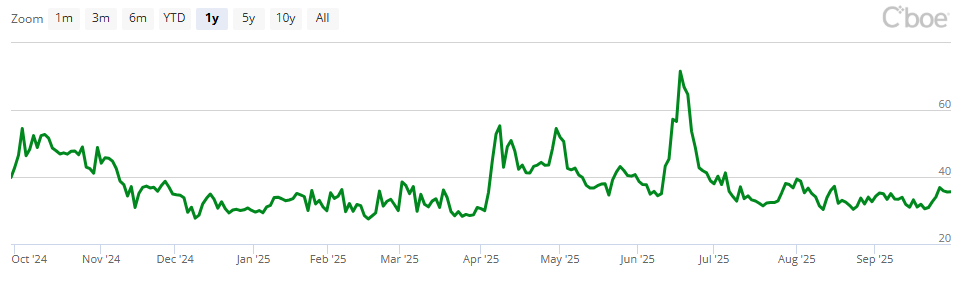
Source: CBOE
This move highlights mounting market nervousness: as the index climbs, the likelihood of sharp moves in crude prices increases. Rising volatility is interpreted as a signal of uncertainty, reducing appetite for long positions and strengthening the bearish bias in the short term.
WTI Technical Outlook

Source: StoneX, Tradingview
- Dominant bearish momentum: Recent declines have generated a new wave of selling, wiping more than $5 off WTI prices in the short term. Candlesticks continue to show strong downward pressure without signs of indecision. As long as this behavior persists, the bearish bias is likely to prevail and test key technical barriers in the market.
- RSI: The RSI remains below the 50 neutral mark, confirming that selling pressure has dominated over the past 14 sessions. Unless a clear rebound emerges, downward momentum could continue to weigh on crude.
- TRIX: From a long-term perspective, the TRIX remains below zero, reinforcing the view that a bearish bias has persisted in recent weeks. Unless the line shows consistent recovery, the selling trend will likely continue to dominate.
Key Levels:
- $66 – Major Resistance: Aligned with the 200-period simple moving average, this is the most important barrier for buyers. A clear break above could trigger a structural shift and pave the way for a stronger bullish bias.
- $64 – Nearby Resistance: Corresponds to the 50-period simple moving average. Price action around this zone could reflect indecision and favor lateral consolidation in the coming sessions.
- $62 – Key Support: A level that has held as a barrier in recent weeks. A break below would signal the start of a more consistent bearish move, opening room for a stronger short-term downtrend.
Written by Julian Pineda, CFA – Market Analyst
Follow him: @julianpineda25